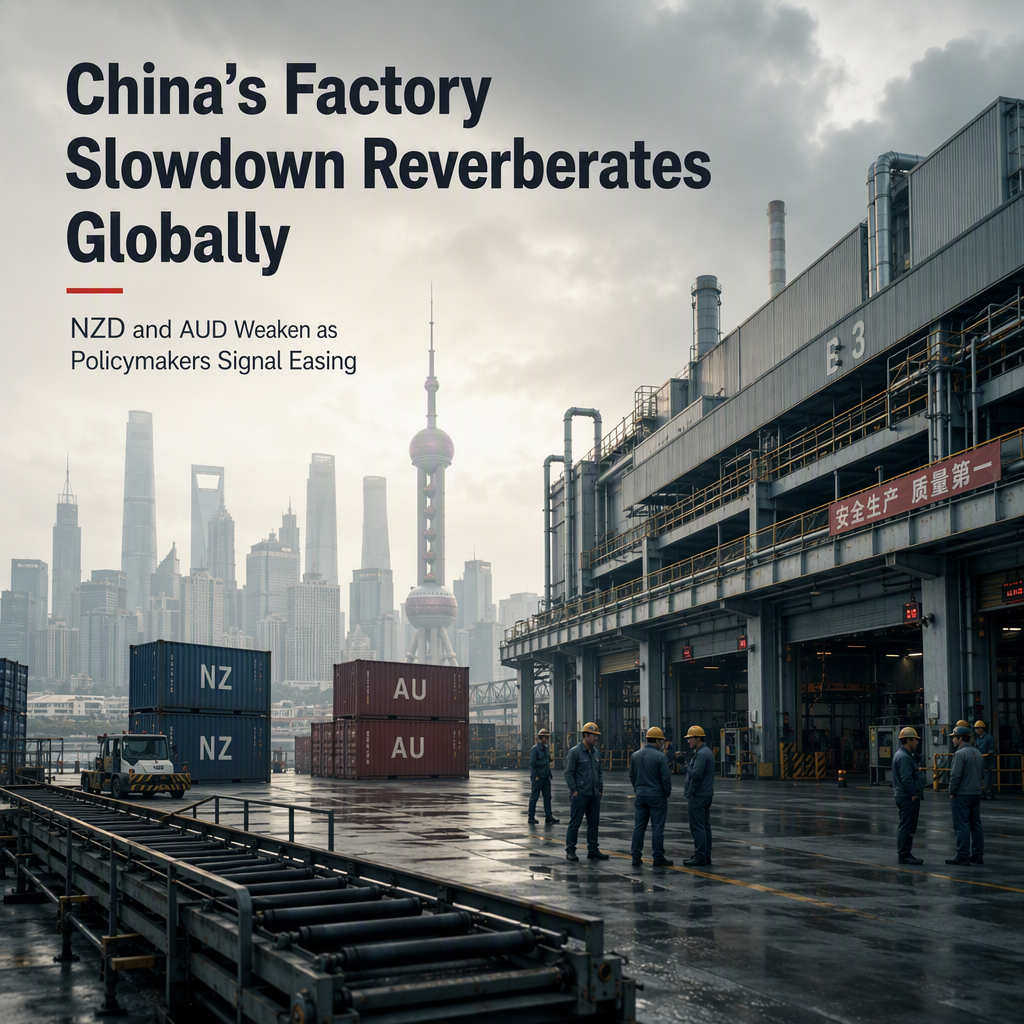
China's official Manufacturing Purchasing Managers' Index (PMI) fell to 49.2 in July from 50.3 in June, missing the market consensus of 50.0 and marking the first contraction since February, which ends a three-month expansion streak driven by exporters rushing shipments ahead of U.S. tariff increases [1][2][3]. The Non-Manufacturing PMI also declined to 49.0 from 50.2, falling short of the expected 50.0 print [1][2]. July's manufacturing reading is the weakest since February and signals a reversal in momentum for China's industrial sector [3].
The disappointing PMI data has had immediate currency market repercussions. The New Zealand Dollar (NZD/USD) lost ground after three days of gains, trading around 0.5870 during Asian hours on Friday, while the Australian Dollar (AUD/USD) edged slightly lower, down 0.04% to 0.7026 at press time [1][2]. Both currencies are sensitive to Chinese economic data due to their countries' trade ties with China [1][2].
China's economic slowdown is further underscored by second-quarter GDP growth of 4.3% year-on-year, the slowest pace in more than three years and below the lower end of the full-year target of 4.5% to 5% [3]. Exports, previously a key growth driver, are now showing signs of strain, with U.S.-bound shipments falling outright for the first time in several months according to China Beige Book [3]. Factory activity decelerated in July, with manufacturing posting the worst employment performance and job growth deteriorating across all sectors surveyed from a year earlier [3]. Retail sales also fell in July from both the prior month and a year earlier, with travel and restaurants experiencing sharp downturns [3].
In response to these challenges, China's top policymakers acknowledged "difficulties and challenges facing the economy" at their mid-year meeting and pledged to accelerate fiscal spending and introduce "incremental policies" to support growth in the second half of the year [3]. However, the Politburo's readout stopped short of announcing concrete policy steps, with Eurasia Group analysts noting that officials continue to prioritize risk containment over near-term growth, particularly regarding property, local government debt, and smaller financial institutions [3].
Meanwhile, in New Zealand, consumer sentiment showed signs of recovery, with the ANZ-Roy Morgan Consumer Confidence Index rising 8 points to 99.3 in July, its highest since February, though still 19 points below its January peak [1]. Broader economic expectations for the year ahead improved, and strategists at Brown Brothers Harriman noted ongoing recovery in real GDP growth, even as New Zealand bonds underperformed peers [1]. Despite this, the NZD weakened as the US Dollar strengthened, supported by a hawkish Federal Reserve stance emphasizing a resolute 2% inflation target and higher yields, as reflected in the FXS Fed Sentiment Index jumping 18.94 points to 147.58 [1].
CONCLUSION
China's unexpected contraction in both manufacturing and non-manufacturing PMIs for July has triggered declines in China-proxy currencies like the NZD and AUD, highlighting the global market's sensitivity to Chinese economic data. While Chinese policymakers have pledged to accelerate fiscal support, the lack of immediate concrete measures and ongoing structural risks suggest continued caution. The market's reaction underscores concerns about China's growth outlook and its ripple effects on major trading partners.