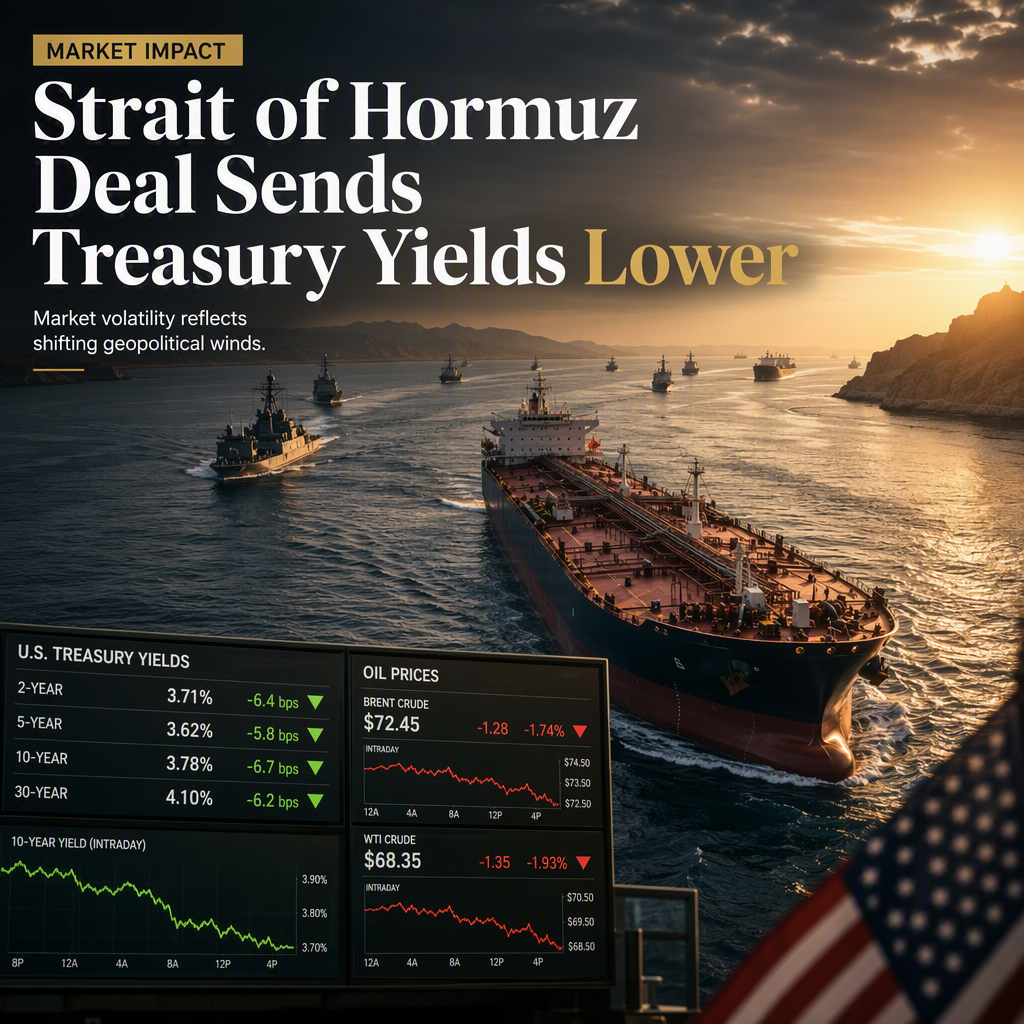
Yields on U.S. Treasurys declined on Wednesday as investors closely monitored developments surrounding a potential deal to reopen the Strait of Hormuz, a critical shipping route, and its implications for the U.S. economy and inflation outlook [1]. The yield on the 10-year U.S. Treasury note, a key benchmark for consumer loans, fell by more than 1 basis point to 4.6086% in early trading, while the 30-year Treasury bond yield, which is particularly sensitive to geopolitical events, dropped 2 basis points to 5.1617% [1]. In contrast, the 2-year Treasury note yield, which often tracks expectations for Federal Reserve interest rate moves, rose by 1 basis point to 4.2061% [1].
Treasury Secretary Scott Bessent stated on Tuesday that a deal to allow commercial shipping through the Strait of Hormuz could be reached within the week, which led to a sharp decline in U.S. government bond yields and a nearly 6% drop in U.S. crude oil prices during Tuesday's session [1]. Subsequently, U.S. Central Command announced via X that the southern route of the Strait of Hormuz was "free and open" [1]. However, oil prices rebounded slightly in early Wednesday trading, with West Texas Intermediate futures for September delivery rising 0.58% to $76.21 and Brent crude climbing almost 1.1% to $80.20 [1].
Market participants are now awaiting a series of upcoming economic data releases to assess how the situation in the Middle East may influence U.S. inflation and the Federal Reserve's future interest rate decisions [1]. Key data points include Friday's non-farm payrolls and unemployment rate for July, as well as the Institute for Supply Management's services PMI, which is expected to rise to 54.5 in July from 54.0 in June, according to consensus forecasts [1].
CONCLUSION
The prospect of a deal to reopen the Strait of Hormuz has led to lower U.S. Treasury yields and volatile oil prices, reflecting shifting market expectations for inflation and Federal Reserve policy. Investors are now focused on upcoming economic data to gauge the broader impact of these geopolitical developments.