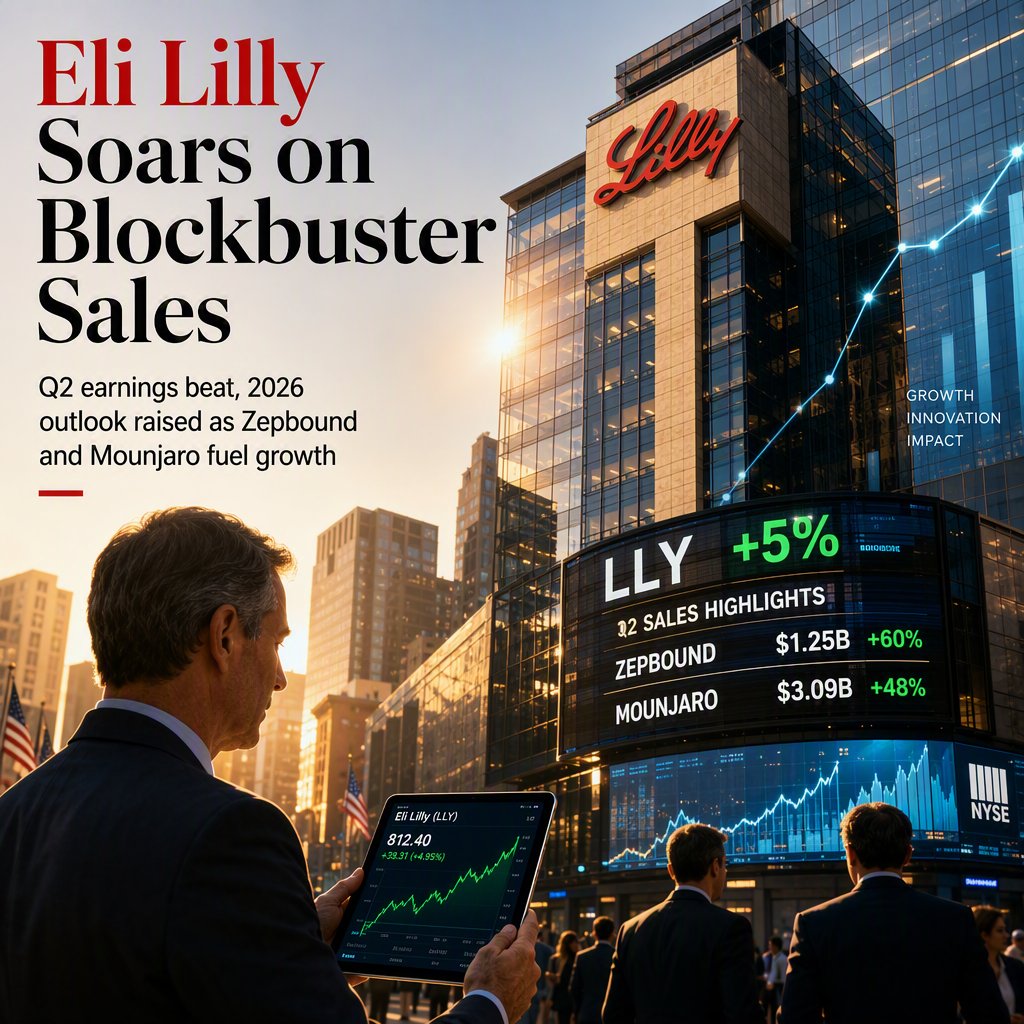
Eli Lilly reported second-quarter earnings and revenue that significantly exceeded analyst expectations, driven by robust demand for its weight loss drug Zepbound and diabetes treatment Mounjaro [1]. The company raised its full-year 2026 revenue guidance to a range of $85 billion to $87 billion, up from the previous forecast of $82 billion to $85 billion [1]. This quarter also marked the first time sales from Lilly's newly launched obesity pill, Foundayo, were included, following its U.S. approval in April [1].
For the second quarter, Mounjaro's worldwide revenue soared 91% to $9.94 billion, with U.S. sales reaching $4.8 billion. These figures surpassed analyst expectations of $8.99 billion in worldwide sales and $4.44 billion in U.S. revenue, according to StreetAccount [1]. International sales of Mounjaro were particularly strong, jumping 172% [1]. Zepbound generated $4.93 billion in U.S. revenue for the quarter, a 44% increase from the prior year, also beating analyst estimates of $4.69 billion [1]. The company noted that while demand for Zepbound rose, realized prices declined partly due to previously announced cash-pay discounts [1].
Foundayo, the new GLP-1 obesity pill, recorded $98 million in sales for the quarter, slightly below analyst estimates of $103 million compiled by FactSet [1]. This product is competing directly with a rival oral drug from Novo Nordisk that launched a few months earlier [1].
Eli Lilly's adjusted earnings per share for the quarter were $8.38, well above the $6.01 expected by analysts surveyed by LSEG [1]. The company raised its full-year adjusted profit guidance to a range of $35.50 to $36.50 per share, noting that the underlying profit guidance was increased by $2.78 per share at the midpoint, but this was offset by $3.03 per share in charges related to deals made during the quarter [1].
Shares of Eli Lilly rose more than 5% in premarket trading following the earnings release [1]. The company is also pursuing an aggressive M&A strategy, recently acquiring a psychedelics drugmaker in July and announcing plans to buy three vaccine makers in May [1]. Despite lower prices for its medications in the U.S., resilient demand for Zepbound and Mounjaro has fueled several strong quarters for the company [1].
CONCLUSION
Eli Lilly's strong second-quarter results, driven by surging sales of Zepbound and Mounjaro, led to a raised full-year outlook and a positive market reaction. The company's ongoing product launches and M&A activity signal continued growth momentum. Investors responded favorably, with shares rising over 5% in premarket trading.