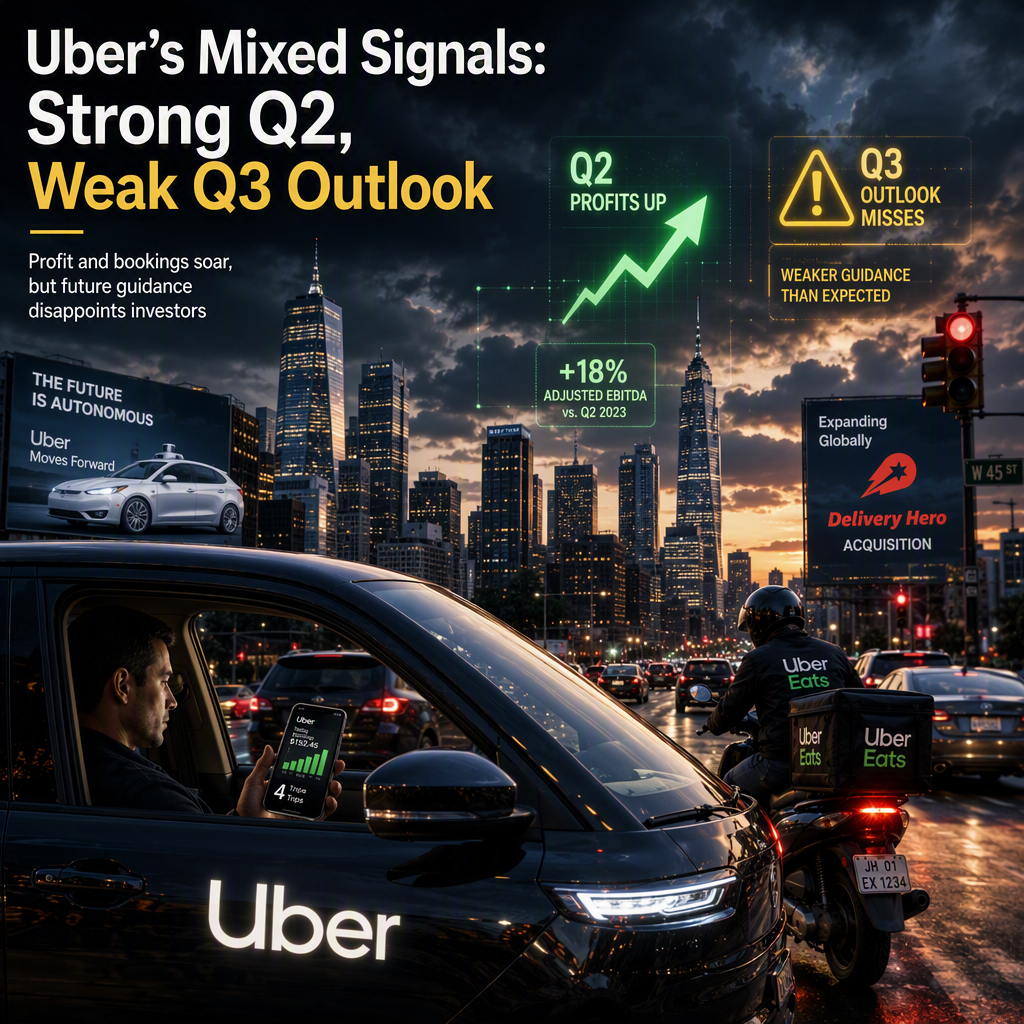
Uber reported second-quarter results that met analyst expectations for profit but issued a weaker-than-expected forecast for the third quarter [1]. In Q2, Uber posted earnings per share of 81 cents, matching the consensus estimate, and revenue of $14.19 billion, slightly below the expected $14.24 billion [1]. Revenue grew 12% year-over-year from $12.65 billion, while net income rose to $2.39 billion, or $1.17 per share, compared to $1.35 billion, or 63 cents per share, a year earlier [1].
Uber's core mobility segment generated $7.36 billion in sales, and delivery revenue reached $5.25 billion in Q2 [1]. Mobility gross bookings increased 22% year-over-year to $28.99 billion, and delivery bookings rose 26% to $27.46 billion [1]. Total bookings for the quarter were $58 billion, surpassing the $57.23 billion average analyst estimate [1].
Looking ahead, Uber forecasted third-quarter bookings of $59.25 billion at the midpoint, which is below the $59.33 billion average analyst estimate [1]. The company's EPS guidance for Q3 is 84 to 88 cents, also trailing the 89-cent consensus [1]. Uber shares have declined 12% year-to-date, underperforming the Nasdaq's 14% gain over the same period [1].
Uber continues to expand its delivery business, recently announcing a $14.8 billion agreement to acquire Germany's Delivery Hero, which will broaden its food and grocery delivery markets [1]. CEO Dara Khosrowshahi highlighted the positive impact of the World Cup on ride-hailing, with over 8 million tourists using Uber in host cities across the U.S., Canada, and Mexico during the quarter [1]. The company is also investing heavily in autonomous vehicles, planning to commit over $10 billion in the coming years to scale AVs, though its exclusive partnership with Waymo in Atlanta and Austin will end by early 2028 [1].
CONCLUSION
Uber delivered solid Q2 results with strong bookings and profit growth, but its weaker-than-expected Q3 forecast weighed on market sentiment. The company's ongoing investments in delivery expansion and autonomous vehicles signal a focus on long-term growth, though near-term guidance disappointed investors. Shares have underperformed the broader market year-to-date.