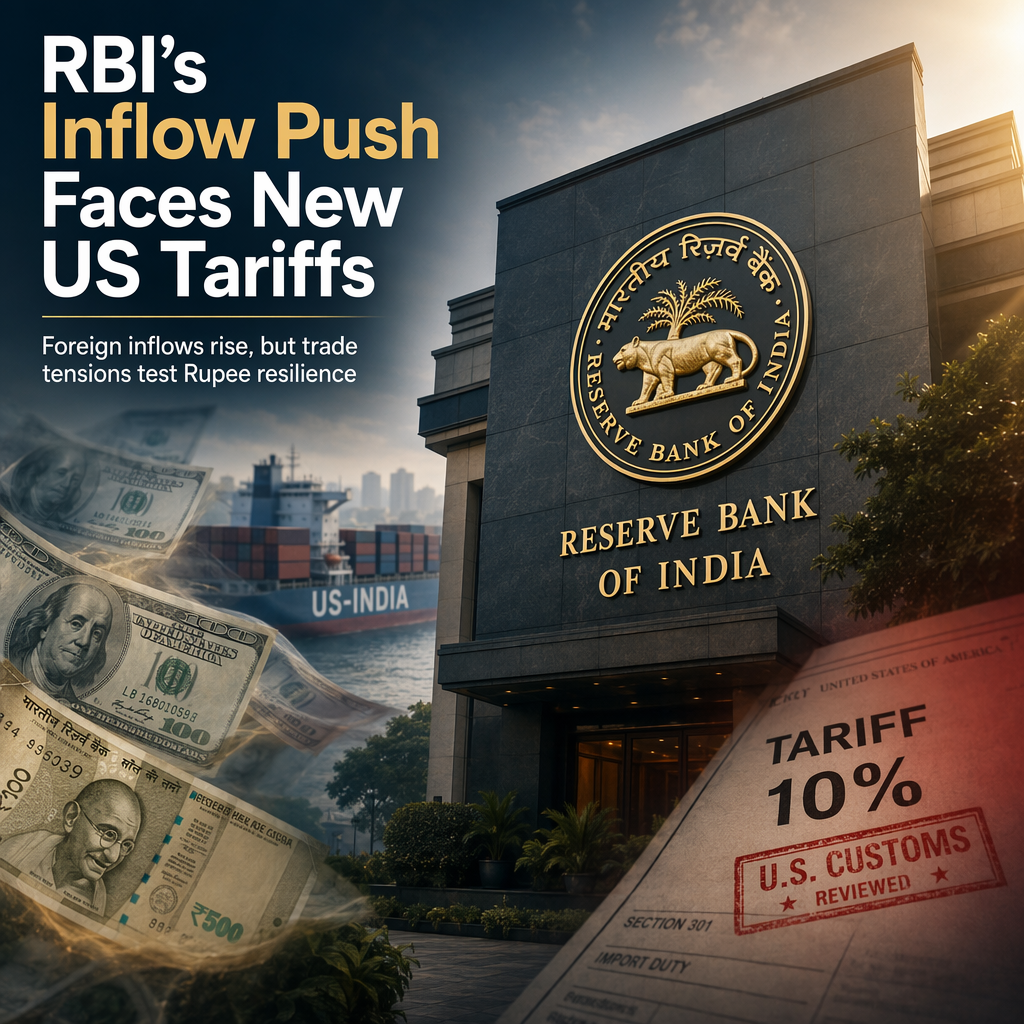
Commerzbank analysts report that the USD/INR exchange rate was little changed near 96.57 on Friday, but has edged higher since early July, reflecting renewed upward pressure from oil prices. However, the recent pullback in oil prices is expected to ease some of the strain on the Indian Rupee (INR) [1]. The Reserve Bank of India (RBI) has implemented measures to attract foreign inflows through FCNR(B), ECB, and OFCB schemes, which are gaining traction. Domestic banks reported USD 20.7 billion in FCNR(B) deposits, external commercial borrowings, and overseas foreign currency borrowings as of 17 July, and these measures are estimated to attract up to USD 80 billion by year-end. The FCNR(B) facility will close on 30 September, while the ECB and OFCB schemes will expire on 31 December [1].
On the trade front, the United States imposed a new 10% tariff on imports from India following findings related to forced labour in supply chains. This tariff took effect on 24 July, replacing the temporary 10% levy introduced under Section 122, which expired the same day. According to India's Commerce Ministry, 45% of goods, including electronics and pharmaceutical products, will be exempt from the new tariff. The Ministry also noted that negotiations with the US on a bilateral trade agreement are ongoing, with the aim of reaching an early conclusion [1].
The July flash PMIs indicate that the moderation in economic activity is deepening, led by softer domestic demand and renewed cost pressures. Manufacturing remains more resilient, supported by stronger external demand as firms build inventory buffers amid global uncertainty. In contrast, service providers are facing rising competitive pressures and weaker demand conditions. Looking ahead, renewed Middle East tensions pose a downside risk through higher energy costs and potential supply-chain disruptions, while the pickup in price pressures could complicate the RBI's wait-and-see stance [1].
In the foreign exchange market, USD/INR was little changed at around 96.57 last Friday but rose 0.3% over the week. The pair has trended higher since early July, largely due to upward pressure on oil prices. The recent pullback in oil prices is expected to help relieve some pressure on the INR [1].
CONCLUSION
The RBI's measures to attract foreign inflows are showing positive results, potentially supporting the Rupee amid external pressures such as new US tariffs and volatile oil prices. While manufacturing remains resilient, the overall economic outlook is challenged by softer domestic demand and rising costs. Ongoing trade negotiations and global uncertainties will be key factors to watch for the Rupee's trajectory.