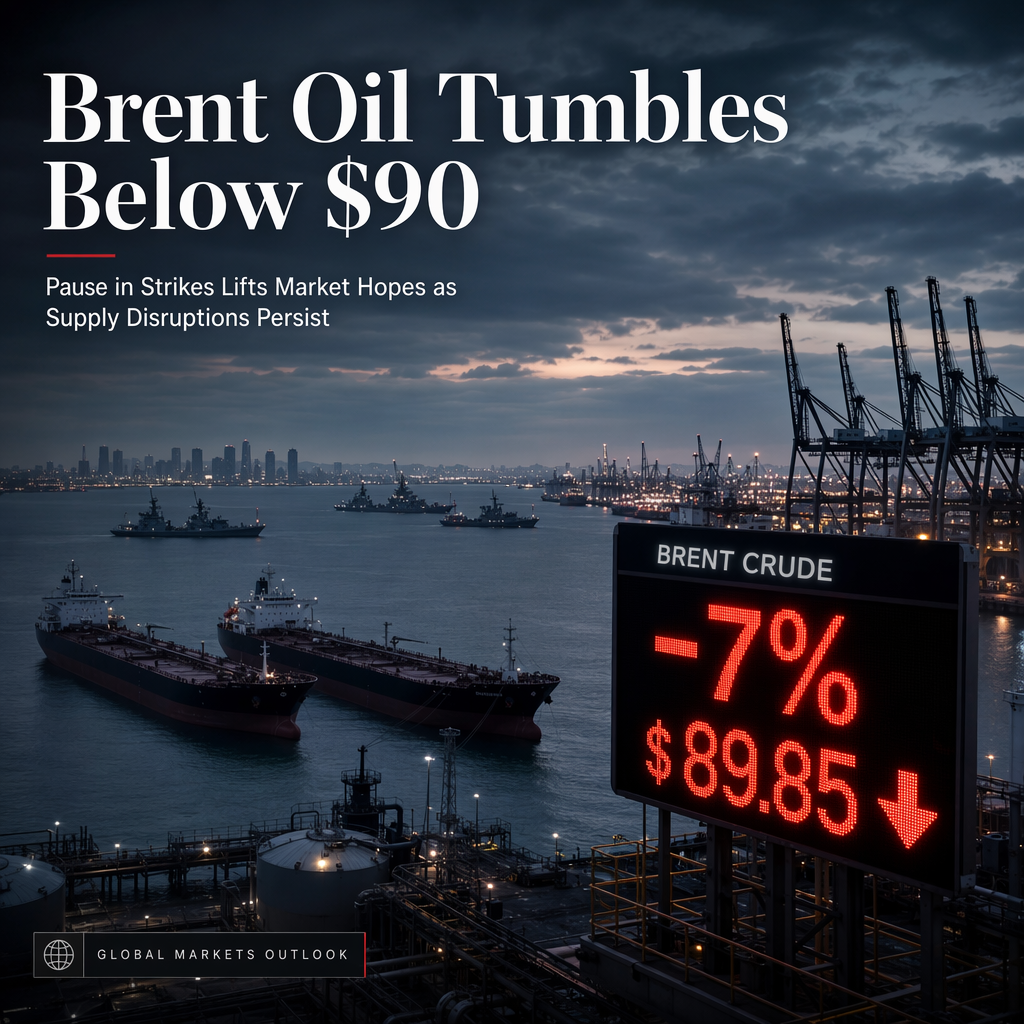
Brent crude oil prices experienced a sharp decline, briefly dropping below $90 per barrel, as the United States and Iran paused their escalating strikes to allow 'space' for diplomacy after 13 consecutive days of attacks that had threatened global economic stability [1][2]. U.S. crude also fell to around $83 per barrel, with both benchmarks down approximately 7% on Monday morning [2]. This retreat in oil prices reflects the market's anticipation for positive news and signals of de-escalation, although the underlying reasons for the pause remain unclear, with little explanation from the U.S. side [1].
Despite the price drop, supply disruptions persist. Oil loadings at Russia’s Sheskharis terminal in Novorossiysk have reportedly been halted since July 21, with the facility having shipped roughly 650,000 barrels per day this year [1]. Additionally, the CPC terminal, which had been shipping around 1.7 million barrels per day in recent months, has also suspended operations amid a surge in Ukrainian drone attacks on Russian energy infrastructure [1]. These disruptions coincide with attacks by Iran-backed Houthi rebels in the Red Sea, further limiting shipping traffic through key chokepoints such as the Strait of Hormuz and Bab el-Mandeb [2]. On Sunday, only 11 commodity vessels passed through Bab el-Mandeb, marking the lowest levels in months [2].
Market optimism has increased following the pause in hostilities, with global markets mostly higher and U.S. stock futures surging [2]. However, the situation remains tense. President Donald Trump previously considered a 'massive attack' to break Iran’s grip on the Strait of Hormuz, but both sides have refrained from attacks for three days [2]. U.S. Ambassador to the United Nations Mike Waltz stated that the halt in strikes was in response to ongoing talks, though he acknowledged internal divisions within Iran [2]. Tehran, meanwhile, offered limited hope for peace efforts, with Foreign Ministry spokesman Esmaeil Baghaei emphasizing that there are no negotiations with the U.S. at present and asserting that the Strait of Hormuz remains 'closed' [2].
Analysts from ING note that speculative net longs in oil and ICE gasoil have increased, driven mainly by short covering and middle distillate tightness [1]. They caution that a recovery in oil prices is unlikely until there is clarity on whether the de-escalation is permanent and whether vessels can safely navigate the Strait of Hormuz [1].
CONCLUSION
The pause in U.S.-Iran strikes has led to a sharp drop in oil prices and renewed market optimism, but persistent supply disruptions and ongoing tensions in key shipping routes continue to weigh on the outlook. Analysts warn that a sustained recovery in oil prices will depend on lasting de-escalation and improved security for vessel navigation. For now, the market remains highly sensitive to geopolitical developments and supply constraints.