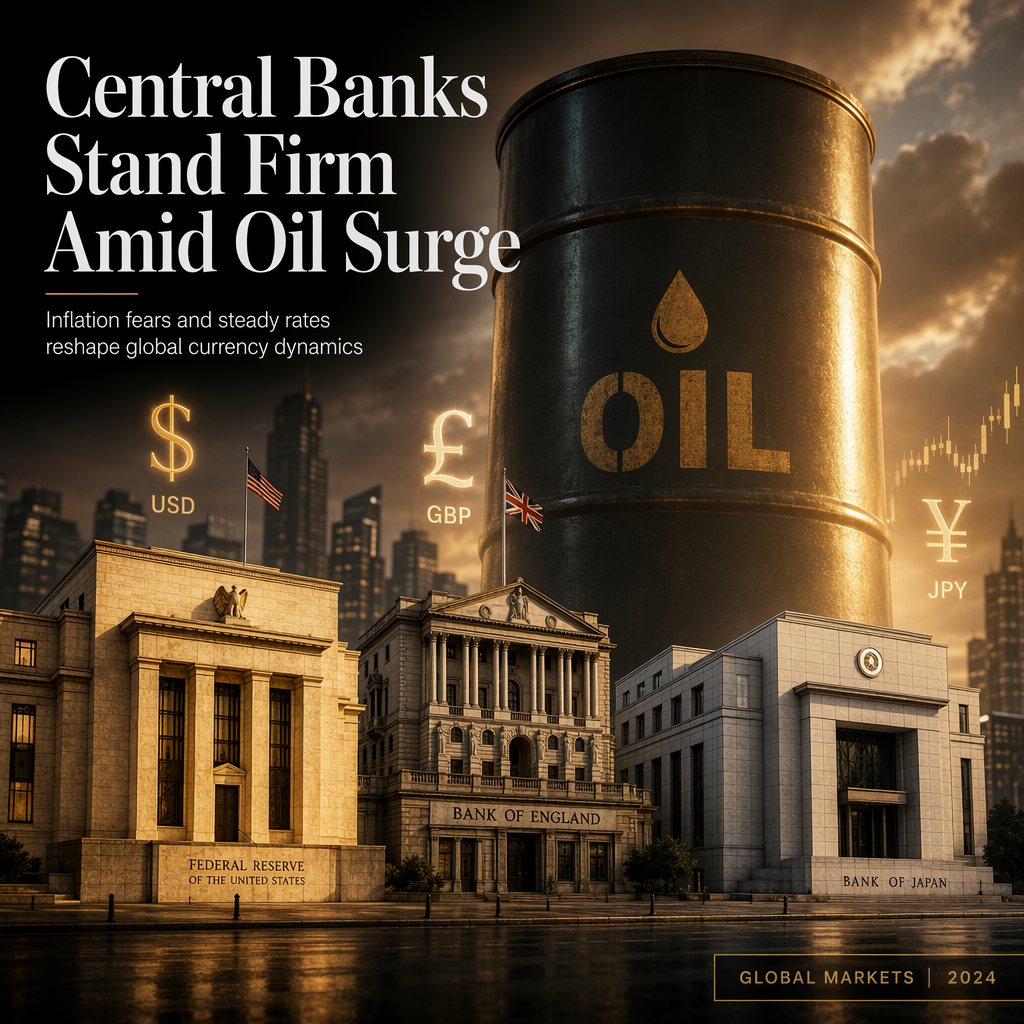
Recent commentary from major financial institutions highlights a period of cautious central bank policy amid renewed inflation pressures driven by higher oil prices. According to OCBC analysts Sim Moh Siong and Christopher Wong, the probability of a July Federal Reserve (Fed) rate hike initially fell to just 10% following benign US inflation data, but has since rebounded to 35% as oil prices reignited inflation concerns [1]. Markets have shifted from viewing a July hike as a remote possibility to a meaningful risk, though the consensus remains that the Fed will hold rates steady. The market reaction is expected to hinge on the Fed's communication: a hawkish hold could keep the US Dollar (USD) supported by pushing tightening expectations further out, while a poorly explained pause could undermine Fed credibility, lift inflation breakevens, and weigh on the Dollar in the coming months [1].
In the United Kingdom, BNY's Geoff Yu notes that the Bank of England (BoE) is also expected to keep policy unchanged this week, despite renewed price pressures from energy [2]. The BoE is anticipated to hold rates at 3.75%, with at most two dissents, as mortgage rates have already rebounded significantly due to rising swap rates. Fiscal policy is seen as a key factor, with the new government launching initiatives aimed at fiscal relief, including a major package due in early Q4 and potential increases in tax thresholds [2]. Yu argues that the current market pricing of around 42 basis points of BoE tightening by year-end appears excessive, but upside growth surprises could support British Pound (GBP) resilience. Governor Andrew Bailey continues to emphasize slowing wage growth and a focus on softer inflation [2].
Turning to Japan, Brown Brothers Harriman’s Elias Haddad expects the Bank of Japan (BoJ) to leave its policy rate at 1.00% after a 25 basis point hike in June, as inflation remains below the bank’s 2% target [3]. The swaps curve prices in a further 25 basis point hike by year-end and a total of 60 basis points of tightening over the next twelve months, which would keep the policy rate within the BoJ’s estimated neutral range of 1.10%-2.50% [3]. Despite the USD/JPY pair surging to near a 40-year high last week due to firmer crude oil prices, Japan’s macroeconomic backdrop would otherwise favor a stronger Japanese Yen (JPY) in the coming weeks, absent the renewed oil shock [3].
Across all three economies, central banks are signaling a preference for policy stability in the face of oil-driven inflation risks, with market expectations and fiscal developments playing a significant role in shaping currency movements.
CONCLUSION
Central banks in the US, UK, and Japan are expected to maintain current policy rates despite renewed inflation pressures from higher oil prices. Market reactions will depend heavily on central bank communication and fiscal policy developments, with the US Dollar and British Pound likely to remain supported if hawkish tones persist, while the Japanese Yen could recover if oil price pressures subside. Overall, the market impact is moderate, with a focus on forward guidance and fiscal measures.