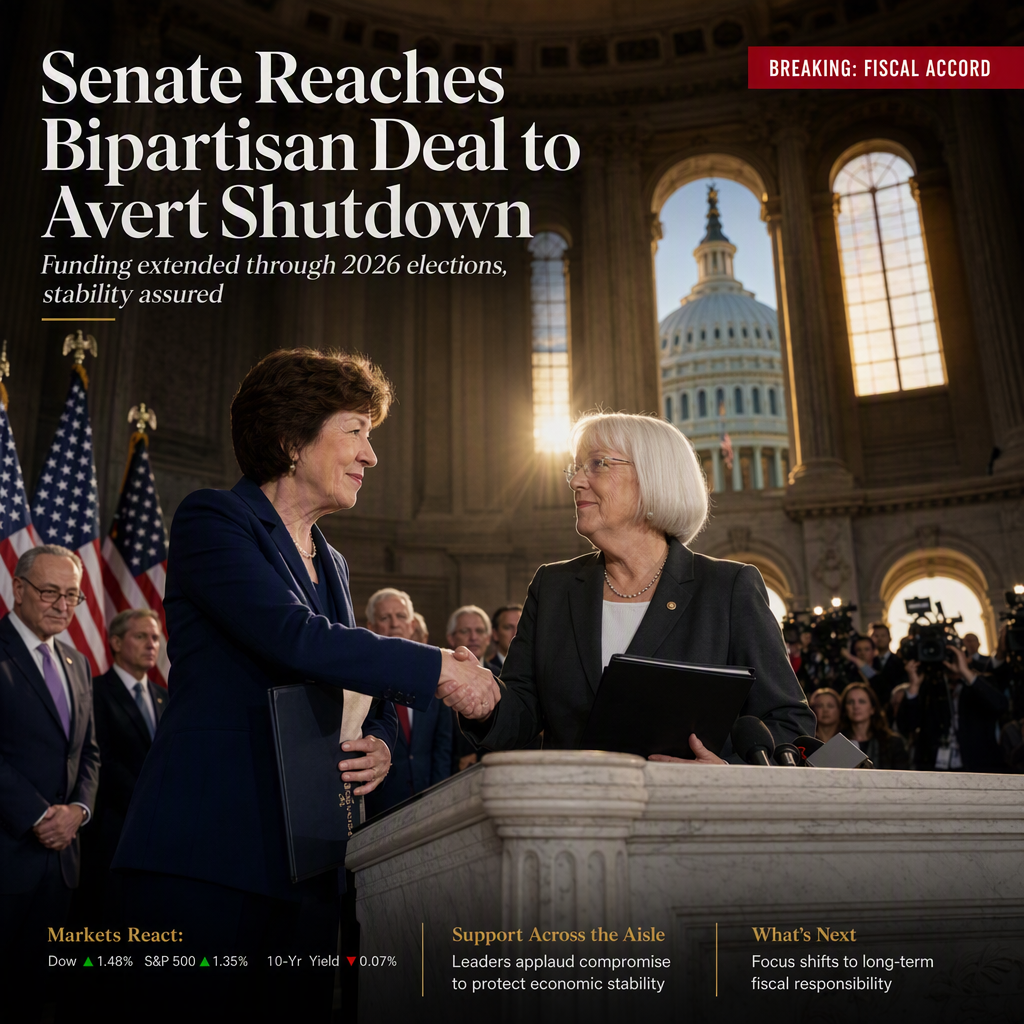
Senate leaders have reached a bipartisan agreement to keep the U.S. government funded past the 2026 midterm elections, thereby averting a potential government shutdown that would have begun on October 1 if Congress failed to act. The current funding is set to expire at the end of September 30, and the newly announced continuing resolution (CR) would extend funding at existing levels until December 11 [1]. The deal was announced by Senate Appropriations Committee Chair Susan Collins, R-Maine, and Vice Chair Patty Murray, D-Wash., and is intended to provide Congress with additional time to negotiate a longer-term funding solution after the midterm elections, when the political landscape may shift [1].
The Senate is scheduled to hold a procedural vote to advance the legislation on Monday, with the goal of passing it before the August recess. However, the bill must also pass the House, which has already left for its August recess and will return in early September. Notably, House Republicans have passed their own funding bill that would extend funding through December 4, meaning the two chambers will need to reconcile their differences [1].
The Senate's stopgap bill is described as “straightforward” by Collins, avoiding controversial provisions and including necessary adjustments for the SNAP and WIC food programs, as well as disaster relief and national security programs. Collins emphasized that the measure allows time for bipartisan appropriations work, which she prefers for annual government funding [1]. Murray highlighted that the Senate bill addresses Democratic concerns with the House version, including rejecting additional war spending and closing loopholes that would allow the administration to transfer funds to Border Patrol or cancel grants arbitrarily [1].
Senate Minority Leader Chuck Schumer, D-N.Y., praised the deal as a “responsible path forward” and credited Senator Murray for blocking what he described as efforts to politicize federal grants. The legislation was negotiated with input from top Senate party leaders and is positioned as a bipartisan effort to avoid a disruptive government shutdown [1].
CONCLUSION
The Senate's bipartisan agreement to extend government funding through December 11, 2026, significantly reduces the risk of a government shutdown before the midterm elections. While the measure still requires reconciliation with the House version, the deal is seen as a responsible step that provides stability and time for further negotiations. Market participants are likely to view the development as a positive sign of legislative cooperation and reduced near-term fiscal uncertainty.