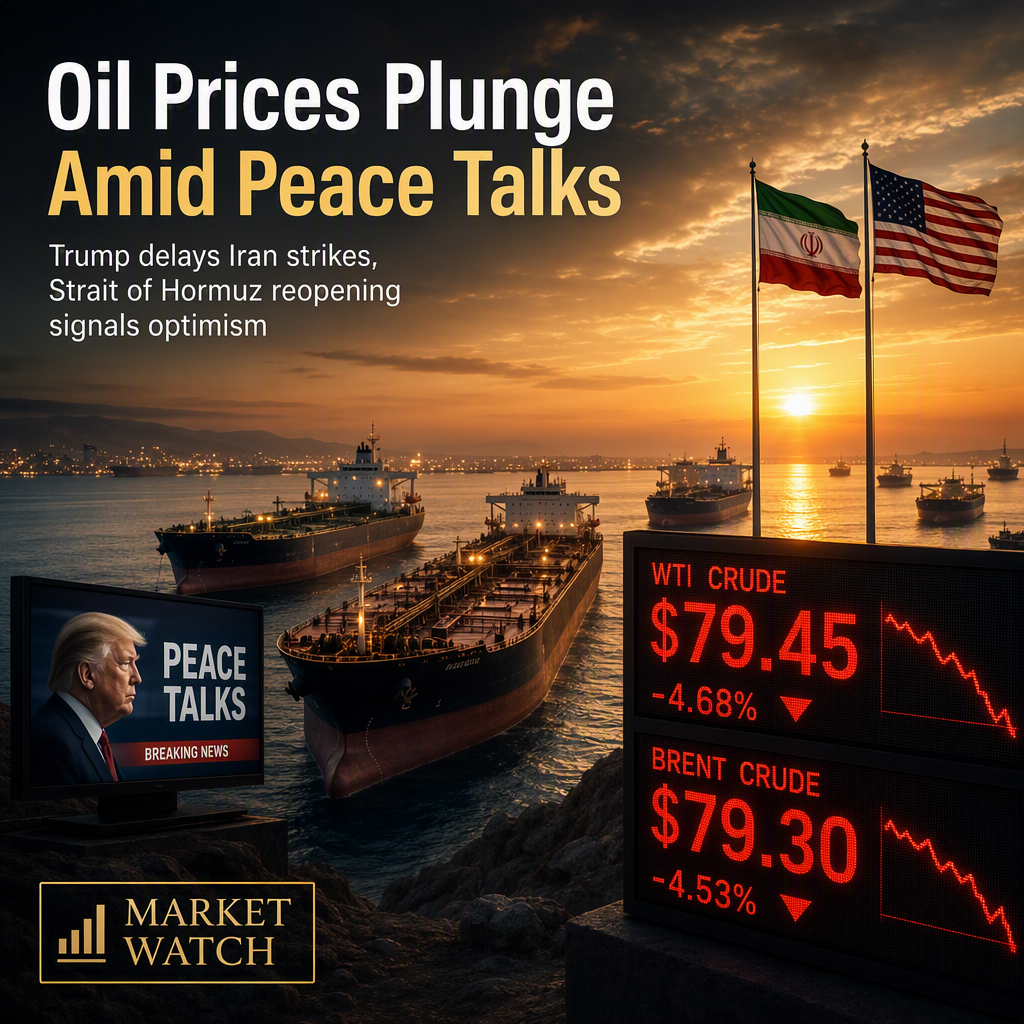
Oil prices experienced a significant decline on Monday following President Donald Trump's announcement that he would delay ordering new strikes against Iran, citing progress toward a peace agreement involving U.S. allies in the Middle East. Trump stated that the agreement would include the 'Immediate, Complete and Total OPENING OF THE HORMUZ STRAIT, and an end to Iran's nuclear threat,' and indicated that negotiations were set to begin Monday afternoon. This news led to a sharp drop in oil prices, with West Texas Intermediate crude falling about 6.2% to around $79.45 a barrel, a decline of approximately $5, while Brent crude dropped over 3.5% to about $79.30 a barrel [1].
The market's reaction was driven by hopes that a deal could restore the flow of oil shipments through the Strait of Hormuz, which had been constrained due to the conflict and the threat of Iranian attacks and mines. However, a spokesman for Iran's foreign ministry, as reported by Reuters, contradicted Trump's statement, asserting that no negotiations with the U.S. were occurring or scheduled, and that ongoing discussions were only with Oman regarding the management of the Strait of Hormuz [1].
Earlier in the year, oil prices had spiked above $110 a barrel as the conflict disrupted Middle Eastern oil shipments, causing tanker traffic to plummet due to the threat of missile and drone strikes and mines in the Strait. Prior to the conflict, oil prices ranged between $60 and $70 a barrel. The surge in oil prices also led to higher gasoline prices in the U.S., with the national average for a gallon of regular gasoline reaching $4.095 as of Monday, up 7% from a month ago and 30% from a year ago, putting pressure on household budgets [1].
President Trump also commented on the oil industry, referencing an interview with Chevron CEO Mike Wirth and urging oil companies to lower consumer prices. He credited his administration with supporting the industry's success and called for retail oil prices to decrease. The White House has previously criticized gas stations for not lowering prices, while groups representing smaller gas stations argue that retail prices are tied to oil prices and that profit margins are not being padded [1].
CONCLUSION
The delay in U.S. military action against Iran and the prospect of peace talks led to a sharp decline in oil prices, reflecting market optimism for a de-escalation in the region. However, conflicting statements from Iranian officials introduce uncertainty about the likelihood of negotiations. The market remains sensitive to developments in the Strait of Hormuz and the broader geopolitical landscape.