
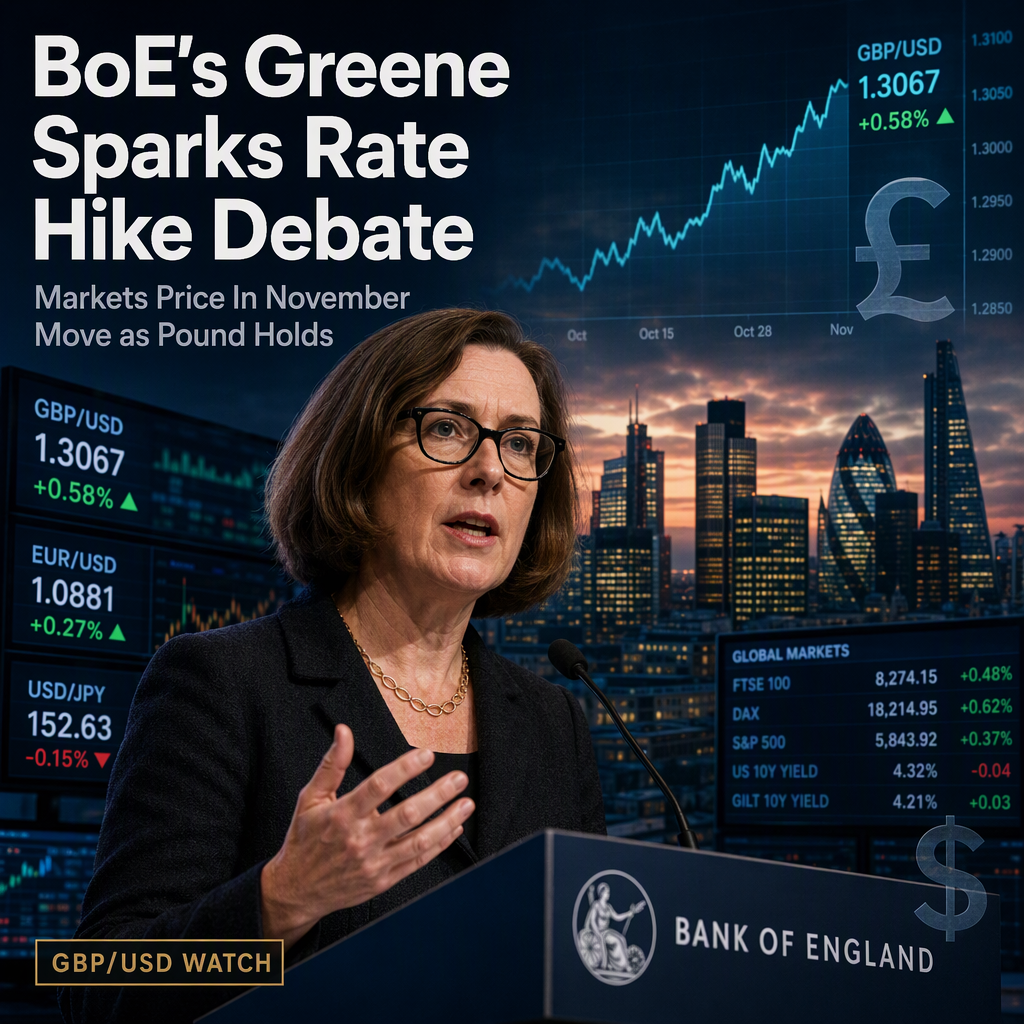
Bank of England (BoE) external member Greene stated in Cape Town that it is dangerous to assume markets will do the BoE's work for it, emphasizing that UK pay awards are expected to be around 3.5% next year [1]. Greene has voted for a rate hike at each of the last three BoE meetings [1]. In contrast, Governor Bailey has argued that higher borrowing costs since the US-Iran war began have given the BoE time to decide, a stance Greene criticized as dangerous [1].
Market participants are currently pricing in about an 83% chance that the UK's Bank Rate will rise to 4.00% from 3.75% on November 5, compared to roughly a one in five chance for a US Federal Reserve hike on October 28 [1]. If the BoE moves first, the Bank Rate would match the top of the Fed's 3.75%-4.00% range, eliminating the extra interest advantage for Dollar deposits over Pound deposits [1].
GBP/USD dipped just below 1.3200 before Governor Bailey's speech in Istanbul, nearing the three-month low set on October 1, but rebounded to just under 1.3250 as the Dollar weakened from its 18-month high, ultimately closing in the upper third of the day's range [1]. Since September 24, daily lows have clustered within about 30 pips of 1.3200, and highs have remained below 1.3300 except for a brief spike on September 30. The pair has traded below its 50-day and 200-day EMAs since mid-September [1].
Looking ahead, the BoE has seven speeches scheduled between October 12 and October 16, culminating with Governor Bailey, and each event will test the 83% probability priced in for a November hike [1]. Key upcoming data releases include the University of Michigan survey on US inflation expectations and the US Consumer Price Index on October 14, as well as UK GDP data for August on October 15. A strong US inflation reading could pressure GBP/USD lower, while a soft reading may reinforce expectations for a BoE hike in November [1].
CONCLUSION
The market is heavily pricing in a Bank of England rate hike in November, with GBP/USD showing resilience amid policy debate among BoE officials. Upcoming central bank speeches and economic data releases are expected to further influence market expectations and currency movements.