
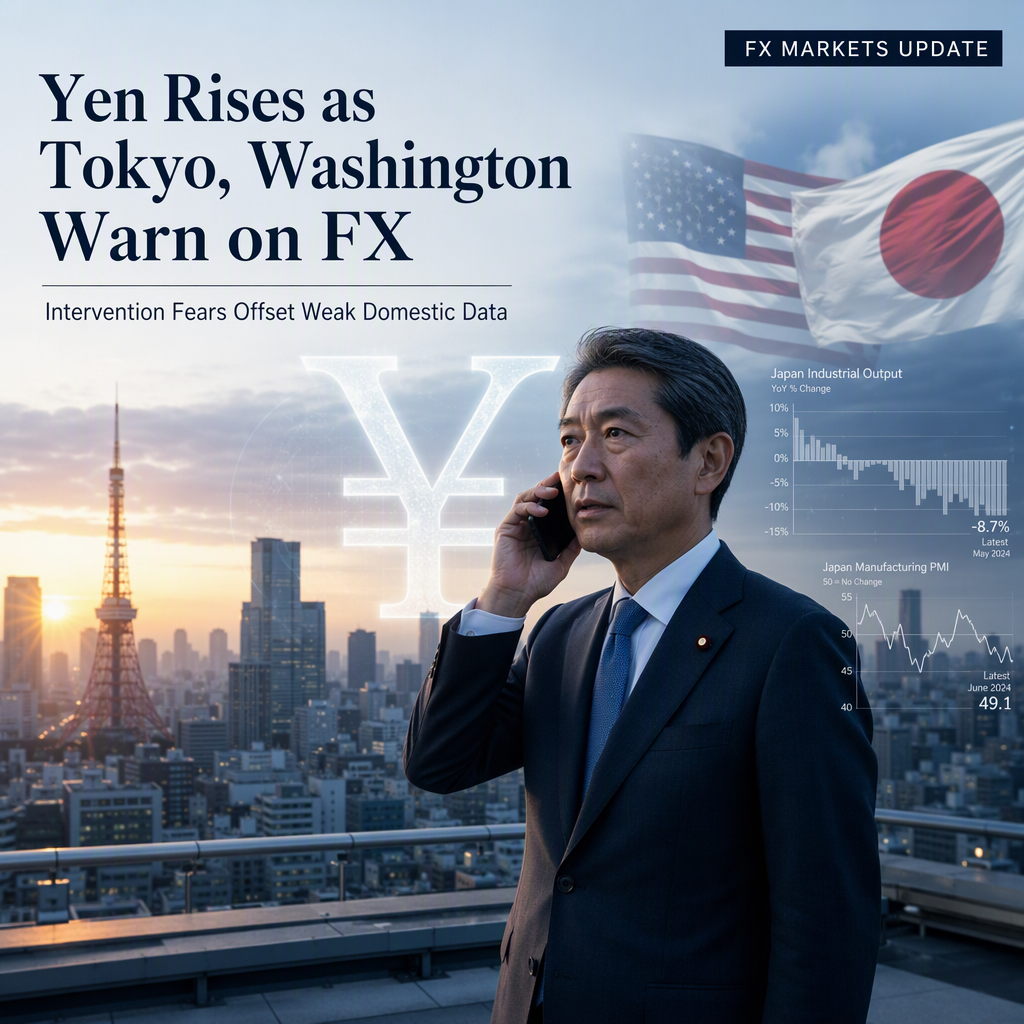
The Japanese Yen (JPY) edged higher against the US Dollar (USD), with the USD/JPY pair losing momentum around the 157.00 level during the early Asian session on Wednesday. This move was attributed to renewed intervention fears after US Treasury Secretary Scott Bessent and Japan's Finance Minister Satsuki Katayama reaffirmed their commitment to strengthen cooperation to address Yen weakness. Katayama stated that the undervalued Yen is problematic and confirmed ongoing close communications with the US Treasury to ensure orderly foreign exchange markets. She also referenced US President Donald Trump's concerns over the JPY, raised during a meeting with Prime Minister Sanae Takaichi last week. Japan's top currency diplomat, Atsushi Mimura, emphasized that markets should take seriously the 'very clear' message from Tokyo and Washington regarding FX depreciation concerns [1].
Despite disappointing domestic data, with industrial production falling 2.2% year-on-year in August compared to 4.0% previously, the Yen managed to gather strength. Analysts at Scotiabank highlighted the Yen as a clear outlier in G10 FX, noting a late Asian-session surge driven by FX-related comments from Vice Minister for International Affairs Atsushi Mimura, which reinforced the Yen's relative strength on the crosses [1].
On the US side, hawkish signals from Federal Reserve officials, including Governor Michael Barr and Cleveland Fed President Beth Hammack, suggested that further rate increases may be needed to combat inflation. Fed's Goolsbee also delivered a hawkish-leaning address, warning of the risks of policy complacency and persistent inflation. Market participants are closely watching upcoming US ADP employment and Personal Consumption Expenditures (PCE) Price Index reports. According to the CME's FedWatch Tool, there is a 47.1% probability of a Fed rate hike in October and a 92.5% chance of an increase in December [1].
CONCLUSION
The Japanese Yen's modest gains were driven by strong verbal intervention signals from Japanese and US officials, despite weak domestic economic data. Market attention now turns to upcoming US economic releases and the Federal Reserve's policy outlook, which could influence further moves in the USD/JPY pair.