
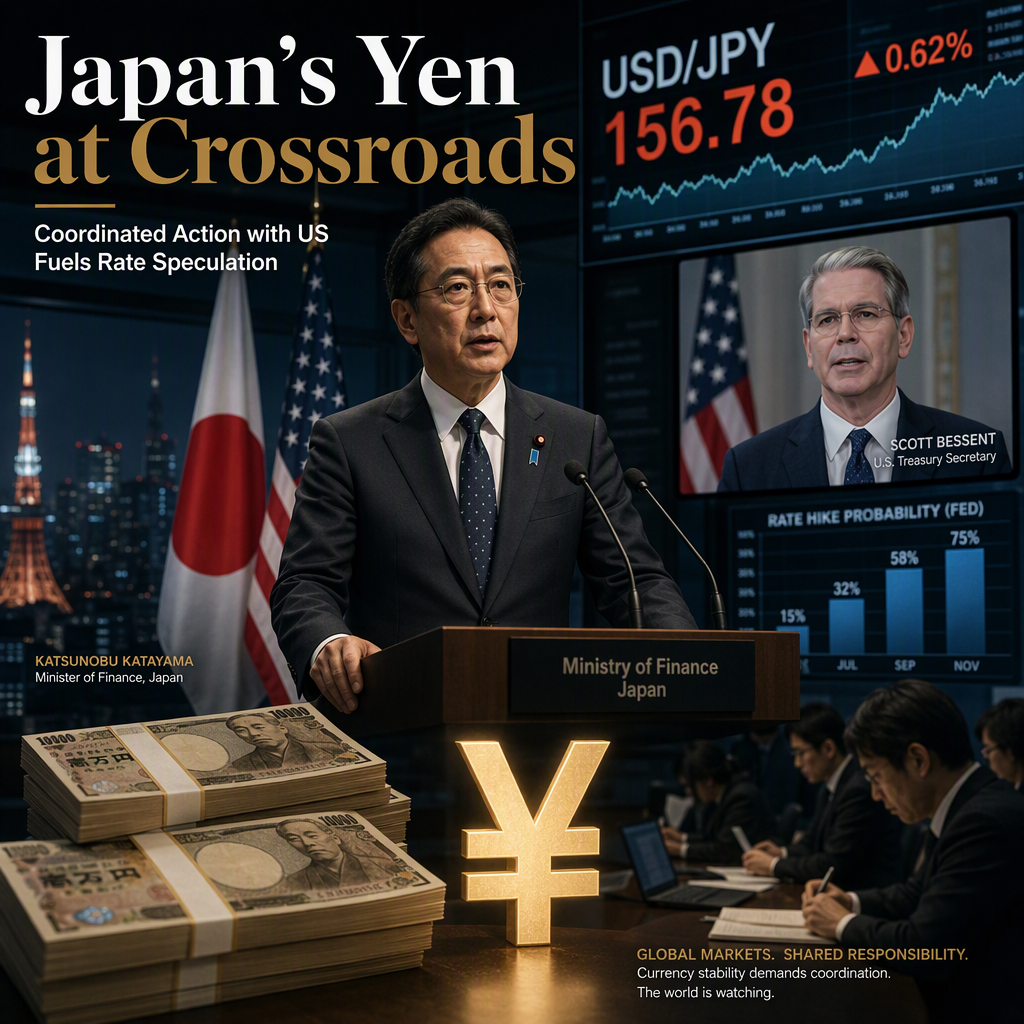
Japan's Finance Minister Katayama stated on Tuesday that the Japanese Yen is currently undervalued, describing this as a general problem for the country. She revealed that she and US Treasury Secretary Bessent agreed during a September 25 call to strengthen cooperation between their respective governments, with a commitment to maintain orderly currency markets through close contact between Japan and the US Treasury [1].
The Ministry of Finance (MoF) previously intervened in the currency market on July 30, spending a record ¥15.4 trillion to support the Yen when it was near its weakest level in about four decades. Despite this intervention, the USD/JPY is now about six Yen lower than where the buying started, and the Yen is still considered undervalued by the Finance Minister [1].
Vice Finance Minister for International Affairs Mimura emphasized that markets should take the coordinated messaging from Tokyo and Washington seriously. MUFG analysts interpreted recent official comments as encouraging expectations that the Bank of Japan (BoJ) may raise rates more quickly, possibly under US pressure. The BoJ raised its policy rate to 1.25% on September 18, the highest in 31 years, while the US Federal Reserve's range remains at 3.75%-4.00%. Analysts note that it would require ten more quarter-point BoJ hikes to close the gap with the Fed's lower bound, which currently supports the carry trade keeping USD/JPY elevated [1].
Key upcoming data releases include Japan's August retail sales, the MoF's intervention figures for late August to late September, and the quarterly Tankan survey. The intervention data will clarify whether recent warnings from Tokyo were backed by actual Yen purchases. Additionally, Tokyo's September consumer prices and jobless rate, as well as US inflation and payrolls data, are expected to influence central bank decisions at the end of October [1].
Technical analysis shows resistance for USD/JPY just under 158.00, with support at 157.00. The market is closely watching whether Tokyo's rhetoric will be matched by further intervention or policy action [1].
CONCLUSION
Japan's government continues to signal concern over the Yen's undervaluation and is coordinating with US authorities to address currency market stability. While recent interventions and rate hikes have not fully reversed Yen weakness, upcoming data and central bank meetings will be critical in determining the next market direction. Investors remain alert to both official actions and economic indicators for further cues.