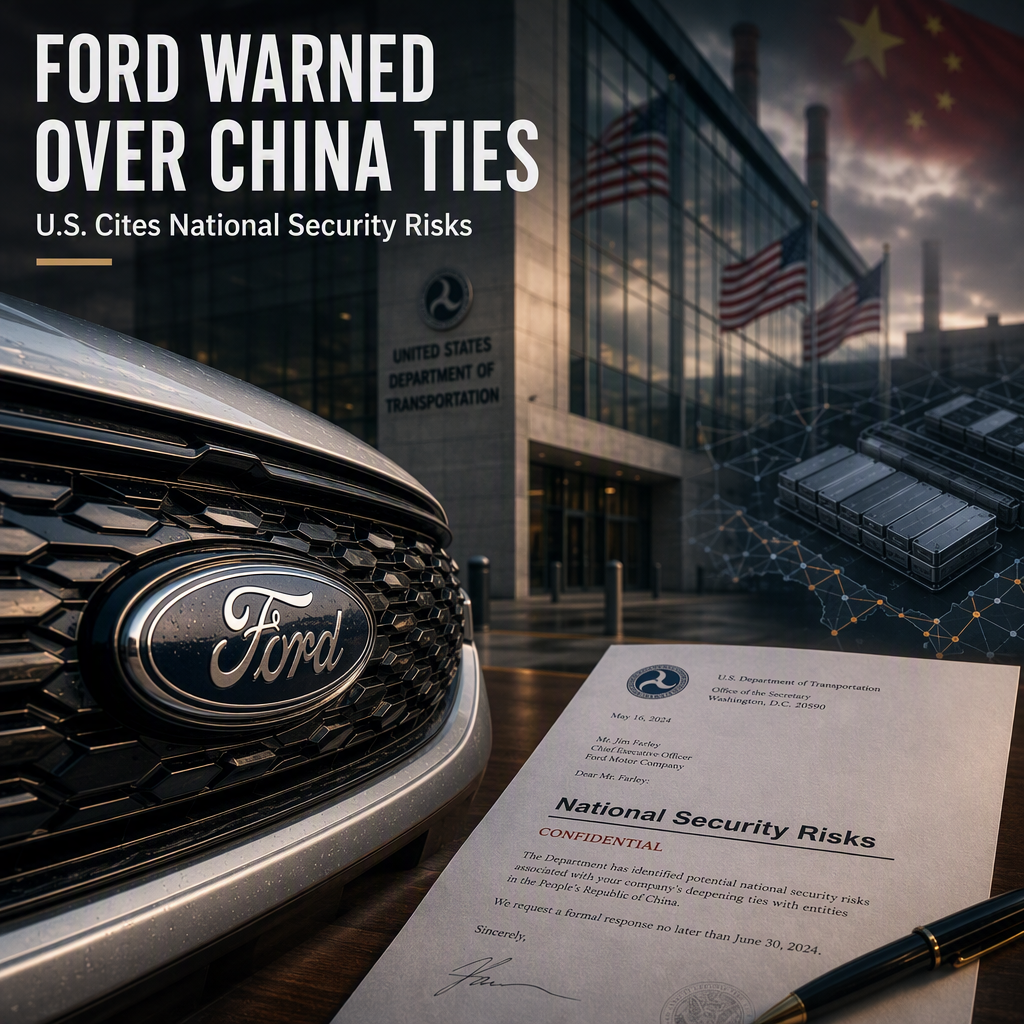
U.S. Transportation Secretary Sean Duffy has issued a strong warning to Ford Motor Co., criticizing the automaker's increasing reliance on Chinese technology and manufacturing partnerships. In a letter sent to Ford CEO Jim Farley, Duffy expressed concerns that Ford's business strategy poses risks to U.S. national security and American manufacturing, marking one of the Trump administration's most direct public rebukes of a major American automaker over its China ties [1].
Duffy's letter highlighted several specific examples, including Ford's continued use of licensed battery technology from Chinese manufacturer CATL at its BlueOval Battery Park in Marshall, Michigan, a joint venture with Chinese-owned Geely in Spain, reported discussions with BYD over hybrid vehicle components, and delayed plans to reshore Lincoln models such as the Nautilus, which could extend until 2030 [1]. Duffy argued that these moves deepen Ford's reliance on Chinese supply chains and help strategic competitors expand their influence in the global auto industry [1].
The Secretary warned that Chinese law could require companies to provide the government access to proprietary and customer data, creating potential national security risks. He also noted that increased reliance on Chinese manufacturing could come at the expense of American workers [1]. Duffy urged Ford to reduce its dependence on foreign technology and to chart a path toward technological self-reliance, emphasizing the expectation for iconic American companies to out-innovate competitors [1].
This warning comes amid broader legislative efforts, as the Senate Commerce, Science and Transportation Committee recently approved bipartisan legislation that would ban the import, sale, and operation of vehicles manufactured by companies designated as foreign entities of concern, including those based in China. The measure would also prohibit certain connected vehicle technologies developed by those countries [1].
Market data shows Ford's stock (F) last traded at $14.62, up $0.21 on the day [1].
CONCLUSION
The U.S. government's warning to Ford over its deepening ties with Chinese companies underscores growing national security and economic concerns. While Ford's stock saw a modest increase, the letter and pending legislation signal potential regulatory headwinds for automakers with significant Chinese partnerships.