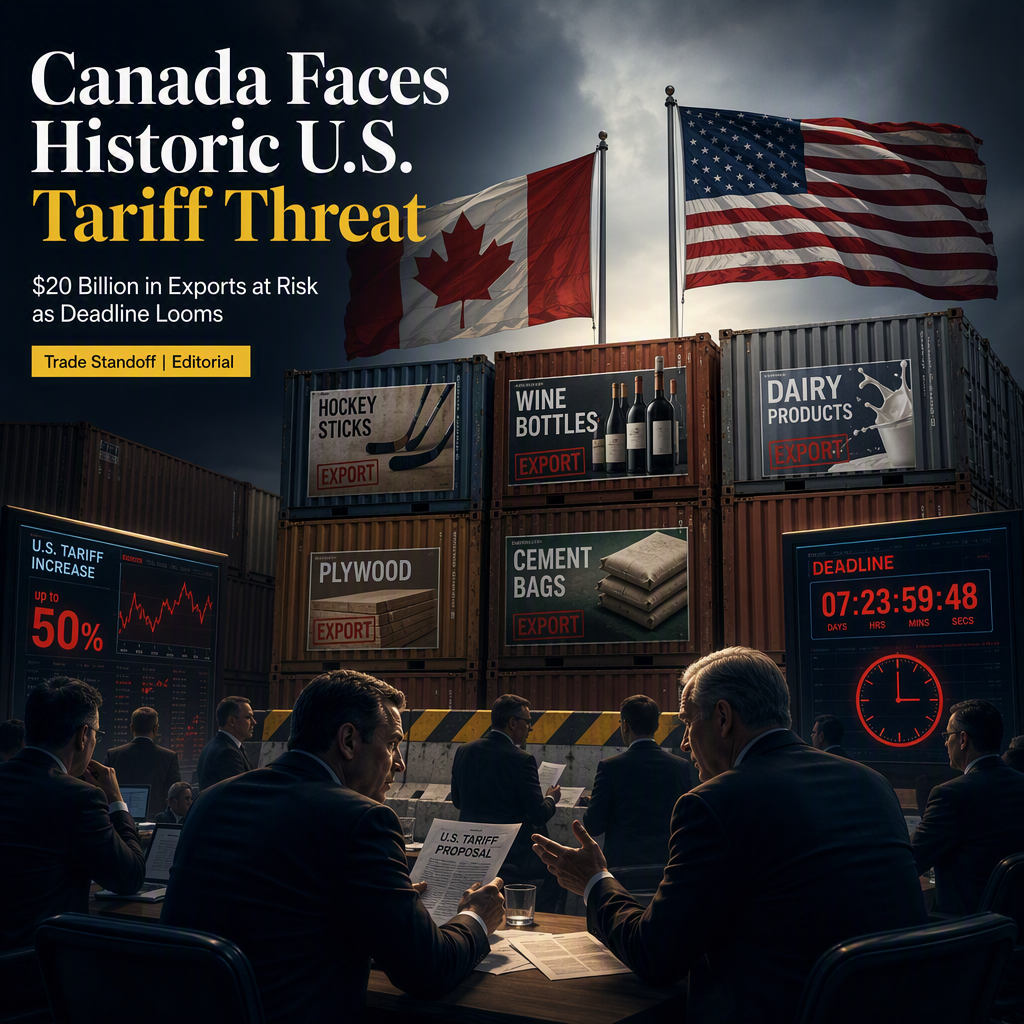
The Canadian government is urgently negotiating with the Trump administration to prevent a new round of U.S. tariffs, which are scheduled to take effect on Wednesday and could impact approximately $20 billion worth of Canadian exports to the United States [1]. These tariffs would apply to a range of products, including hockey sticks, certain clothing items, wines, some dairy products, and building materials such as cement and plywood, while excluding energy products, potash, fish, and critical minerals [1].
The White House has justified the tariffs as a response to what it describes as Canada’s 'discriminatory treatment of American products,' aiming to 'level the playing field for crucial American exports — cars, alcohol, and dairy' [1]. The duties are to be implemented under Section 338 of the Tariff Act of 1930, which allows the president to impose tariffs of up to 50% on countries that discriminate against U.S. commerce; this would be the first time Section 338 has been invoked, and legal challenges are expected [1].
The trade tensions follow more than a year of escalating measures between the two countries, including previous U.S. tariffs on steel, aluminum, autos, and IEEPA tariffs related to alleged fentanyl trafficking, which Canada has denied [1]. Canada retaliated with its own tariffs on American products, prompting the current U.S. response [1]. U.S. Trade Representative Jamieson Greer stated that the new duties are directly related to Canada’s retaliatory measures, emphasizing that only China and Canada have taken such actions against the U.S. [1].
If enacted, the tariffs could increase costs for American consumers, as importers may pass on the additional expenses. Consumer prices have already risen 3.4% over the past year, up from 2.4% before the Iran war, and tariffs currently cost the average American household about $1,100 annually, according to Yale’s Budget Lab [1]. The outcome of the ongoing negotiations remains uncertain, with both sides reportedly at an impasse as of Monday [1].
CONCLUSION
The looming U.S. tariffs on Canadian exports represent a significant escalation in trade tensions, with potential to impact both economies and raise consumer costs. With negotiations stalled and legal challenges anticipated, the market faces heightened uncertainty as the tariff deadline approaches.