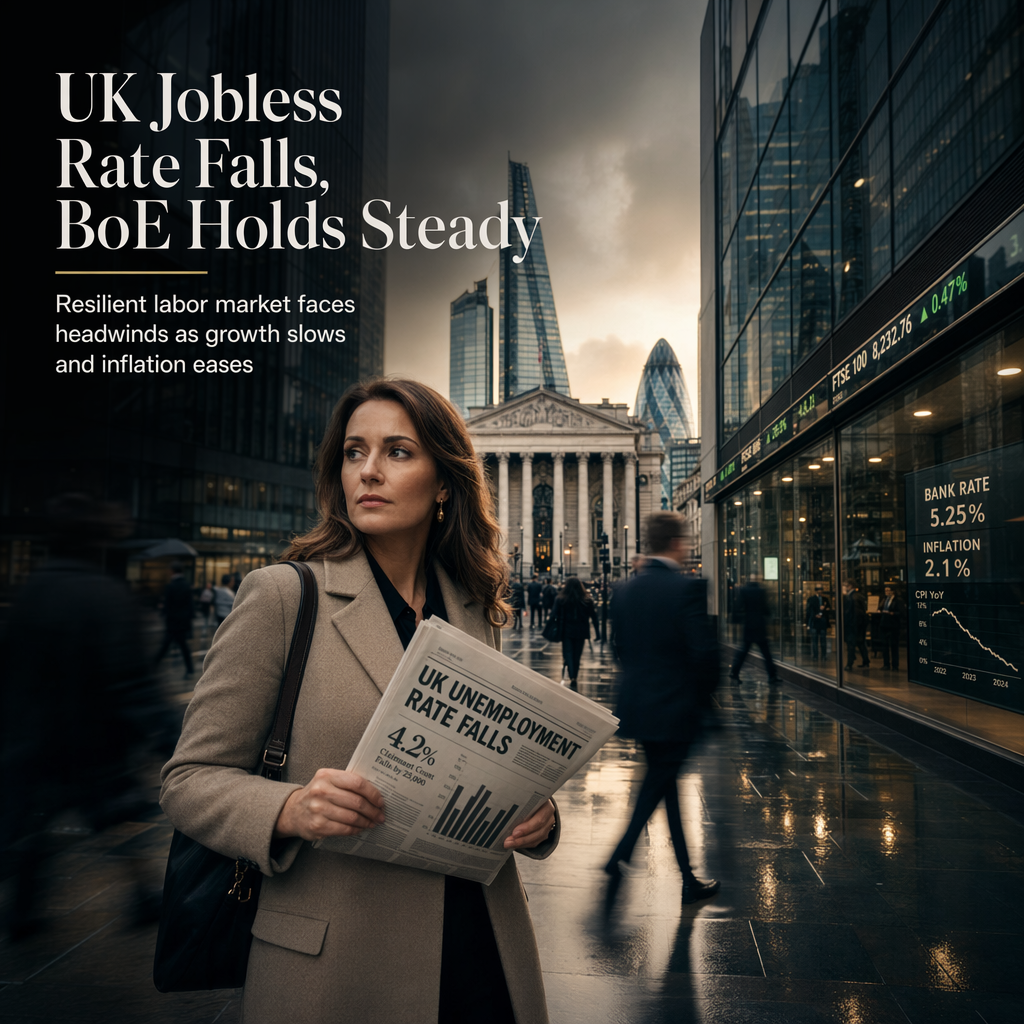
The United Kingdom's ILO Unemployment Rate declined to 4.9% in the three months to April, down from 5.0% in March and below the market consensus of 5.0%, according to data from the Office for National Statistics (ONS) released on Thursday [1][2]. Despite the lower unemployment rate, the number of people claiming jobless benefits increased by 31.2K in May, compared to a revised 8.3K rise in April and the expected 25.8K gain [1][2]. Employment Change for April was 100K, which, while lower than March's 148K, exceeded the expected 80K [2]. Wage growth remained steady, with Average Earnings excluding Bonus rising by 3.4% year-over-year, matching the previous period and surpassing the 3.2% forecast, while Average Earnings including Bonus climbed by 4.4%, also beating the 4.0% estimate [2].
Following the employment report, the British Pound edged slightly higher, with GBP/USD trading 0.14% up at 1.3310. The Pound was strongest against the Canadian Dollar among major currencies [2]. The EUR/GBP cross trimmed gains near 0.8650, with the Pound trading flat against the Euro in early European hours [1].
Attention is now focused on the Bank of England's (BoE) interest rate decision, scheduled for Thursday. The BoE is widely expected to keep the benchmark Bank Rate unchanged at 3.75% for the fourth consecutive meeting [1][3]. This expectation is underpinned by softer-than-expected consumer inflation figures, with the Consumer Price Index (CPI) holding steady at 2.8% year-over-year in May, down from a 3.3% peak in March and below the BoE's February projections [3]. Monthly inflation eased to 0.2% from 0.7%, and core inflation also grew below expectations [3].
The UK economy has shown signs of slowing, with GDP shrinking by 0.1% in April after growing 0.3% in March and 0.4% in February. Industrial Production stalled following a 0.2% contraction in the previous month [3]. The BoE risks deepening a potential recession if it tightens policy further, and recent developments, including a sharp drop in oil prices and progress on a US-Iran peace deal, have reduced inflationary pressures [3].
Markets will closely analyze the BoE's meeting minutes and the vote split, especially after the previous 8-1 vote to hold rates, with Chief Economist Huw Pill previously advocating for a hike [3]. Governor Andrew Bailey is not scheduled to speak after the decision, so investors will look for clues in the official documentation regarding the future policy path [3].
CONCLUSION
The UK labor market showed resilience with a lower unemployment rate and steady wage growth, but rising jobless claims and slowing economic activity highlight underlying challenges. With inflation easing and growth concerns mounting, the BoE is expected to maintain its current policy stance, shifting market focus to the tone of the meeting minutes and any signals on future rate moves.