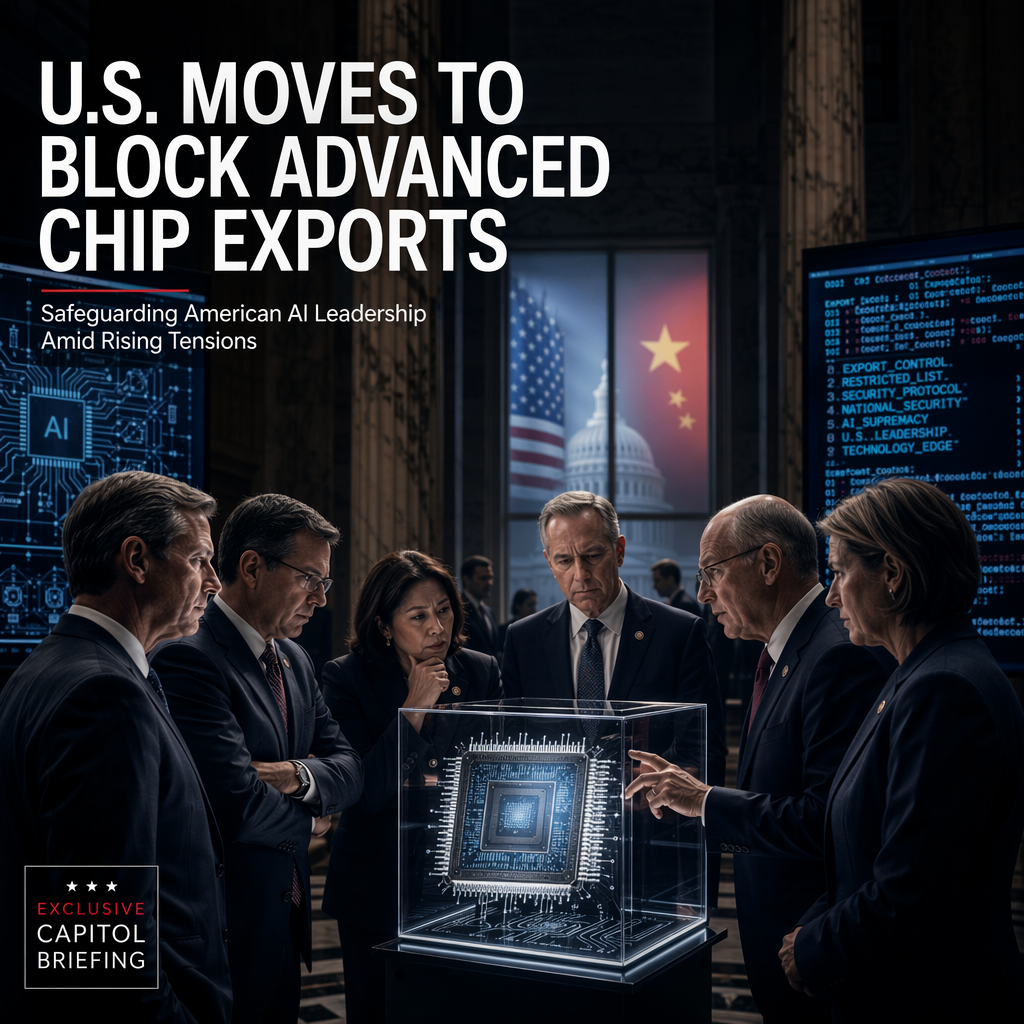
On June 11, the Senate Banking Committee held a hearing focused on whether the United States can ensure that rapid advances in artificial intelligence (AI) support innovation, affordability, and American dominance, with a central emphasis on maintaining control over the world’s most advanced chips and restricting their access to China [1]. The hearing highlighted bipartisan legislative efforts, including the 'AI Overwatch Act' introduced by Indiana Republican Sen. Jim Banks and Florida Republican Rep. Brian Mast, which aims to codify and make permanent the prohibition on exporting advanced chips to China—a policy initially enforced by the Trump administration [1].
The AI Overwatch Act proposes a clear test to ensure that chip sales do not enhance adversaries’ military, intelligence, surveillance, or cyber capabilities, while also facilitating expedited exports to trusted allies and partners, thereby maintaining U.S. oversight and ownership of top-tier AI capabilities [1]. In parallel, the bipartisan and bicameral 'Match Act,' introduced by Sens. Jim Risch, Pete Ricketts, and Andy Kim, seeks to bar the sale and servicing of essential chipmaking tools to facilities in China, codify restrictions on companies such as Huawei and SMIC, and encourage allied nations to align their export controls to prevent American toolmakers from being undercut by foreign competitors [1].
The article underscores that these legislative measures are seen as essential for safeguarding American innovation and technological leadership, as well as for preventing China from closing the gap through domestic chip development or by acquiring advanced manufacturing equipment from abroad [1]. The White House has also accused China of conducting large-scale campaigns to copy American AI models, further intensifying the urgency for robust export controls [1].
No specific market reactions, analyst opinions, or forward-looking financial projections are provided in the article [1].
CONCLUSION
The legislative push to restrict advanced chip and chipmaking tool exports to China is positioned as a critical step for maintaining U.S. technological leadership and national security. While the article does not discuss immediate market reactions, the measures are portrayed as having significant implications for the global semiconductor and AI industries.