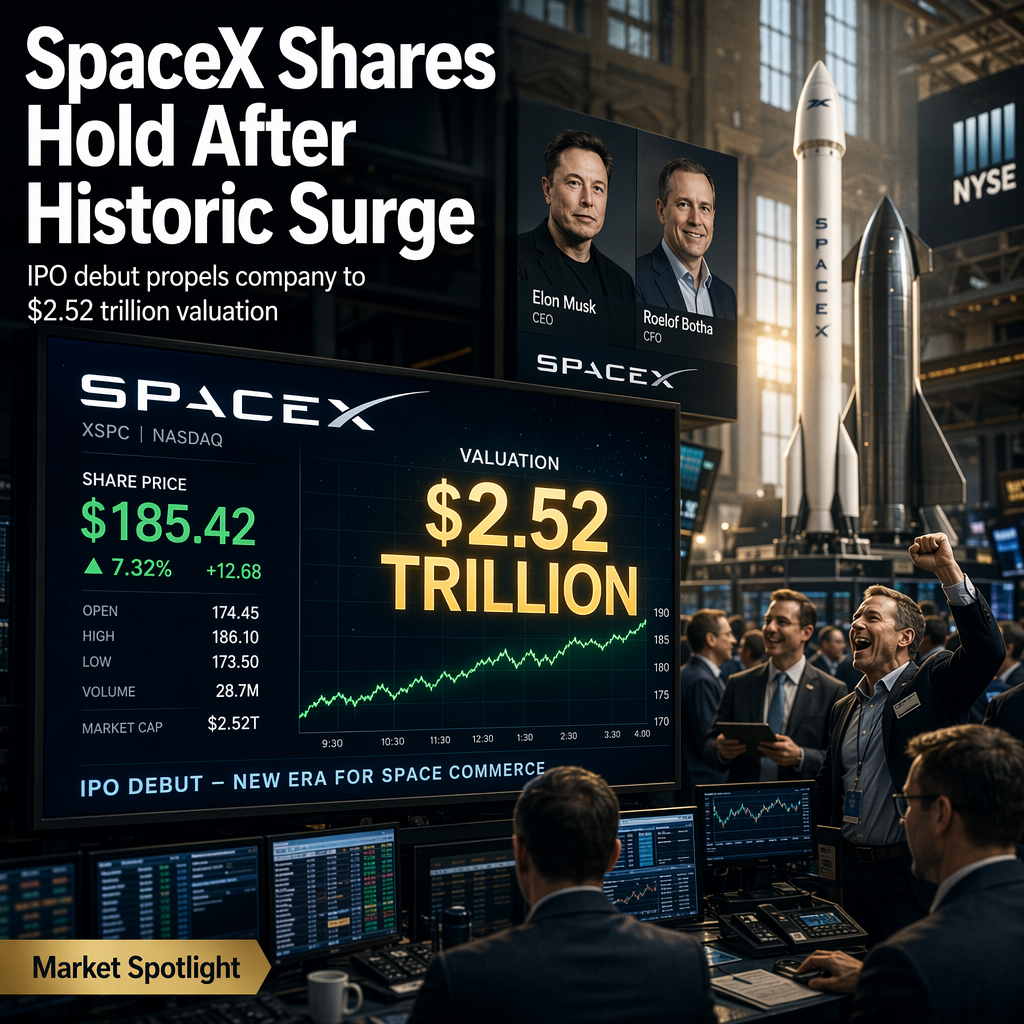
SpaceX shares remained steady in premarket trading on Thursday, following a period of intense volatility after the company's record-breaking initial public offering (IPO) last week [1]. The stock surged more than 40% after debuting at a set price of $135, reflecting strong investor enthusiasm for Elon Musk's space and AI company [1]. However, this bullish momentum appeared to wane on Wednesday, as shares declined by 5%, before ticking up 0.3% in premarket activity [1].
SpaceX's IPO immediately propelled the company into the ranks of the world's most valuable firms, with its market capitalization surpassing Amazon and, briefly, Microsoft [1]. By market close on Wednesday, SpaceX's valuation stood just below Amazon at $2.52 trillion [1]. Elon Musk maintains significant control over the company, holding more than 82% of voting rights and shares valued at over $1 trillion, which limits the influence of outside shareholders [1].
In a notable governance development, SpaceX announced the appointment of Roelof Botha, a longtime friend and ally of Musk, to its board of directors [1]. Botha will serve as an independent director and a member of the audit committee, becoming the eighth board member at SpaceX, where Musk continues as chairman, CEO, and technology chief [1].
Looking ahead, Musk stated on X that SpaceX "might be able to reach approximately" $1 trillion in revenue by 2030, signaling ambitious growth targets for the company [1].
CONCLUSION
SpaceX's historic IPO and subsequent 40% stock surge have positioned it among the world's most valuable companies, though recent trading suggests investor enthusiasm may be moderating. The addition of Roelof Botha to the board and Musk's ambitious revenue projections highlight ongoing developments and high expectations for the company's future. Market attention remains focused on SpaceX's performance and governance as it navigates its new status as a public company.