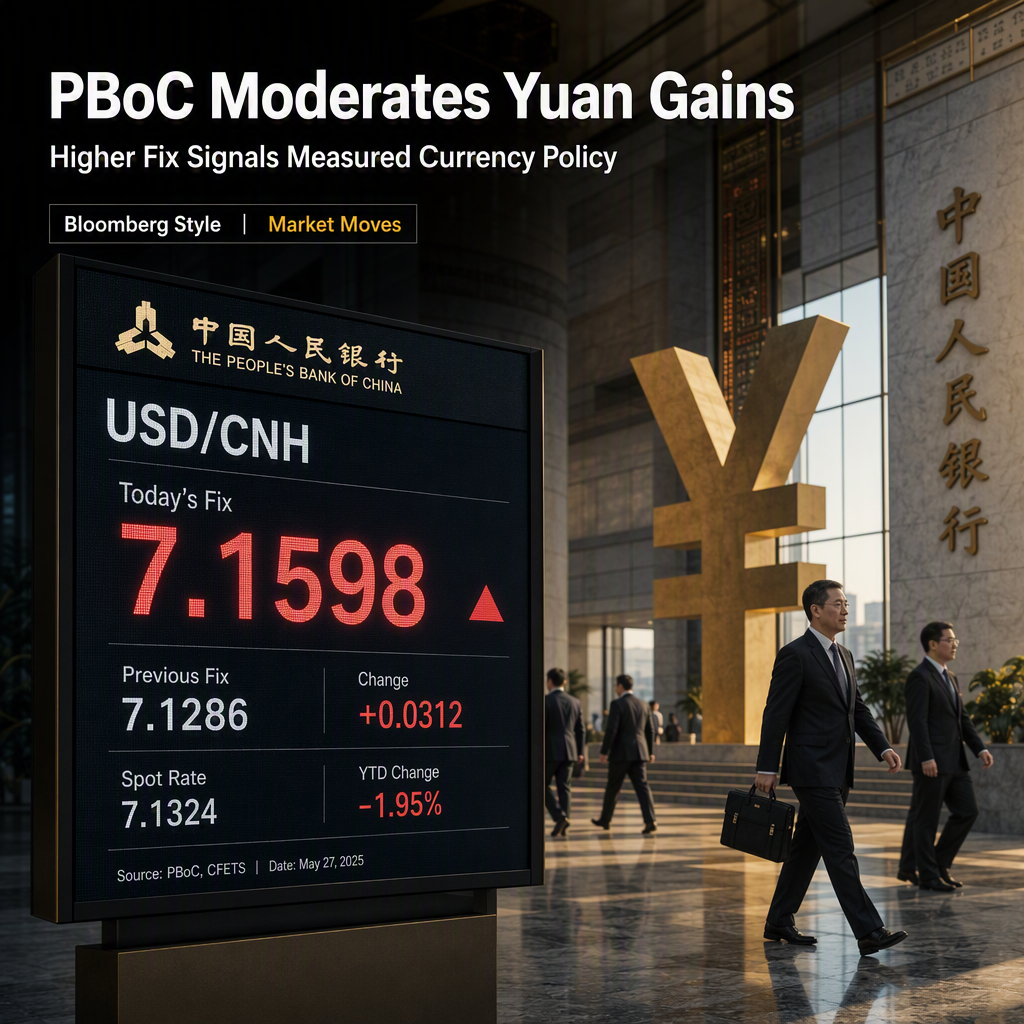
The Chinese yuan (USD/CNH) briefly fell to an intra-day low of 6.7060 on Monday, marking its lowest level since February 2023, before rebounding sharply after the People's Bank of China (PBoC) set the daily fix higher at 6.7795, compared to the previous Friday's fix of 6.7787 [1]. Market estimates had anticipated a fix more than 700 pips lower than the actual figure, which OCBC's Christopher Wong interprets as evidence that Chinese policymakers are aiming to moderate the pace, rather than the direction, of RMB appreciation [1].
Wong notes that subdued U.S. dollar demand and underlying resilience in the RMB may continue to keep USD/CNH biased lower in the near term, but the PBoC's fixing is likely to act as a 'speed limiter' on further yuan gains [1]. Technical analysis indicates no clear directional bias at present, with daily momentum and RSI not signaling a strong trend. Key support levels are identified at 6.7060 and 6.70, while resistance is seen at 6.7180 and 6.7270 (the 21-day moving average) [1].
The market implication is that while the yuan may continue to appreciate, the PBoC is likely to intervene to prevent excessive volatility or rapid moves, favoring a measured and controlled appreciation path [1]. No explicit analyst forecasts or forward-looking statements beyond this measured approach are provided in the source.
CONCLUSION
The PBoC's higher-than-expected fix signals a preference for gradual yuan appreciation, acting as a brake on rapid gains. Market participants should expect continued two-way risks and a measured policy stance, with the fix serving as a key tool to moderate currency movements.