
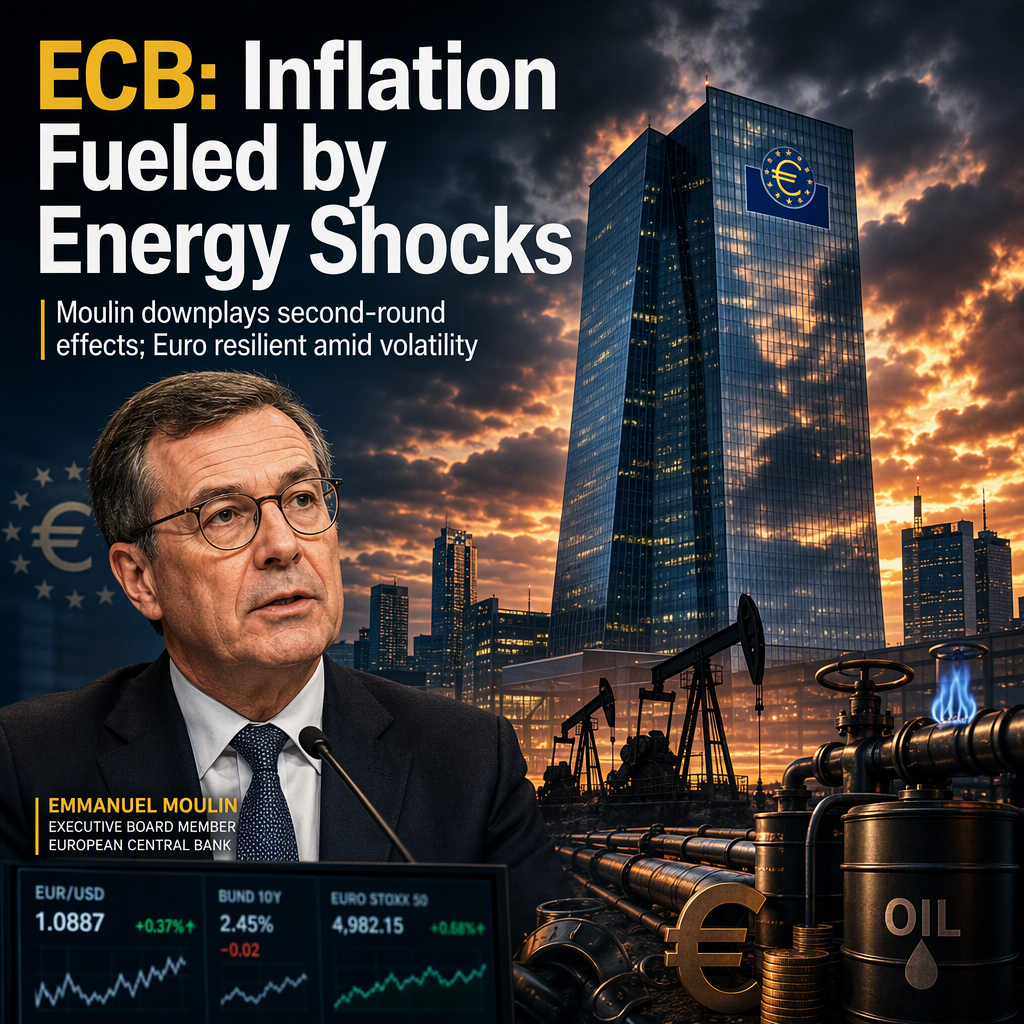
European Central Bank (ECB) Governing Council member Emmanuel Moulin stated that high inflationary pressures in the Eurozone are '100% driven by energy shocks' during the European trading session on Thursday [1]. Moulin emphasized that he does not see evidence of second-round inflation effects in the region, aligning with other ECB members who have similarly dismissed such concerns [1]. He further noted that the current inflationary shock is being compounded by a geopolitical shock, which is also transmitting into a financial shock [1]. Despite these challenges, Moulin highlighted that economic growth in the Euro area has remained 'quite resilient' [1].
In terms of market reaction, there was no immediate significant movement in the Euro (EUR) following Moulin's remarks. As of the time of reporting, the EUR/USD currency pair was trading marginally lower, near 1.1190 [1]. No additional forward-looking statements or analyst opinions were provided in the source article [1].
CONCLUSION
ECB’s Moulin’s comments attribute Eurozone inflation entirely to energy shocks and downplay the risk of second-round effects. The market response was muted, with the EUR/USD showing only a slight decline. Economic growth in the Euro area is described as resilient despite ongoing shocks.