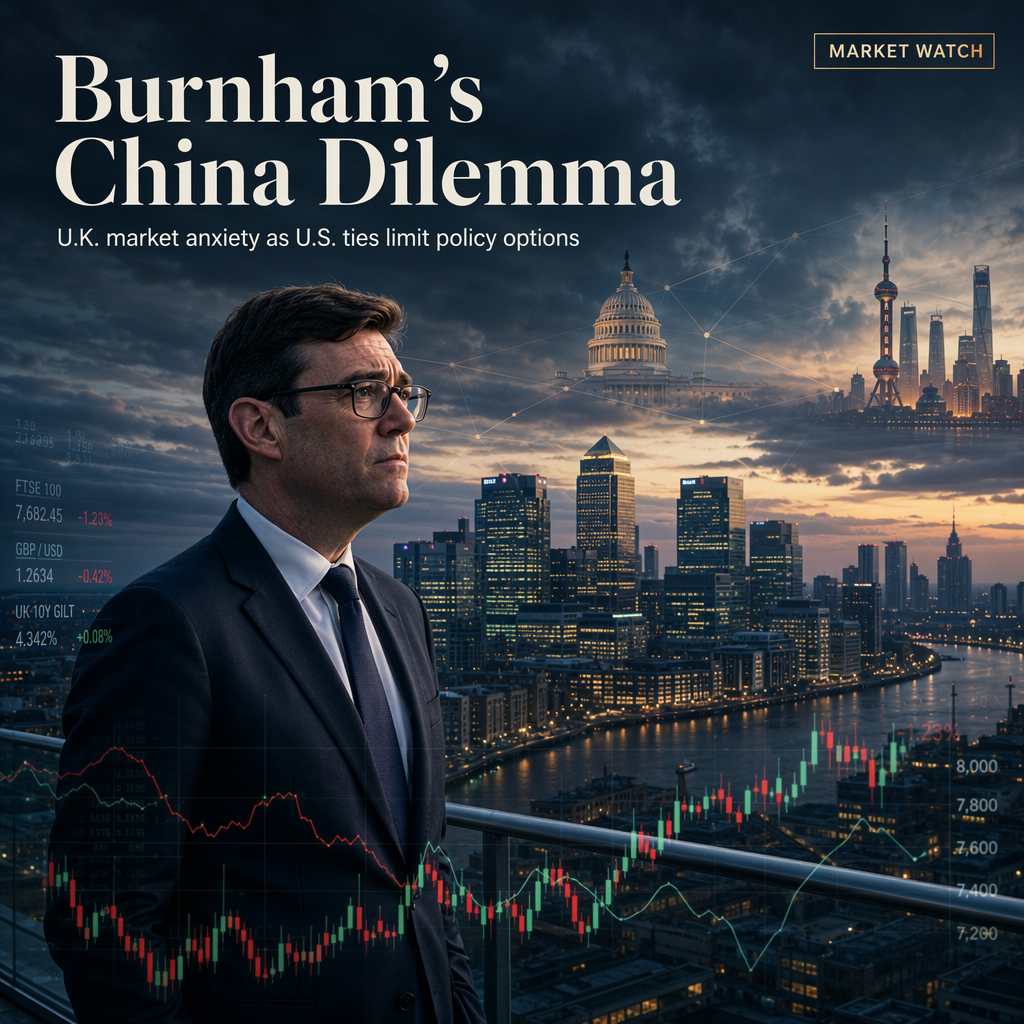
Britain's new Prime Minister, Andy Burnham, is navigating a complex policy environment as he seeks to define the U.K.'s approach toward China. Despite Burnham's personal inclination toward fostering closer economic relations with China, the U.K.'s deep economic and security ties with the United States are expected to significantly limit his ability to pursue an independent China policy. Financial and market analysis highlights the U.K.'s reliance on American financial markets and technology, with British companies—especially in the financial services sector—integrated into global supply chains that depend on U.S. regulatory and technological frameworks. This dependence has previously influenced government decisions, such as restricting Chinese investment in sensitive sectors and excluding Huawei from the U.K.'s 5G network rollout [1].
A senior London-based analyst noted, 'Burnham may want to explore closer economic relations with China, but he will quickly find that Britain's hands are tied by its alliance with the U.S. and the realities of global financial markets.' Market sentiment is described as cautious, with investors wary of any major shifts in U.K.-China policy, particularly in the context of ongoing U.S.-China tensions [1].
Recent data indicates that U.K. exports to China have stagnated, and investment inflows from China have declined, attributed to regulatory uncertainty and geopolitical risk. The FTSE 100 index has mirrored these concerns, as shares of companies with significant exposure to China have underperformed the broader market. Technical analysis points to resistance levels for these stocks, and analysts are advising against aggressive trading until there is greater policy clarity [1].
Major London brokerage firms, including Barclays, are advising clients to closely monitor developments in both Westminster and Washington. They warn that any moves by Burnham to recalibrate ties with China will be scrutinized by U.S. policymakers and could trigger volatility in sterling and U.K. equities [1].
In summary, while Burnham may seek to leverage Britain's historical connections with China to boost growth and trade, market dynamics and strategic alliances with the U.S. are likely to dictate the limits of his policy options. Investors and traders are advised to keep an eye on key support and resistance levels in China-exposed stocks and to remain cautious amid the uncertain geopolitical landscape [1].
CONCLUSION
Andy Burnham's ambitions for a recalibrated U.K.-China relationship are likely to be constrained by the country's dependence on the U.S. and prevailing market dynamics. Investors are advised to remain cautious, as any policy shifts could trigger volatility in U.K. equities and sterling, especially for China-exposed stocks.