
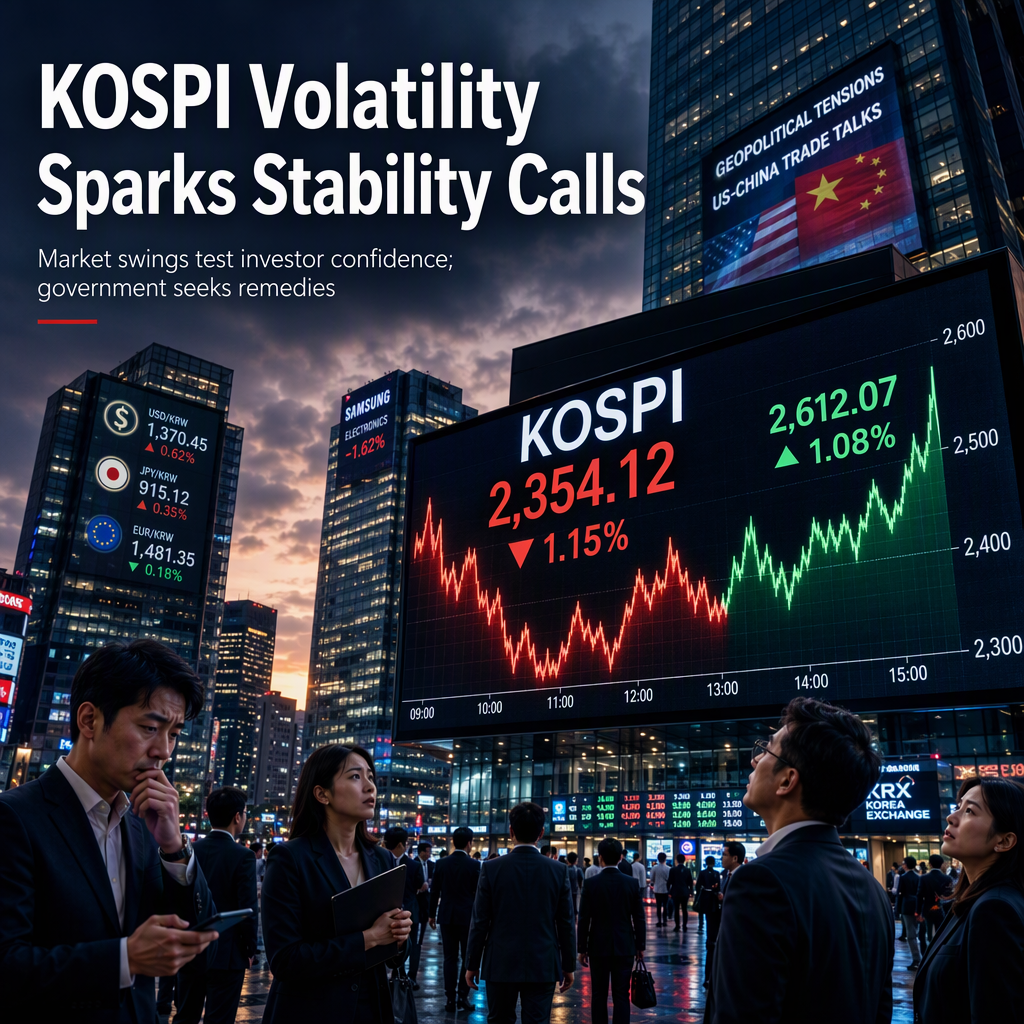
South Korea's financial markets have recently experienced significant volatility, with the benchmark KOSPI index repeatedly undergoing sharp fluctuations driven by external factors, speculative trading, and shifts in investor sentiment [1]. In recent months, the KOSPI has moved within a broad range, reflecting uncertainty about both the global economy and local policy direction. The index has dropped steeply on several occasions, only to rebound rapidly, undermining investor confidence and complicating long-term investment planning for companies [1].
According to data from Korea Exchange, the KOSPI has traded between support levels near 2,300 and resistance above 2,600, frequently breaking through technical indicators such as the 50-day and 200-day moving averages [1]. Technical analysis reveals that periods of high trading volume have coincided with abrupt price changes, suggesting a lack of institutional stability. Chart descriptions highlight the KOSPI's tendency to form sharp peaks and valleys, with the Relative Strength Index (RSI) often moving into overbought and oversold territory, indicating emotional trading and herd behavior [1].
Analysts attribute the instability to several factors, including geopolitical tensions, shifting U.S. monetary policy, and speculative buying by retail investors [1]. The government has responded by signaling policy measures aimed at calming the markets, emphasizing transparency and predictable regulation. However, critics argue that more needs to be done to prevent manipulation and excessive speculation [1].
Trading advice from local brokers has shifted toward caution, with recommendations to watch for confirmed breakouts above resistance at 2,600 before committing to new positions and to maintain stop-loss orders to protect against sudden drops. Support is seen at the 2,300 level, with additional technical support near 2,350 [1]. Market sentiment remains mixed, with some investors seeing opportunities in volatility, but the prevailing mood is one of concern. A fund manager emphasized the need for less excitement and more predictability, urging the government to focus on delivering stability [1].
CONCLUSION
South Korea's KOSPI index continues to experience pronounced volatility, prompting calls for greater market stability and regulatory action. While some investors are attracted by the opportunities presented by price swings, the dominant sentiment is concern over unpredictability and risk. The government's efforts to signal policy measures are seen as a step forward, but further action may be necessary to restore investor confidence and support sustainable growth.