
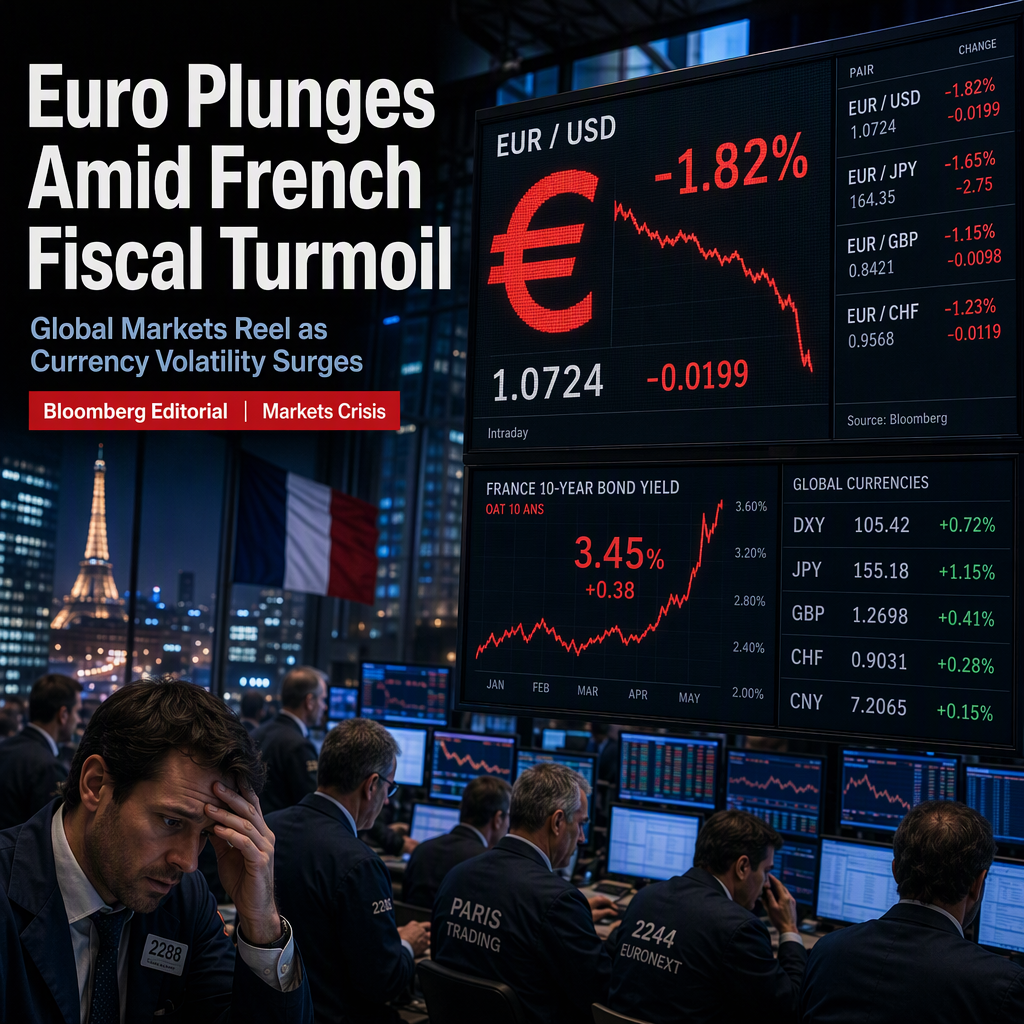
A wave of fiscal concerns in France triggered significant volatility across major currency markets at the start of the week, with the Euro coming under pronounced pressure and ripple effects felt in the British Pound and Australian Dollar pairs [1][2][3]. The Euro's weakness was attributed to France's budget crisis, which has widened the spread between French and German 10-year government bond yields to around 150 basis points, the largest gap since 2011 [3]. This fiscal shock spilled over into other Eurozone sovereign bond markets, amplifying risk aversion and weighing on the Euro, which briefly dropped to an intra-day low of 1.1161 against the US Dollar, its lowest since May 2025 [2][3].
Strategists at Brown Brothers Harriman noted that the European Central Bank's (ECB) Transmission Protection Instrument could provide a backstop against disorderly spread widening, but its activation depends on EU member states maintaining 'sound and sustainable fiscal and macroeconomic policies.' France's deteriorating finances complicate the case for ECB intervention, though broader contagion could increase pressure on the ECB to act [2]. ECB Chief Economist Philip Lane highlighted that the rise in long-term interest rates represents a material tightening of financial conditions for the euro area, adding to the Euro's downside pressure [2].
The British Pound also weakened, falling by over 0.19% against the US Dollar to trade at 1.3218, as Eurozone stress outweighed softer US services momentum [1]. Despite a better-than-expected S&P Global Services PMI in the UK (rising to 52.1 from 51.7), the Sterling's drop was only partially capped by expectations of closer UK-EU ties and remarks from Bank of England officials suggesting a higher likelihood of further tightening [1]. The US Dollar Index (DXY) rose to 102.25, up 0.32%, and touched daily highs of 102.53, with much of its strength attributed to Euro weakness [1][3].
In the US, the ISM Services PMI eased to 54.9 in September from 55.4 in August, slightly below expectations but still indicating expansion [1][3]. Inflationary pressures persisted, with the Prices Paid Index rising to 74.0 from 72.6, and the Employment Index improving to 50.1 from 47.8 [1][3]. US Treasury yields remained elevated, with the 10-year yield holding around 5.30%, near its highest level since 2002, further supporting the Greenback [3].
The Australian Dollar managed to edge higher, with AUD/USD up 0.34% to 0.6970, despite the robust US Dollar and firm Treasury yields. The pair's gains were capped by the global risk environment and technical resistance levels [3]. Meanwhile, oil prices fell by nearly 1% to $90.35 per barrel, influenced by ongoing Middle East tensions and their impact on risk sentiment [1].
CONCLUSION
France's fiscal crisis has triggered a broad selloff in the Euro and pressured other major currencies, driving the US Dollar to multi-month highs. The situation has heightened market volatility and raised questions about potential ECB intervention, while persistent US inflation and elevated Treasury yields continue to support the Greenback. Investors remain cautious as fiscal risks in Europe and global macroeconomic uncertainties dominate market sentiment.