
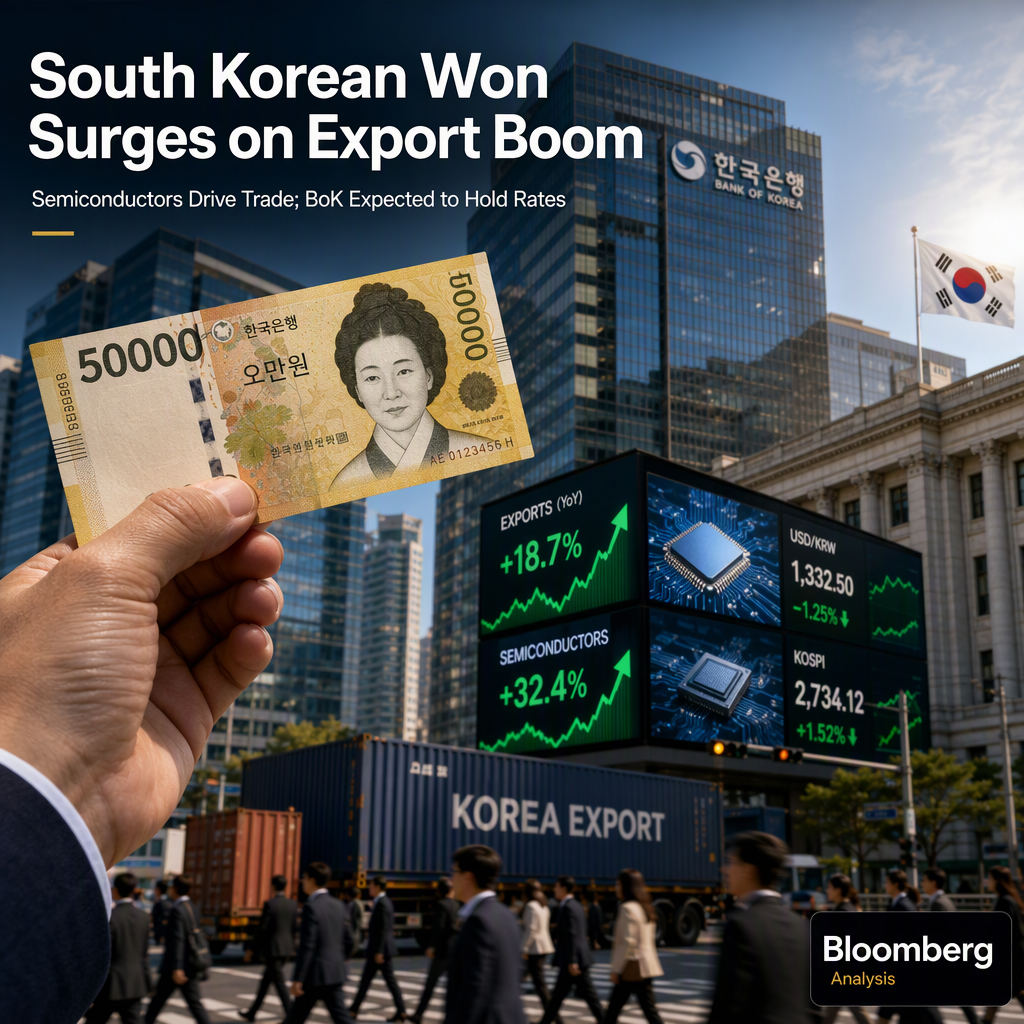
The South Korean Won (KRW) appreciated against the US Dollar last week, driven by robust export performance and supportive government policy actions, according to Commerzbank’s Moses Lim [1]. The USD/KRW exchange rate fell 0.9% to 1,348 last Friday, marking a 0.8% decline for the week. This movement was attributed to strong exporter dollar selling, as major domestic firms repatriated overseas earnings to finance domestic capital expenditure, and a softer USD provided additional support to the KRW [1].
South Korea’s September exports significantly outperformed expectations, rising 83.5% year-over-year (Bloomberg consensus: 62.5%) compared to 68.7% in August. Calendar-adjusted exports accelerated to 104.8% from 72.5% previously. Semiconductor exports were the main driver, surging 262% versus 209% in the prior month. Higher export prices also contributed to the positive trade data [1].
On the inflation front, September’s Consumer Price Index (CPI) eased to 2.9% year-over-year from 3.1% in August, largely due to government relief measures such as petroleum price caps and a KRW193bn subsidy program to contain food prices during the Chuseok holiday. Core inflation also moderated to 2.8% from 3.4%. Despite the moderation, headline inflation remained above the Bank of Korea’s 2% target for the seventh consecutive month, indicating persistent underlying price pressures [1].
Given the elevated but easing inflation and strong export momentum, the Bank of Korea is expected to maintain its hawkish stance but likely hold its policy rate at 3.0% in October, following back-to-back 25 basis point hikes in July and August. The Ministry of Finance and Economy announced a reduction in October bond issuance to KRW12tn, KRW5tn less than initially planned, due to higher-than-expected tax revenues from the electronics upcycle. Finance Minister Lee Hyoung-il indicated the government’s willingness to further scale back bond issuance or conduct emergency buybacks to stabilize the bond market [1].
CONCLUSION
The South Korean Won’s recent strength is underpinned by exceptional export growth, particularly in semiconductors, and proactive government policy measures. While inflation remains above target, the Bank of Korea is expected to pause rate hikes in October, and reduced bond issuance should further support domestic markets. Overall, the outlook for KRW remains constructive amid strong trade and prudent fiscal management.