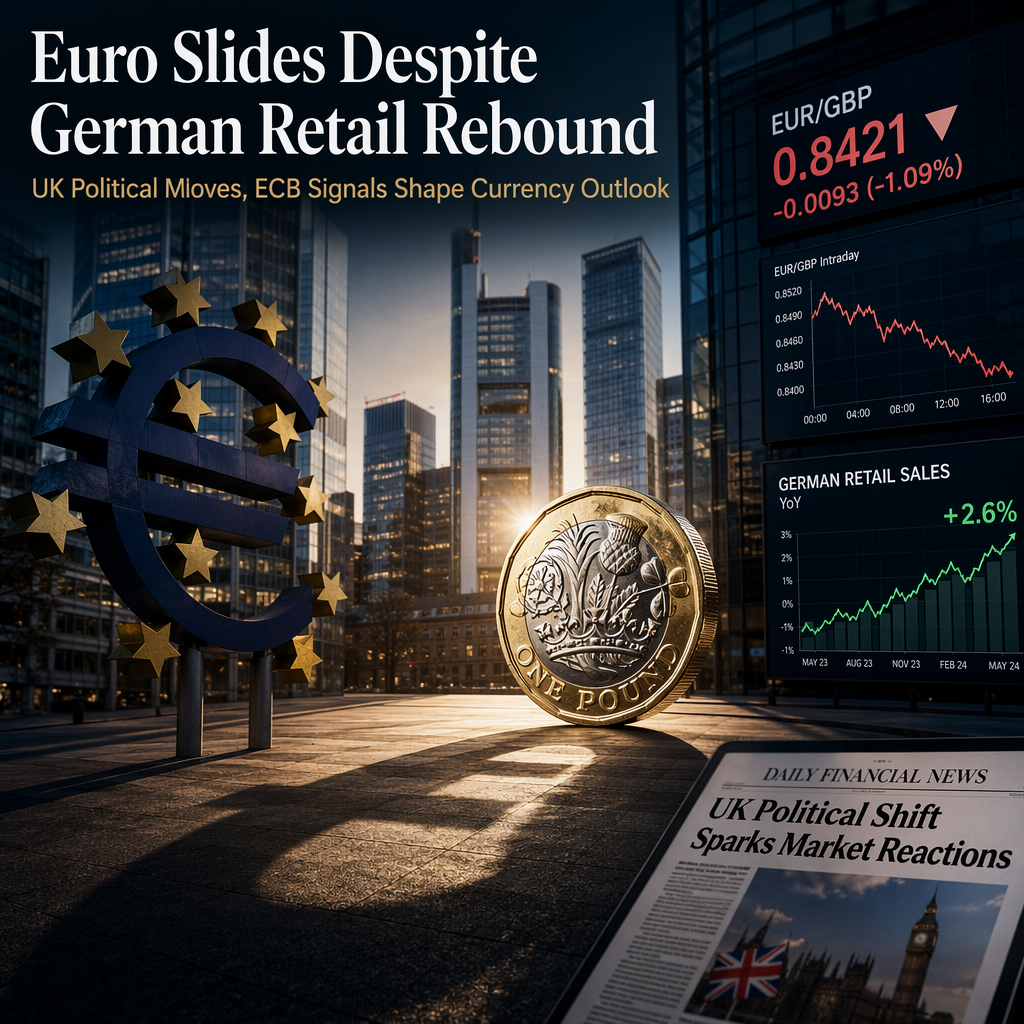
The EUR/GBP currency pair continued to trade in negative territory around 0.8605 during early European trading hours on Tuesday, with the Euro (EUR) holding losses against the British Pound (GBP) despite the release of stronger-than-expected German Retail Sales data [1]. According to Destatis, Germany’s Retail Sales rose by 1.8% year-on-year in May, reversing a previous decline of 0.6% (revised from -0.3%) and surpassing market expectations of 0% [1]. On a monthly basis, retail sales increased by 1.1% in May, compared to a 0.4% decline in April (revised from -0.3%), also beating the forecast of -0.1% [1].
Despite these positive economic indicators from Germany, the Euro remained under pressure. Market participants are awaiting the preliminary reading of Germany’s Harmonized Index of Consumer Prices (HICP) for June, which is scheduled for release later on Tuesday and could provide further direction for the currency pair [1].
Expectations for additional interest rate hikes from the European Central Bank (ECB) this year have diminished as energy prices retreat. Oxford Economics and Capital Economics anticipate that the ECB will not raise interest rates further, although traders are still pricing in the possibility of one more quarter-point increase, which would bring the deposit rate to 2.50% [1].
In the UK, the likely next Prime Minister has pledged to deliver radical changes to the nation’s politics and economy, emphasizing regional empowerment and fiscal discipline. The choice of finance minister is being closely watched by traders, as it could significantly impact the outlook for both the pound and the gilt market [1].
CONCLUSION
Despite stronger-than-expected German Retail Sales data, the Euro remained weak against the British Pound, reflecting subdued market sentiment and reduced expectations for further ECB rate hikes. Upcoming inflation data and political developments in the UK are likely to influence future movements in the EUR/GBP pair.