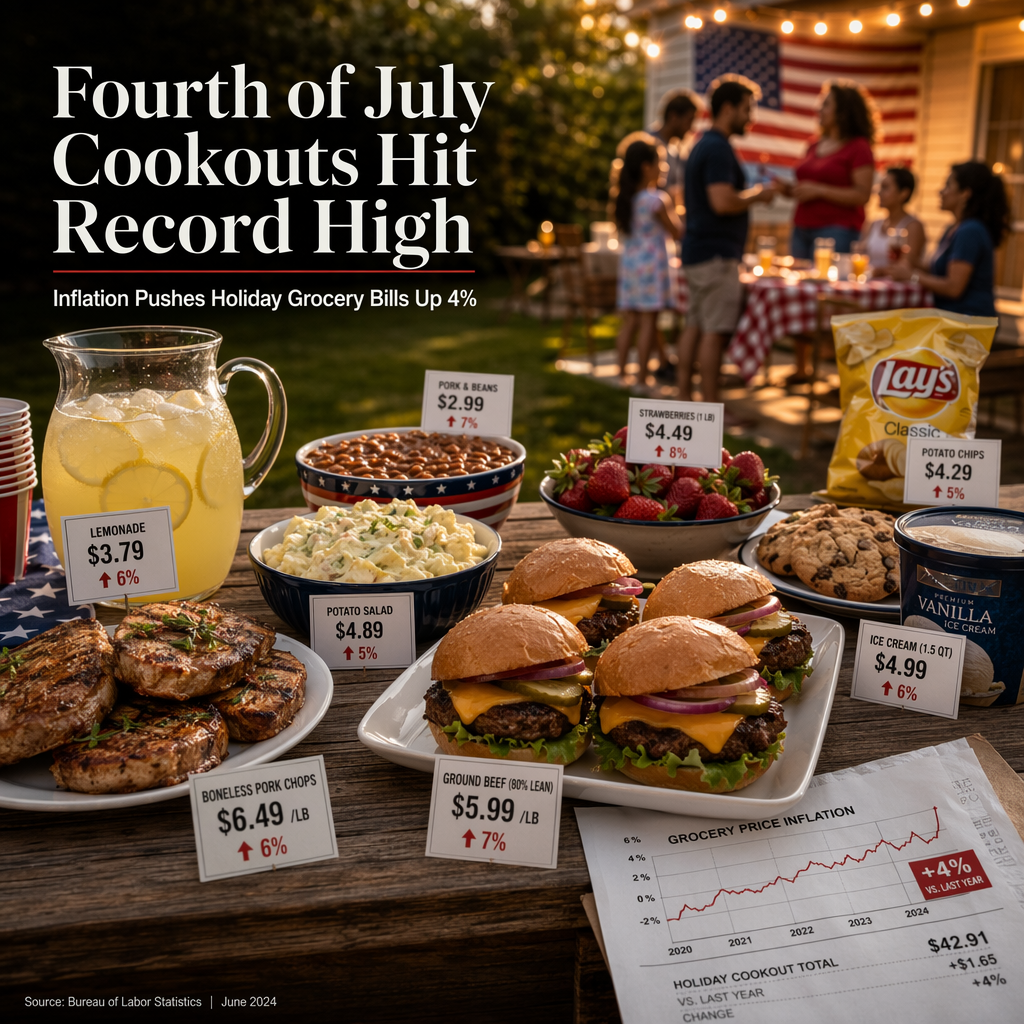
Americans planning Fourth of July barbecues in 2026 are facing record-high costs for traditional cookout fare, according to the American Farm Bureau Federation's Summer Cookout Cost Survey [1]. The survey finds that a classic Fourth of July cookout for 10 people will cost $73.82, or about $7.38 per person, marking an increase of $2.90, or 4%, compared to the previous year [1]. This is the highest total since the Farm Bureau began conducting the survey in 2016 [1].
The basket of goods measured includes cheeseburgers, chicken breasts, pork chops, potato chips, pork and beans, fresh strawberries, ingredients for homemade potato salad and fresh-squeezed lemonade, chocolate chip cookies, and ice cream [1]. The cost increase for the cookout basket closely mirrors broader inflation, with overall U.S. inflation rising 4.2% over the 12 months ending in May [1]. When adjusted for inflation using the consumer price index (CPI), the purchasing-power cost of the basket is nearly flat from last year, with this year's basket at $22.03 in 1982-84 dollars, slightly lower than last year's $22.06 [1].
Key price increases among individual items include ground beef, which is up 5.5% to $14.06 for two pounds—the highest beef price recorded in the survey's history—driven by a national cattle herd at a 70-year low and higher rancher operating costs [1]. Chicken breasts rose 3.5% to $8.06 for two pounds, and pork chops increased 4.7% to $14.79 for three pounds, though pork chop prices remain below 2024 levels [1]. Strawberries saw one of the largest increases, up 12.4% to $5.27 for two pints, due to a damaging frost in Florida and higher costs for labor, fuel, refrigeration, and transportation [1]. Lemonade prices rose 3.9% to $4.54 for 2.5 quarts, mainly due to higher lemon prices, while sugar prices remained steady [1]. The largest increase among all items was seen in pork and beans [1].
The Farm Bureau notes that while families are paying more at checkout, the inflation-adjusted cost of the cookout basket is nearly unchanged from last year, suggesting that the rise in prices is in line with broader economic trends rather than specific to food alone [1].
CONCLUSION
The American Farm Bureau Federation's report highlights that Fourth of July cookout costs have reached a record high, driven by inflation and supply-side challenges in key food categories. While nominal prices are up, the inflation-adjusted cost is nearly flat, indicating that the increases are consistent with broader economic trends. Consumers should expect higher grocery bills, but the real purchasing power impact remains limited.