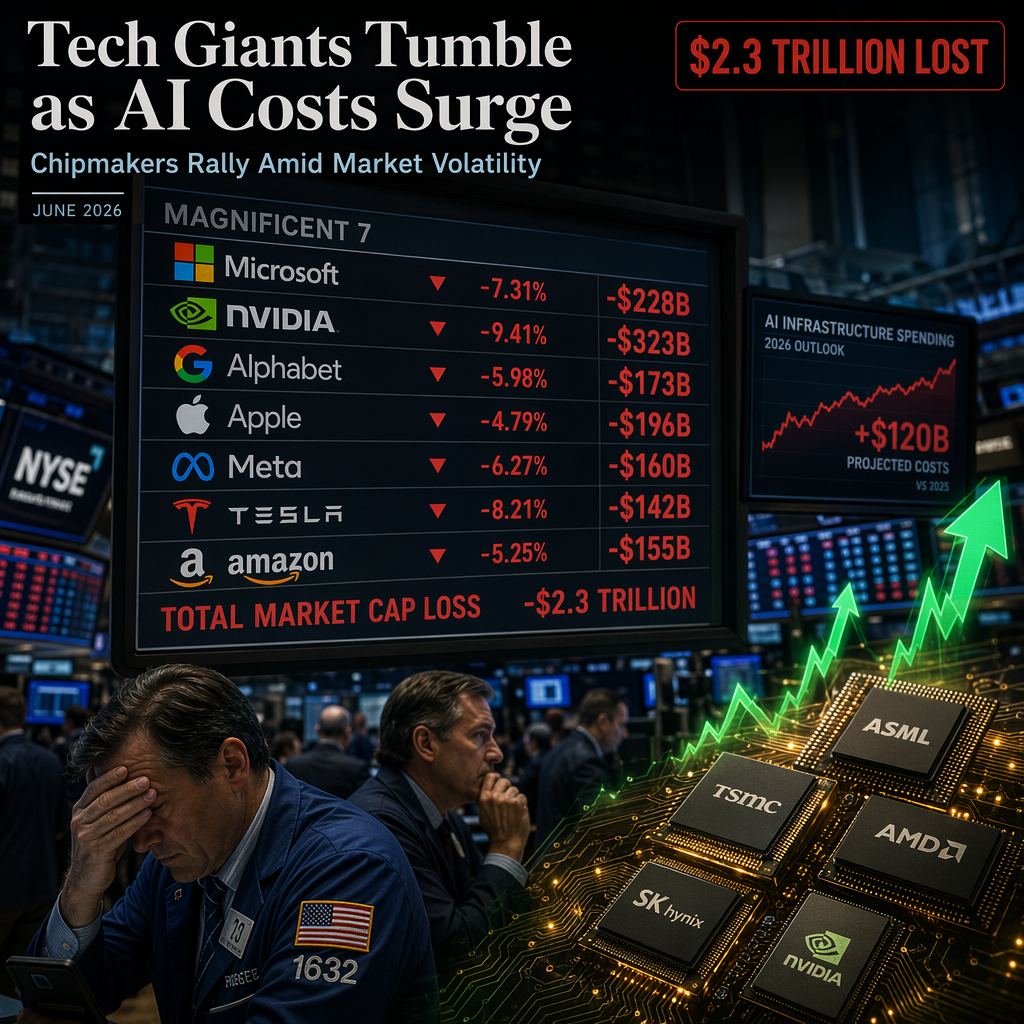
The Magnificent 7 tech stocks—Microsoft, Nvidia, Alphabet, Apple, Meta, Tesla, and Amazon—have collectively lost approximately $2.3 trillion in market value in June 2026, as investors grow increasingly concerned about the massive infrastructure spending required to support artificial intelligence (AI) initiatives [1]. The CNBC Magnificent 7 Index has dropped 10% so far this month, with Microsoft down 20%, Nvidia falling around 13%, and both Apple and Amazon declining by about 8% [1]. This sell-off is attributed to investor jitters over the high costs of AI buildouts, much of which is being financed through debt, and a shift in narrative as these companies transition from asset-light, high free cash flow models to more balance sheet-intensive operations [1].
Dan Ives, managing director at Wedbush Securities, described the current period as a 'gut check' for tech investors, emphasizing the importance of the upcoming second quarter earnings season in July to validate the AI-driven growth story [1]. Tom Lee, head of research at Fundstrat Global Advisors, noted that investors are reassessing the Magnificent 7, suggesting that the heavy balance sheet investments could eventually be seen as a competitive moat as AI replaces traditional human labor [1].
Despite the sell-off in the Magnificent 7, semiconductor stocks have performed strongly. The Philadelphia Semiconductor Index, which includes companies such as Taiwan Semiconductor Manufacturing Co., Micron, and ASML, is up around 6% in June and has surged more than 90% year-to-date, compared to a 3.4% decline for the Magnificent 7 [1]. Chipmakers have benefited from robust demand as Big Tech firms ramp up purchases of semiconductors, leading to supply shortages and price increases, particularly in memory components [1].
The market is closely watching the upcoming earnings season for further clarity on the returns from these massive AI investments, with ongoing volatility expected as investors weigh the costs and potential long-term benefits of the tech sector's transformation [1].
CONCLUSION
The Magnificent 7 have faced a significant market correction due to concerns over the costs of AI infrastructure spending, while chipmakers have emerged as beneficiaries of this trend. Investors are now focused on the upcoming earnings season to gauge whether these investments will deliver the anticipated returns and justify the current market volatility.