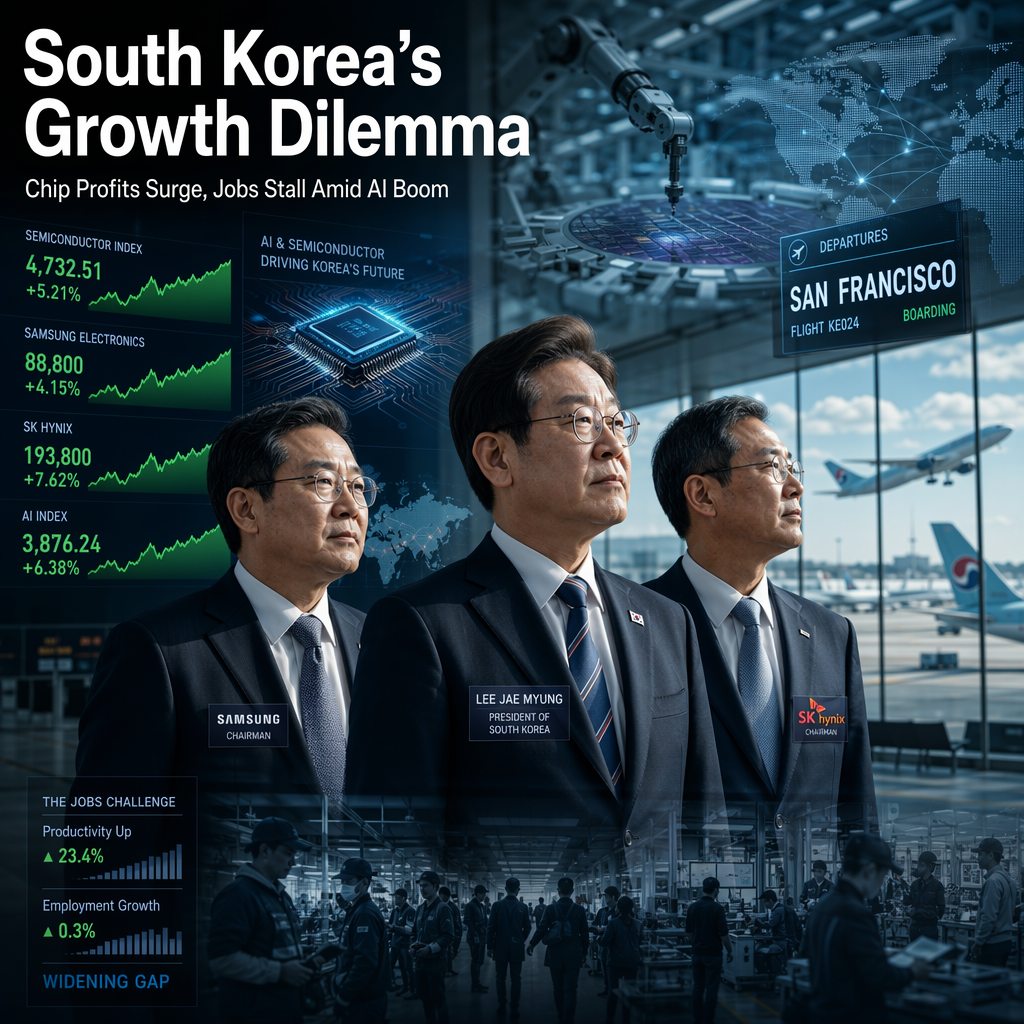
South Korea is facing a phenomenon described as 'growth without jobs,' as the country's chip industry experiences a surge in profits driven by global demand for semiconductors amid the AI investment boom [1]. Despite these gains, job creation in the sector has remained stagnant, largely due to automation and capital-intensive production processes [1]. President Lee Jae Myung is set to travel to San Francisco on July 24, accompanied by the chairmen of Samsung Electronics and SK Hynix, for meetings with global tech leaders [1].
The administration is considering the establishment of a permanent fund to share gains from the AI boom, aiming to ensure that the benefits of increased chip profits are distributed more broadly across the economy [1]. Market analysts note that while semiconductor exports have powered overall economic growth, employment in the sector has not kept pace, raising concerns about the sustainability and inclusiveness of South Korea's economic expansion [1].
President Lee is expected to discuss strategies to convert chip profits into sustainable job growth during his meetings in San Francisco, including the creation of the permanent fund to redistribute gains from the AI and chip sectors [1]. These discussions also aim to secure partnerships and investments that could further strengthen South Korea's position in the global semiconductor supply chain [1]. Policymakers continue to seek solutions that balance high-tech industry expansion with inclusive economic development, addressing the challenge of 'growth without jobs' [1].
CONCLUSION
South Korea's chip sector is enjoying robust profits amid the global AI investment boom, but job creation remains stagnant. President Lee's upcoming trip and policy initiatives signal a push for more inclusive economic gains and sustainable employment. The market impact is medium, as the outcome of these efforts could shape South Korea's role in the global semiconductor industry and its broader economic trajectory.