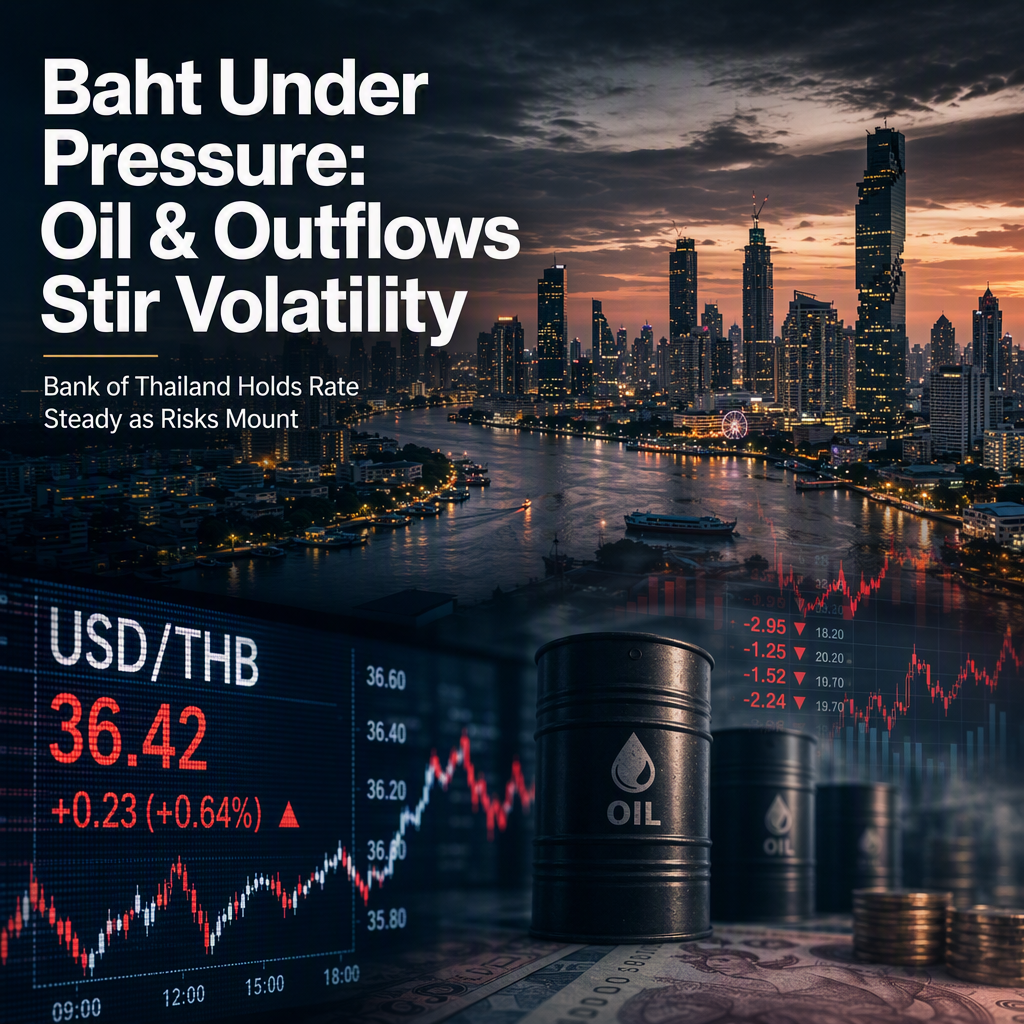
Commerzbank analysts report that the Bank of Thailand (BoT) is expected to maintain its benchmark policy rate at 1.0% during its next meeting on 26 August, viewing this level as sufficiently accommodative for the current economic environment [1]. The Thai Baht (THB) has faced renewed pressure due to rising global commodity prices, particularly oil, and ongoing foreign portfolio outflows, which are cited as downside risks for the currency [1].
The USD/THB exchange rate increased by 0.2% to 33.07 yesterday, reflecting these pressures. Despite this, the pair has retreated from its late-July high of 33.85 and has been consolidating within the 32.90–33.30 range over the past two weeks [1]. The BoT faces a challenging policy environment, as domestic demand remains soft and economic growth is below potential, while inflation—driven by earlier energy shocks—has risen. The central bank expects headline inflation to average 2.8% in 2026 and to remain above its 1-3% target range for part of the second half of the year before easing in 2027 [1].
Commerzbank notes that the inflation shock is largely supply-driven and that medium-term inflation expectations remain anchored, reducing the need for further monetary tightening. The BoT has indicated limited appetite for renewed easing unless there is a significant weakening in domestic activity, suggesting that the policy rate could remain unchanged for the rest of the year [1].
Looking forward, analysts warn that higher global commodity prices and continued foreign portfolio outflows could further weigh on the Thai Baht [1].
CONCLUSION
The Thai Baht faces ongoing pressure from rising commodity prices and foreign outflows, with the Bank of Thailand expected to keep its policy rate steady at 1.0%. Market participants should monitor commodity trends and capital flows, as these factors are likely to influence the Baht's stability in the coming months.