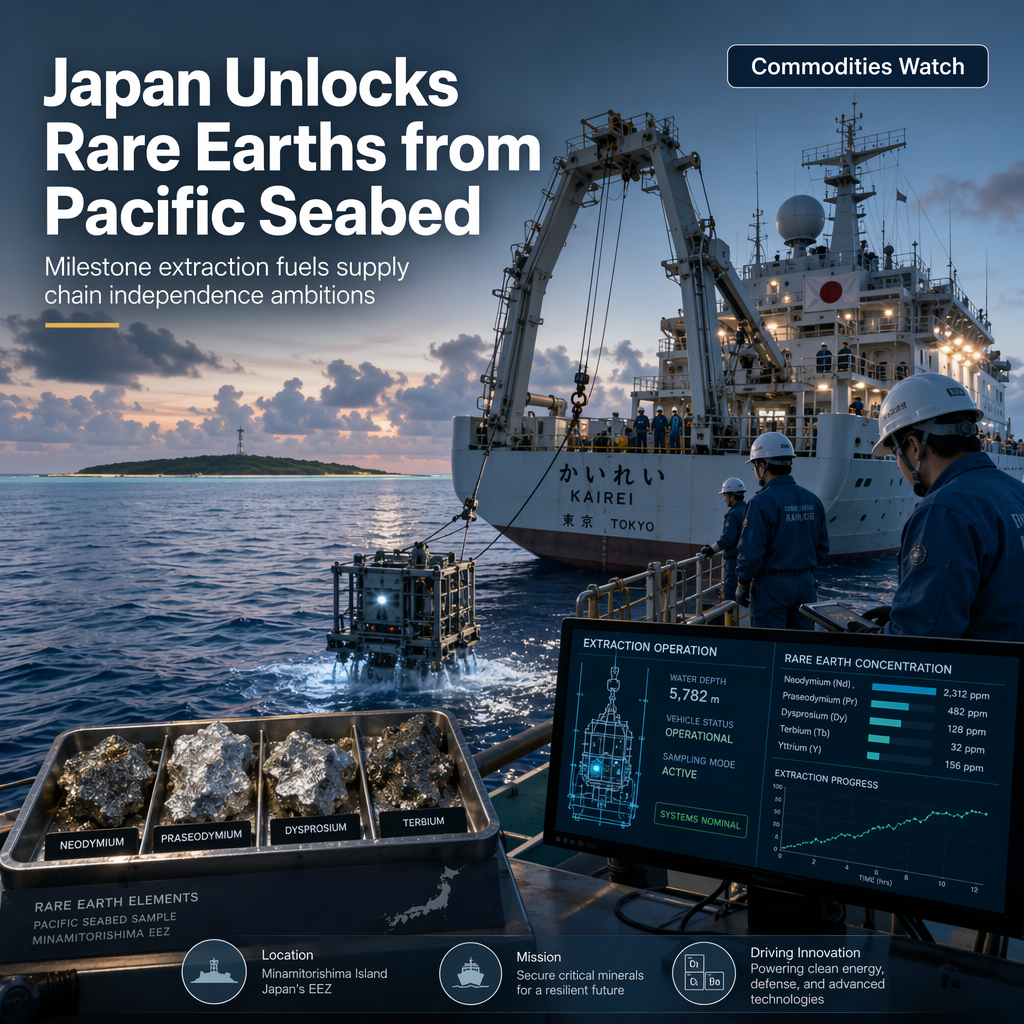
Japan has achieved a significant milestone by successfully recovering rare earth elements, including yttrium and dysprosium, from deep-sea mud off the coast of Minamitorishima, a remote Pacific island [1]. The mud retrieved from the seabed was found to be rich in these rare earths, which are essential for high-tech and industrial applications such as electronics, magnets, and batteries [1]. Currently, Japan is heavily dependent on imports from China for these materials, exposing its supply chain to geopolitical risks [1].
The discovery has heightened expectations for the deposits, with the potential to reshape Japan's rare earth supply chain and reduce reliance on China [1]. However, commercialization of seabed extraction faces significant hurdles. The process is currently too costly to effectively reduce dependence on Chinese imports, and there are uncertainties regarding sustainable production levels and environmental impact [1].
Despite these challenges, the market is closely monitoring developments. Any successful scale-up of seabed extraction could influence rare earth prices and global supply dynamics, making this a closely watched event in the commodities sector [1].
Japan's efforts to establish a stable and economically viable supply chain independent from China will require overcoming technical, economic, and environmental obstacles. The outcome could have broader implications for global rare earth markets and supply security [1].
CONCLUSION
Japan's successful extraction of rare earths from the Pacific seabed marks a promising step toward supply chain independence, but commercialization remains uncertain due to high costs and environmental concerns. The market is watching closely, as further progress could impact rare earth prices and global supply dynamics. For now, Japan's reliance on imports from China continues, pending resolution of these challenges.