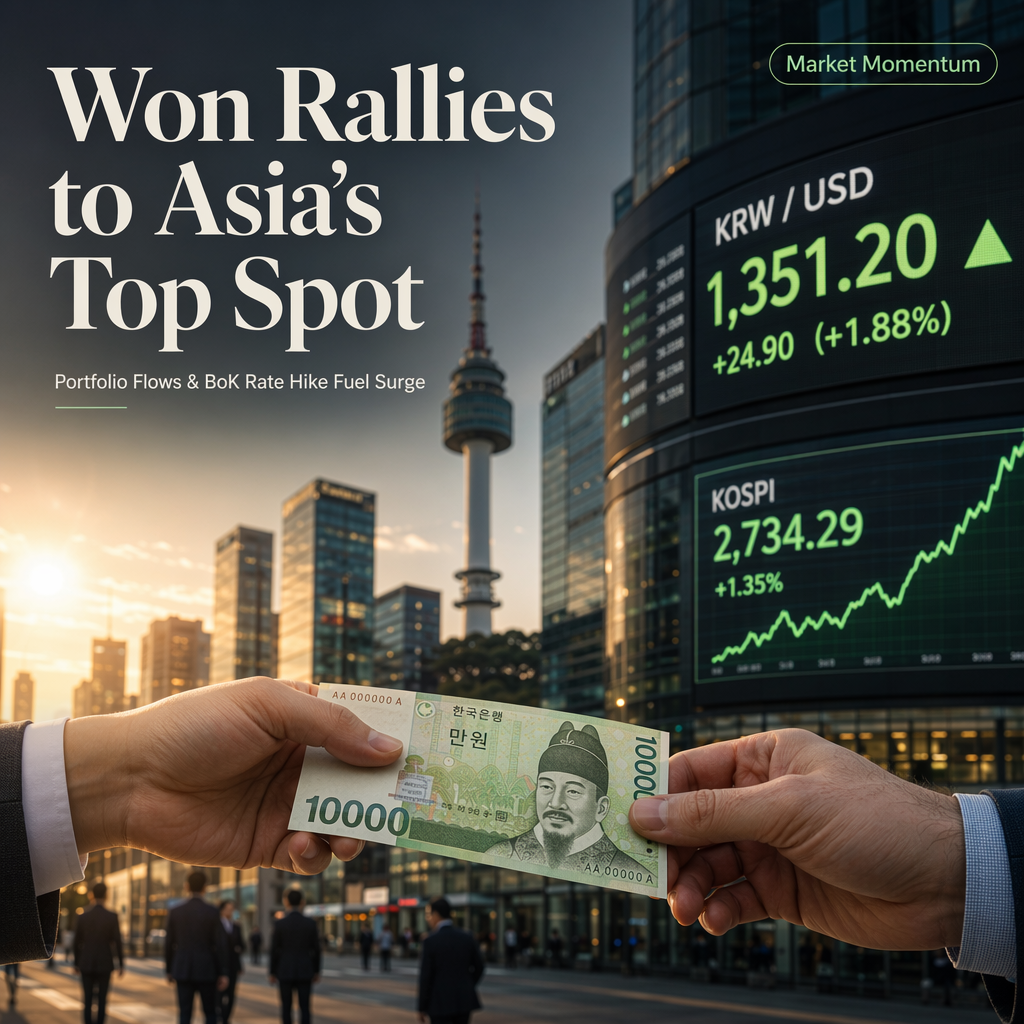
Societe Generale strategists report that the South Korean Won (KRW) has emerged as Asia's best-performing currency in early H2, appreciating nearly 2.8% as the USD/KRW exchange rate fell from around 1,550 to near 1,500. This rally is attributed to FX conversion flows linked to SK Hynix ADRs and growing expectations that the Bank of Korea (BoK) will raise its policy rate by 25 basis points to 2.75% next week Thursday [1].
The strategists highlight a shift in the KRW's FX regime, noting that portfolio flows now play a more significant role than trade balances. This shift has led to a stronger inverse correlation between the KRW and the KOSPI index, especially amid concerns about high valuations in semiconductor stocks such as Samsung and SK Hynix. Previously, the KOSPI's outperformance had pressured the KRW, as foreign investors reduced equity exposure to manage concentration risk. However, during recent equity corrections, the relationship has been less symmetrical, with KRW gains being driven by FX conversion flows associated with SK Hynix's ADR share [1].
The KRW's recent strength marks a reversal from the first half of the year, when it was among the region's weakest currencies alongside the Indonesian Rupiah (IDR), Thai Baht (THB), and Indian Rupee (INR), in contrast to the Chinese Yuan (CNY), which maintained resilience and safe haven status [1].
Market participants are closely watching the upcoming BoK policy meeting, with expectations of a 25bp rate hike providing additional support for the KRW. The combination of portfolio flows and monetary policy expectations has positioned the KRW as a standout performer in the Asian FX landscape [1].
CONCLUSION
The South Korean Won's rally is underpinned by robust portfolio flows and anticipation of a Bank of Korea rate hike. This marks a significant turnaround from its earlier underperformance in 2024, highlighting the growing influence of capital flows and monetary policy on the currency's trajectory.