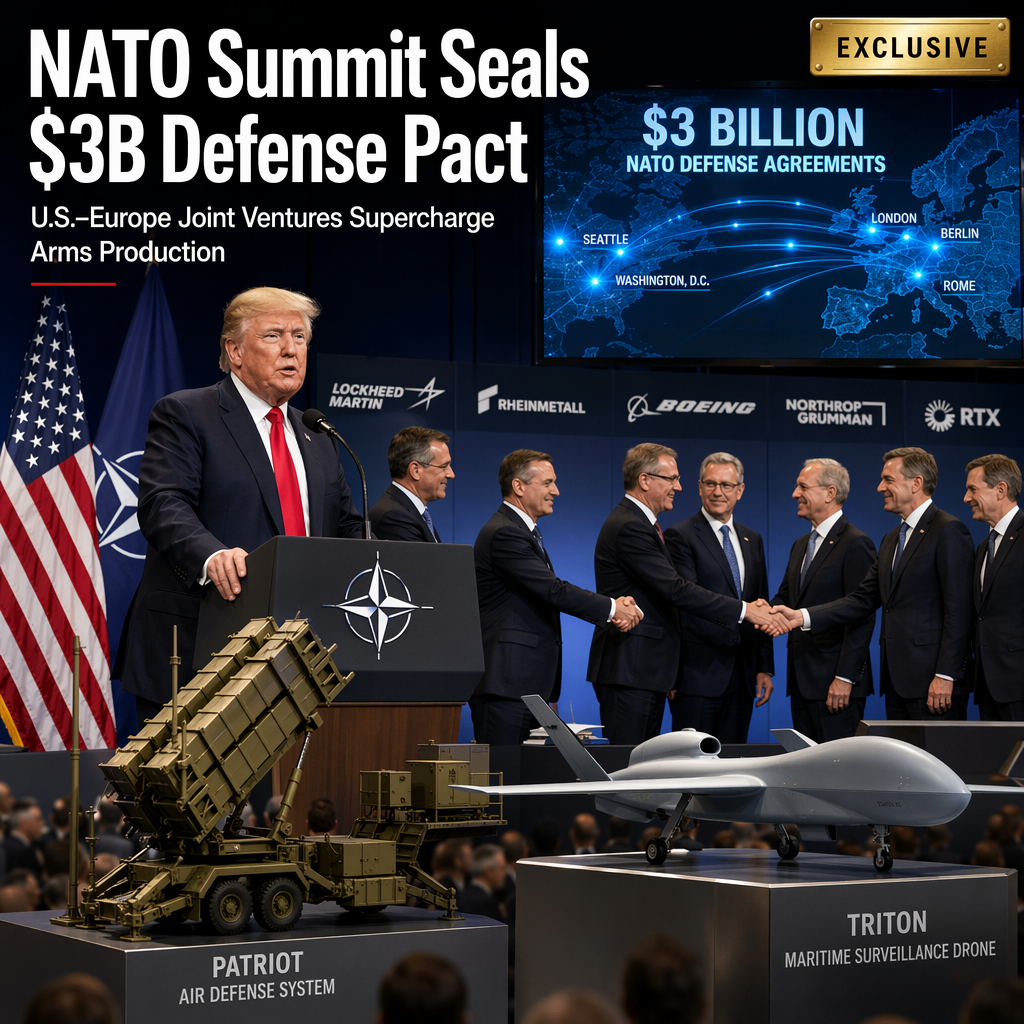
President Donald Trump concluded the annual NATO summit in Turkey with the announcement of $3 billion in deals and joint ventures between U.S. defense companies and America's European allies, according to a White House fact sheet released Thursday [1]. These agreements are part of the Trump administration's ongoing push for NATO members to increase their defense spending [1].
Lockheed Martin will establish a Patriot Advanced Capability-3 (PAC-3) missile sustainment facility in Europe, involving the U.S., Germany, the Netherlands, Poland, and Sweden. This facility will provide in-region maintenance for Patriot missiles, which have seen heavy use in Ukraine and the Middle East in recent years [1]. Additionally, Lockheed Martin will partner with German defense firm Rheinmetall to co-produce the Army Tactical Missile System (ATACMS) in Germany, with production expected to begin as early as next year after the expansion of Rheinmetall's Unterluess facility [1].
Four NATO member countries have signed a letter of interest to acquire Northrop Grumman's MQ-4C Triton maritime surveillance drone, which is similar to the RQ-4D Phoenix variant currently operated by NATO in Italy [1]. RTX (formerly Raytheon) will conduct a feasibility study with the U.S. Department of War to expand production of its Advanced Medium-Range Air-to-Air (AMRAAM) missile in Europe, aiming to make supply chains more resilient. RTX will also collaborate with European companies, including Diehl Defence and Dutch suppliers, to double production of Stinger missiles, which are used by 24 countries, including 10 NATO members [1].
Boeing is set to work with Rheinmetall-Italy on a potential partnership to expand production and sustainment of the Small Diameter Bomb for Europe [1]. These deals are expected to strengthen the defense industrial base on both sides of the Atlantic and address the high demand for advanced weaponry among NATO allies, particularly in light of recent conflicts [1].
CONCLUSION
The $3 billion in new deals and joint ventures secured at the NATO summit mark a significant boost for U.S. defense companies and their European partners. These agreements are poised to enhance NATO's military capabilities and strengthen transatlantic defense supply chains, reflecting increased commitment to collective security.