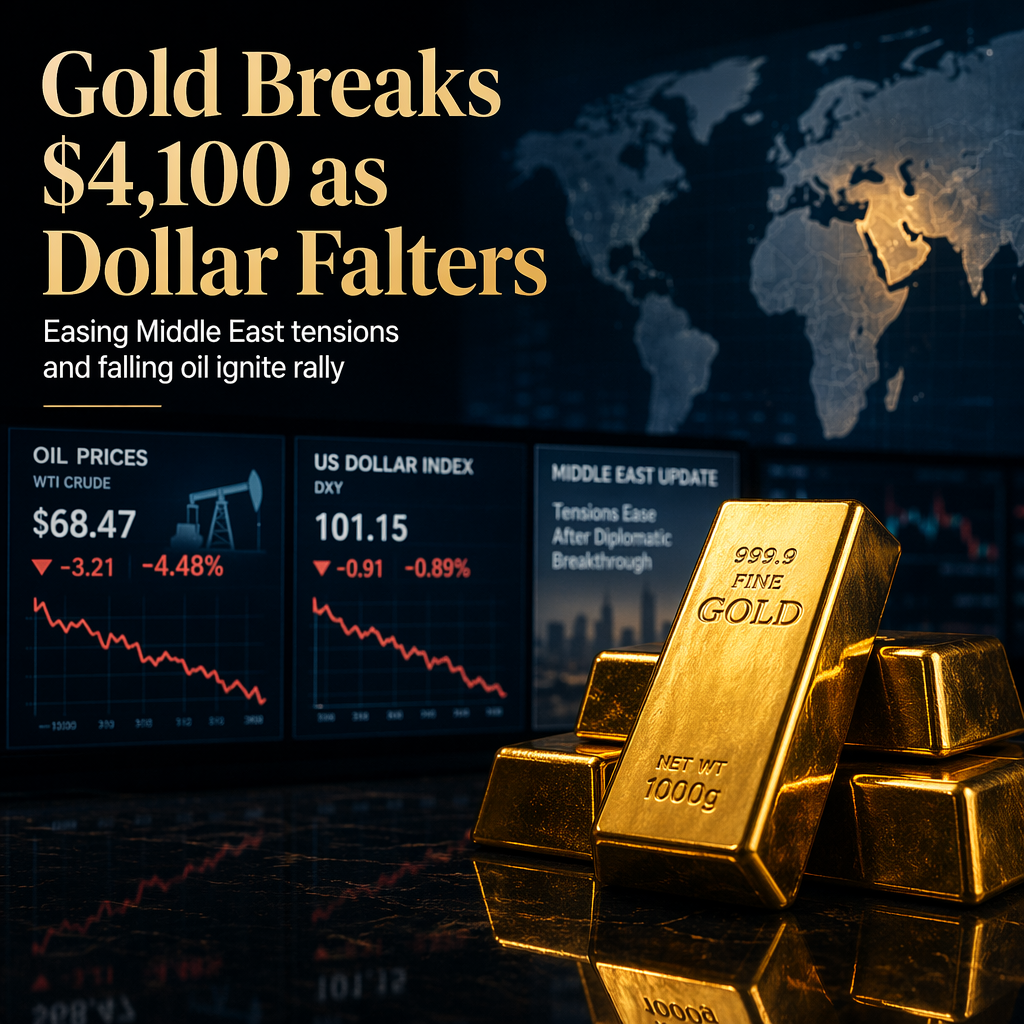
Gold (XAU/USD) rebounded sharply during the North American session on Thursday, climbing over 1.30% to trade at $4,132 after recovering from weekly lows of around $4,021 seen on Wednesday [1]. This move was driven by a retreat in the US Dollar, which weakened as Oil prices fell amid easing tensions in the Middle East. The US-Iran conflict had previously pushed West Texas Intermediate (WTI) Oil above $75.00 per barrel, but prices pulled back on Thursday, reducing pressure on the Dollar [1].
The decline in energy prices has led to speculation that the Federal Reserve might raise borrowing costs to address inflation, which was reported at nearly 4.2% in May [1]. Market participants are now focused on upcoming US economic data releases next week, including the Consumer Price Index (CPI), Producer Price Index (PPI), jobless claims, and housing data, as well as Fed Chair Kevin Warsh's testimony before Congress [1].
According to the latest Fed meeting minutes, the central bank remains slightly hawkish, with most officials seeing a scenario for a rate hike but opting to hold rates steady for now. Money markets are currently pricing in a 62% probability of a 25-basis-point rate hike at the September meeting, as per Prime Terminal data [1]. New York Fed President John Williams emphasized that inflation remains "far too high" and highlighted the importance of energy prices in shaping monetary policy, reiterating the Fed's commitment to bringing inflation down to 2% [1].
Falling US Treasury yields, with the 10-year note down five basis points at 4.529%, have also supported Gold prices by weighing on the Greenback. The US Dollar Index (DXY) is down 0.21% to 100.85, near its weekly low of 100.78 [1]. HSBC revised its average Gold price forecasts for 2026 and 2027 downward to $4,560 and $4,925, respectively, from previous estimates of $4,864 and $5,000 [1]. Despite the recent recovery, Gold remains bearishly biased in the short term, though it posted a two-day peak at $4,138 [1].
CONCLUSION
Gold's rebound above $4,100 was fueled by a weaker US Dollar and falling Oil prices as Middle East tensions eased. While the market anticipates key US economic data and a possible Fed rate hike in September, Gold remains under a bearish bias in the short term, with HSBC lowering its long-term price forecasts. Investors are closely watching upcoming inflation data and Fed communications for further direction.