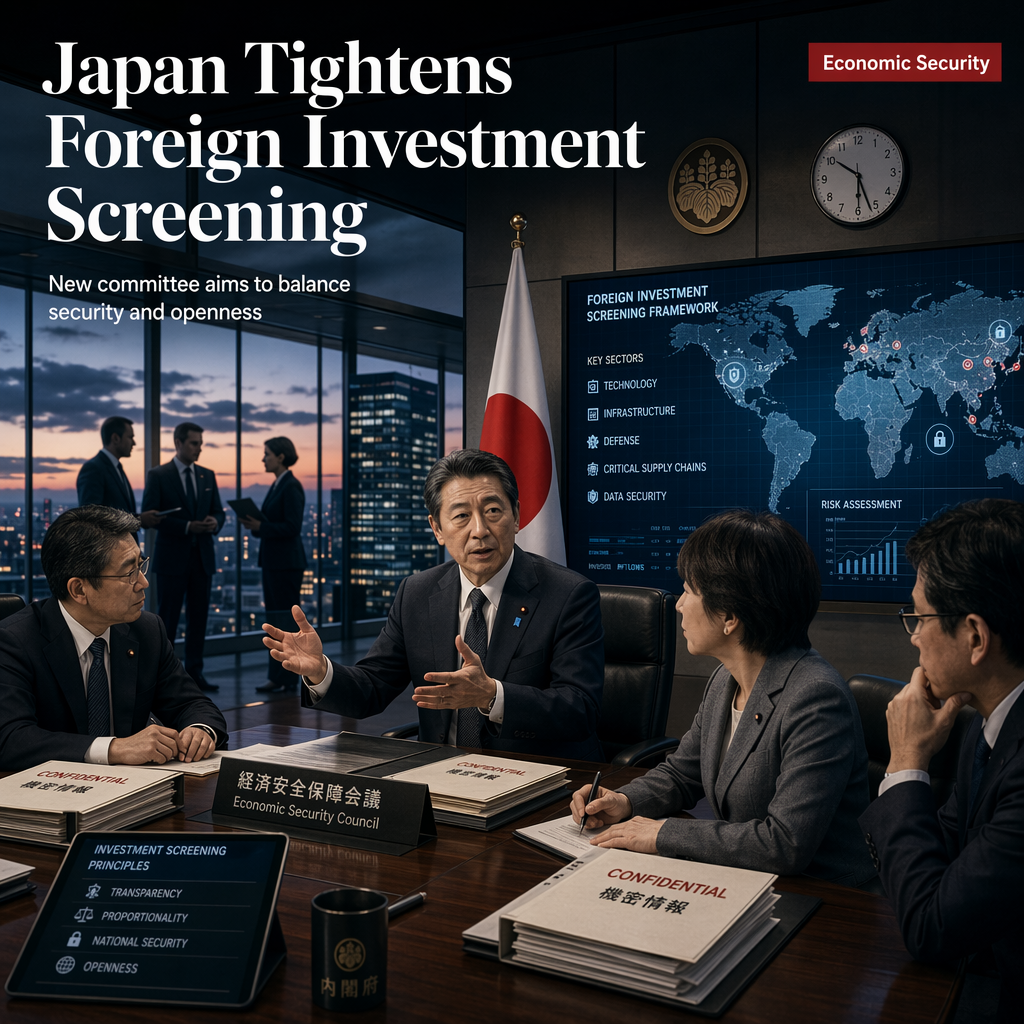
Japan has launched the Japan Foreign Investment Committee, a cross-ministerial body designed to prescreen foreign investments and enhance oversight against economic security risks [1]. The committee will review proposed foreign investments for potential threats to national security and sensitive industries, mirroring the approach of the Committee on Foreign Investment in the United States (CFIUS) [1]. The panel's formation is part of Japan's broader efforts to protect key sectors such as advanced technology, infrastructure, and defense from potentially harmful foreign influence [1].
Finance Minister Satsuki Katayama emphasized the importance of economic security, stating, 'Strengthening our economic security is a top priority. The Japan Foreign Investment Committee will play a pivotal role in protecting our nation's interests while maintaining openness to beneficial foreign investment' [1]. The committee is tasked with reviewing both direct and indirect foreign investment proposals, assessing their impact on critical assets and supply chains [1]. Evaluation criteria include the origin of the investor, the nature of the target asset, and the potential for technology transfer [1].
Market analysts have observed that the new panel may result in increased scrutiny of mergers and acquisitions involving foreign entities, particularly in sectors vital to economic and national security [1]. This could mean additional regulatory hurdles for investors considering deals in Japan [1]. The establishment of the committee follows recent legislative reforms, including tougher foreign investment laws, reflecting Japan's intent to balance economic openness with the need to mitigate security threats in the global investment environment [1].
CONCLUSION
Japan's creation of the Japan Foreign Investment Committee marks a significant step in tightening oversight of foreign investments, especially in sensitive sectors. While the move aims to bolster economic security, it may introduce new regulatory challenges for foreign investors and impact future cross-border deals.