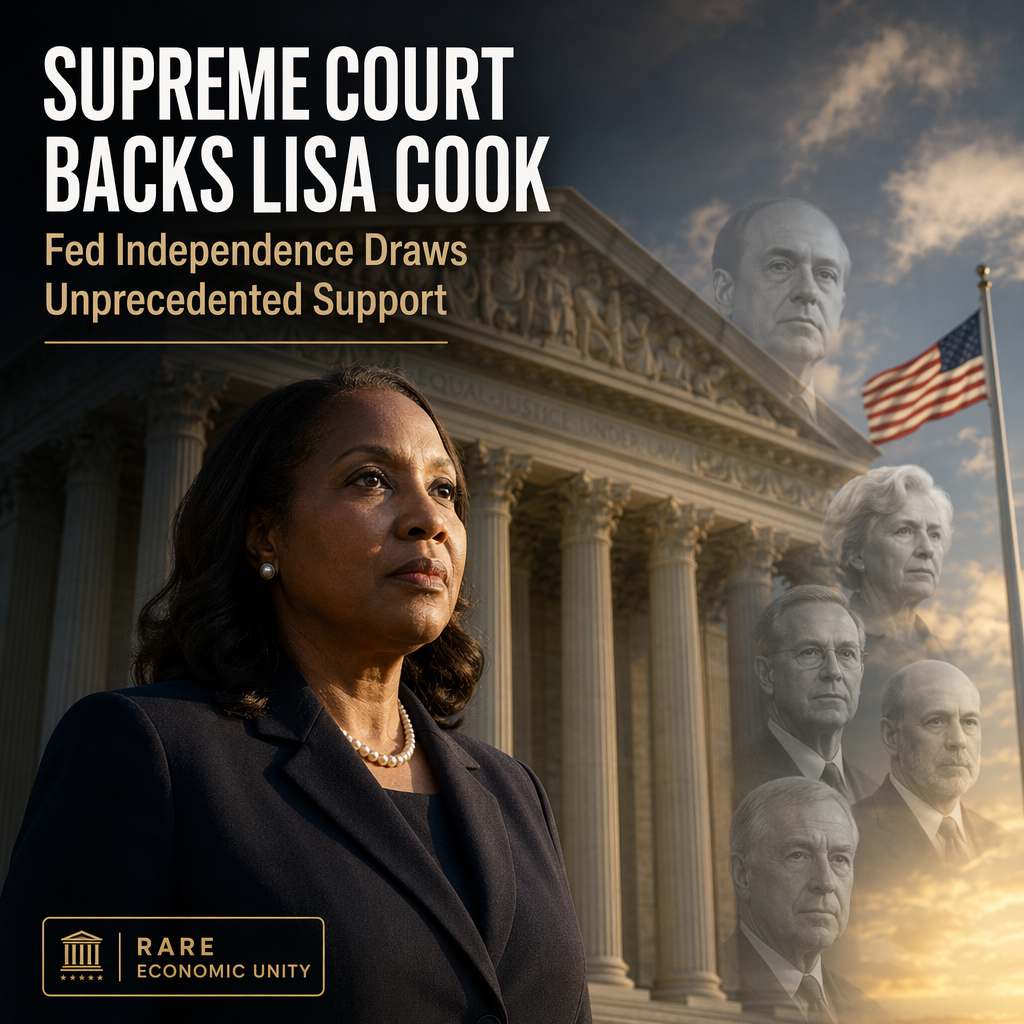
The Supreme Court, in a narrow 5-4 decision, ruled that Lisa Cook, a top official at the Federal Reserve, can remain in her position while her legal challenge to President Donald Trump's attempt to remove her proceeds through the courts [1]. This case has become a significant test of the legal protections that have historically insulated the Federal Reserve from direct political influence [1].
The case prompted an extraordinary amicus brief, a type of court filing by non-parties, from a group of prominent economists and former government officials. The brief was signed by every living former chair of the Federal Reserve—Alan Greenspan, Ben Bernanke, and Janet Yellen—as well as six former Treasury secretaries from both political parties and seven former White House economic advisors, representing about five decades of U.S. economic policy leadership [1]. Such a collective intervention is highly unusual, as these figures typically avoid public legal disputes [1].
In their 32-page brief, the group argued that permitting the president to remove a sitting Fed governor would "erode public confidence in the Fed’s independence and threaten the long-term stability of the economy" [1]. They warned that expanding presidential power over the Federal Reserve Board could weaken the central bank’s independence, potentially leading to higher inflation and economic instability—a concern they stated is already manifesting in real time [1]. The brief emphasized that financial markets, the public, employers, and lenders are closely monitoring the dispute to assess the credibility of the Fed moving forward [1].
Solicitor General D. John Sauer countered that the amicus brief focused on policy arguments rather than the core legal issues of the case, asserting that "policy preferences are not the law, and these particular preferences lack any logical limit" [1].
CONCLUSION
The Supreme Court's decision to allow Lisa Cook to remain at the Federal Reserve during her legal challenge underscores the high stakes surrounding the central bank's independence. The rare intervention by former Fed chairs and Treasury secretaries highlights widespread concern over potential threats to the Fed's autonomy and the stability of U.S. monetary policy.