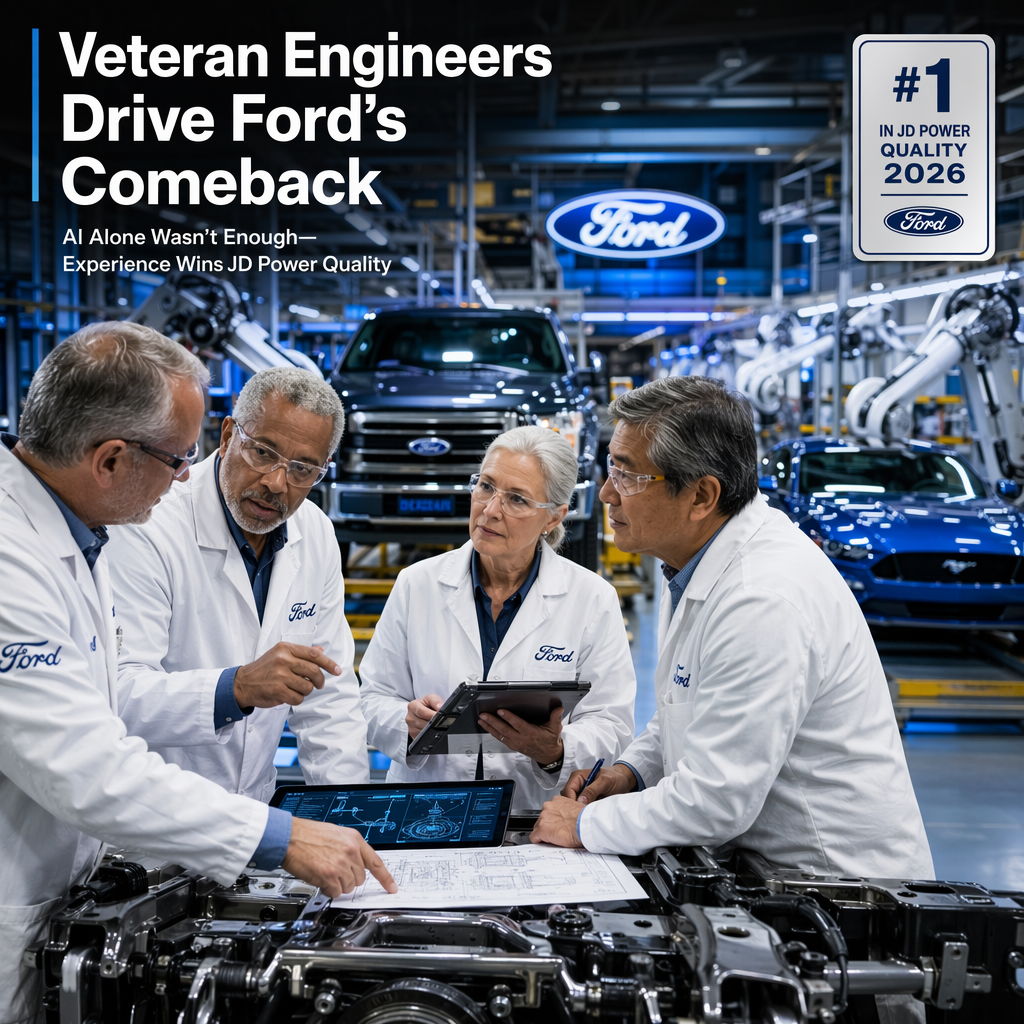
Ford Motor Company has rehired approximately 300 experienced engineers to address shortcomings in its artificial intelligence (AI) tools used for improving production quality. This strategic move follows the realization that AI alone was insufficient to resolve quality issues in the automaker's production processes, as the technology lacked the training and expertise possessed by veteran technicians who had previously left the company before their knowledge could be leveraged to enhance AI performance [1].
Charles Poon, Ford's vice president of vehicle hardware engineering, emphasized that AI is only as effective as the information used to train it, and acknowledged that the company had not adequately valued the experience of its most knowledgeable engineers in recent years. The rehired engineers now serve as internal auditors, conducting mandatory weekly design reviews to identify and eliminate potential failure points before designs reach the factory floor [1].
This initiative has contributed to Ford topping the JD Power 2026 U.S. Initial Quality Study (IQS) for the first time since 2010, with the Ford F-150, Ford Mustang, and Ford Super Duty ranking at the top of their respective segments for the second consecutive year. Other models, including the Ford Escape, Ford Explorer, Ford Expedition, and Ford Maverick, also ranked among the top three in their segments [1].
Ford CEO Jim Farley stated that the shift towards leveraging experienced engineers is improving the company's financial performance by reducing spending on warranty coverage and recalls, leading to cost reductions. Chief Operating Officer Kumar Galhotra highlighted that these engineers and technical specialists are central to Ford's efforts to enhance production quality by addressing process issues before they are integrated into workflows [1].
CONCLUSION
Ford's decision to rehire veteran engineers after AI tools failed to meet quality improvement goals has resulted in significant gains, including topping the JD Power 2026 IQS and reducing warranty and recall costs. The move underscores the continued importance of human expertise in automotive manufacturing and has had a positive impact on Ford's operational and financial performance.