
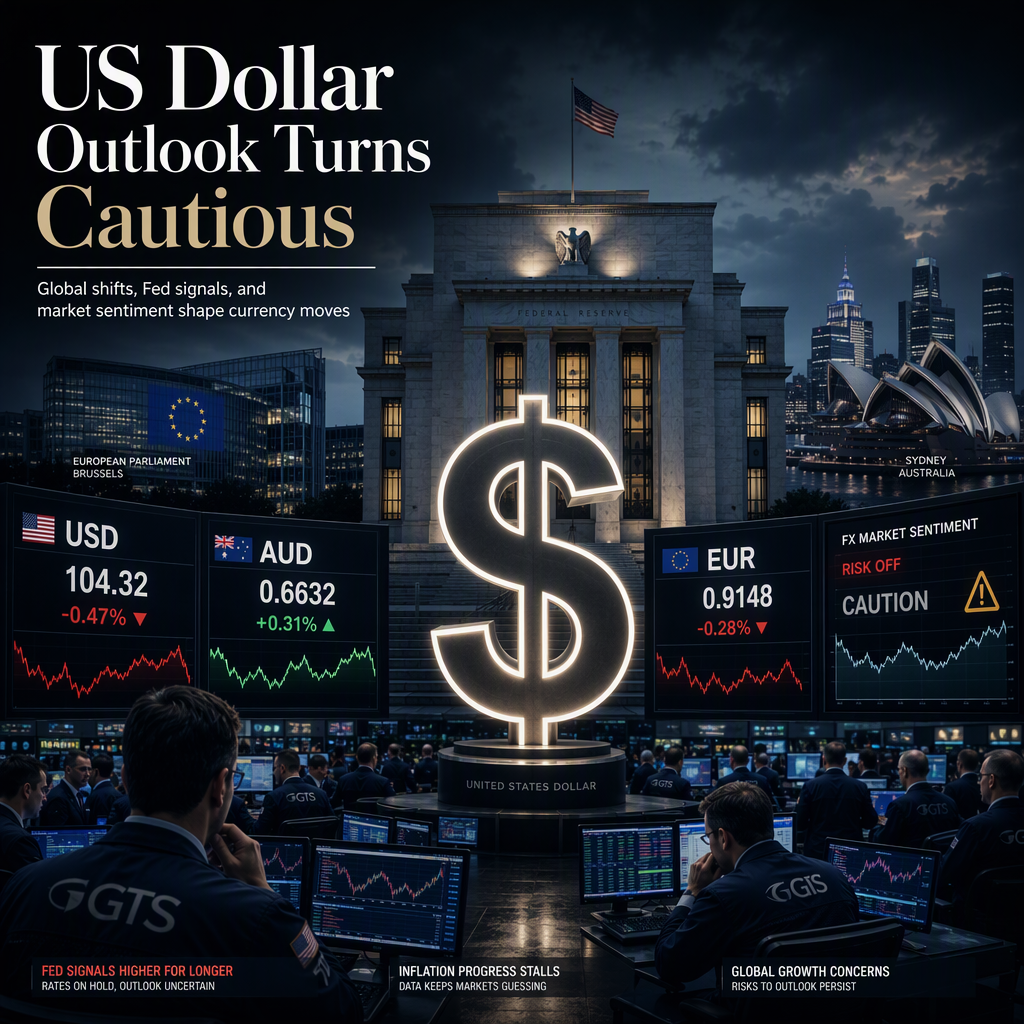
Recent analyses from major financial institutions highlight a nuanced outlook for the US Dollar (USD) against key global currencies, reflecting evolving economic and political factors. OCBC Bank strategists note that while the USD continues to benefit from the US economy's strong exposure to the technology and AI sectors, which have supported growth and productivity, they are increasingly cautious about the potential for further near-term gains. This caution is attributed to softer US labor market data, a more patient and data-dependent Federal Reserve (Fed) stance, and already tight financial conditions. Markets are currently pricing in slightly more than three Fed rate hikes over the next 12 months, a view OCBC considers aggressive given signs of labor market moderation. Should upcoming inflation data confirm contained price pressures, investors may scale back expectations for additional Fed tightening, potentially reducing support for the USD. Furthermore, higher long-term Treasury yields have already tightened financial conditions, lessening the need for further significant Fed hikes [1].
In the currency markets, the Australian Dollar (AUD) has shown tentative gains against the USD, with UOB strategists describing the recent move as a tentative recovery rather than a sustained advance. The AUD closed 0.30% higher at 0.6972 and subsequently edged up to 0.6990 before settling at 0.6984 (+0.18%). UOB expects the AUD to trade within a narrow range of 0.6965/0.6995 in the short term and between 0.6935 and 0.7020 over the next 1–3 weeks, maintaining a neutral outlook [2].
Meanwhile, the Euro (EUR) faces downside risks against the USD, according to MUFG. The sharp widening of the OAT/Bund spread to 150 basis points last week was seen as overdone, with French bonds now retracing from oversold levels as global fixed income selling eases. Political developments in France, particularly Marine Le Pen’s aggressive fiscal consolidation proposals, are viewed as unlikely to materially alter OAT risk ahead of next year’s election. With 56% of French sovereign bonds held by foreign investors, global fixed income sentiment remains a key driver of the OAT/Bund spread. MUFG expects EUR/USD downside risks to persist [3].
Overall, the USD's near-term trajectory is being shaped by a combination of domestic monetary policy signals, global risk sentiment, and political developments in major economies. While structural supports for the USD remain, the outlook is clouded by cautious central bank guidance and shifting investor expectations.
CONCLUSION
The US Dollar retains structural support from the US economy’s technology and AI sectors, but near-term upside appears limited due to evolving Fed policy expectations and tighter financial conditions. The Australian Dollar is expected to consolidate within a narrow range, while the Euro faces continued downside risks amid political uncertainty and bond market volatility. Market participants are likely to remain attentive to upcoming economic data and central bank communications for further direction.