
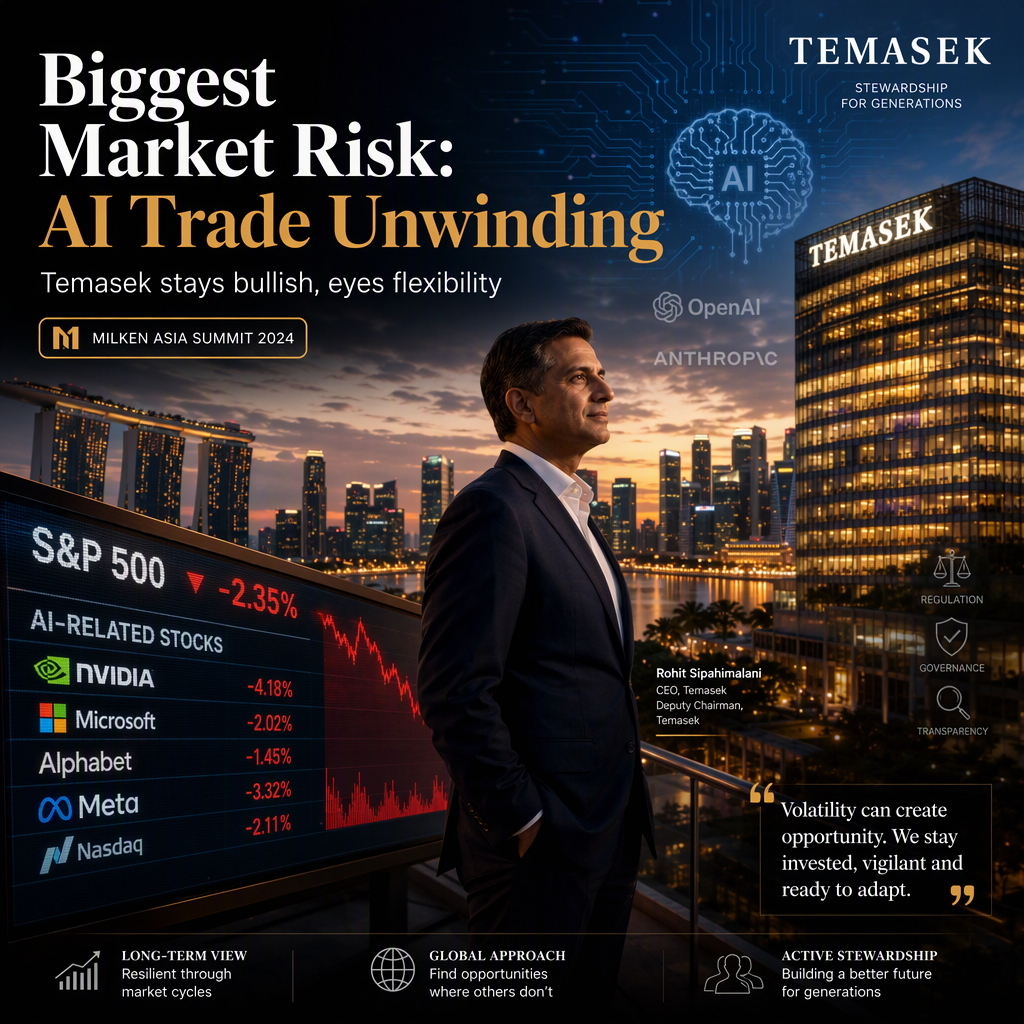
Singapore's state-owned investment firm Temasek has identified the potential unwinding of the artificial intelligence (AI) trade as the biggest risk currently facing markets, according to Chief Investment Officer Rohit Sipahimalani. Speaking at the Milken Institute Asia Summit in Singapore, Sipahimalani emphasized that while such a reversal is not seen as imminent, market volatility could arise as soon as 2027 [1].
Sipahimalani highlighted that AI has been a key driver keeping U.S. stocks, particularly the S&P 500, near record highs despite rising Treasury yields. He noted that the earnings strength of major AI-linked companies has supported the index, but cautioned that this resilience is concentrated among a small group of winners. Specifically, he pointed out that about half the stocks in the Russell 3000 are at least 20% below their June highs, underscoring underlying market weakness masked by index-level performance [1].
A reversal in the AI trade could be triggered by factors such as increased regulatory scrutiny due to safety concerns or evidence that customers are not achieving sufficient returns from their AI investments, Sipahimalani said. Despite these risks, Temasek remains bullish on AI over the long term and continues to increase its investments in the sector. Currently, about half of Temasek's AI exposure is in publicly traded assets, with plans to raise this proportion to 70-75% to allow for greater flexibility in adjusting investments as the industry evolves [1].
Temasek has also invested in private AI model developers such as OpenAI and Anthropic, though Sipahimalani noted that the size of these exposures is smaller compared to areas where the firm has more flexibility. He stressed the importance of being able to pivot quickly in the fast-changing AI environment [1].
CONCLUSION
Temasek sees the potential unwinding of the AI trade as the most significant risk to markets, though it remains optimistic about the sector's long-term prospects. The firm is increasing its exposure to publicly traded AI assets to enhance investment flexibility amid a rapidly evolving industry landscape.