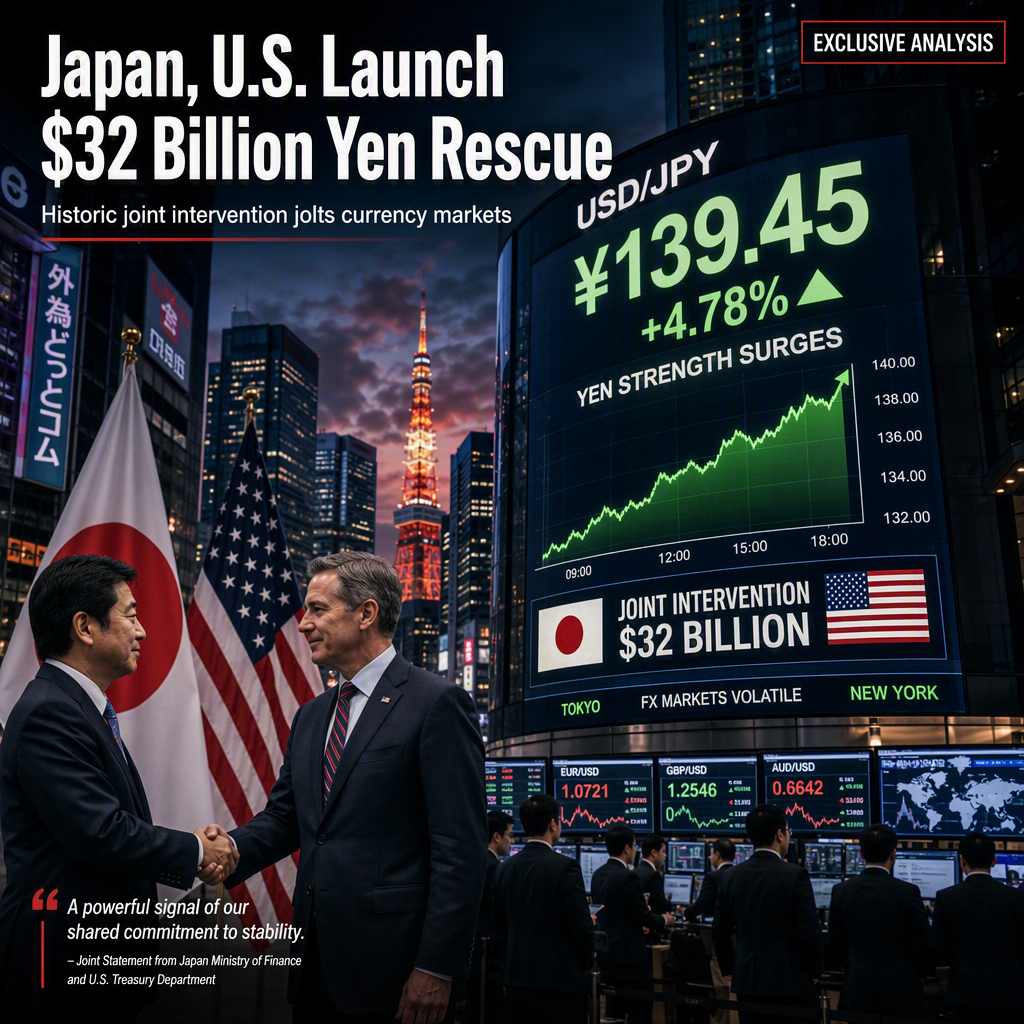
Japan, in coordination with U.S. authorities, intervened in the foreign exchange market on Friday, spending approximately $31.8 billion to buy yen, according to preliminary Bank of Japan money market data [1]. This intervention, which included the U.S. selling euros for yen, marked the first joint action between Japan and the U.S. since March 18, 2011 [1][2]. The yen surged from about 160 to the dollar to the 158 range around 6 p.m. on July 31 in Japan following the intervention [1]. According to MUFG’s Lee Hardman, Japanese Finance Minister Katayama confirmed the joint intervention, justifying it as a response to excessive volatility and disorderly movement in the yen in recent months [2]. Katayama also emphasized that Japan 'will not hesitate to conduct further joint intervention' if necessary [2]. The intervention was further supported by plans to utilize the Federal Reserve’s FIMA Repo Facility, which allows Japan to access up to $60 billion per day without selling Treasuries for up to seven days [2]. Hardman noted that the threat of further joint intervention and the possibility of a faster pace of Bank of Japan rate hikes could provide additional support for the yen and discourage speculative short positions [2]. Market reactions were immediate, with the yen strengthening by about 5% before paring gains on Monday, settling at 157 to the dollar from just above 163, its lowest level in four decades [3]. However, analysts remain skeptical about the sustainability of the yen's rebound. HSBC and UBS strategists highlighted that the yen's fundamentals remain weak, and a structural shift in Bank of Japan policy would be necessary for a sustained rally [3]. HSBC analysts stated, 'Unless we see much faster BoJ rate hikes, and the government taking a clearer stand on the JPY... we still lack confidence in projecting a downtrend for USD-JPY' [3]. There was also market surprise and some skepticism regarding the U.S. selling euros instead of dollars to buy yen, as this diverges from traditional intervention methods and may raise questions about the efficacy of U.S. participation [3]. ING's Chris Turner noted that the dollar's resilience is likely due to uncertainty over future Federal Reserve rate hikes [3]. While MUFG’s Hardman expressed confidence that the yen is in the process of bottoming out, other analysts, including Robin Brooks of the Peterson Institute, warned that the intervention could ultimately weaken confidence in the yen if not backed by more decisive policy changes [2][3].
CONCLUSION
Japan and the U.S. executed a significant joint intervention, spending nearly $32 billion to support the yen, resulting in a sharp but short-lived appreciation. While authorities signaled readiness for further action and analysts at MUFG see potential for a yen bottom, broader market sentiment remains cautious, with many experts doubting the sustainability of gains without deeper policy shifts from the Bank of Japan.