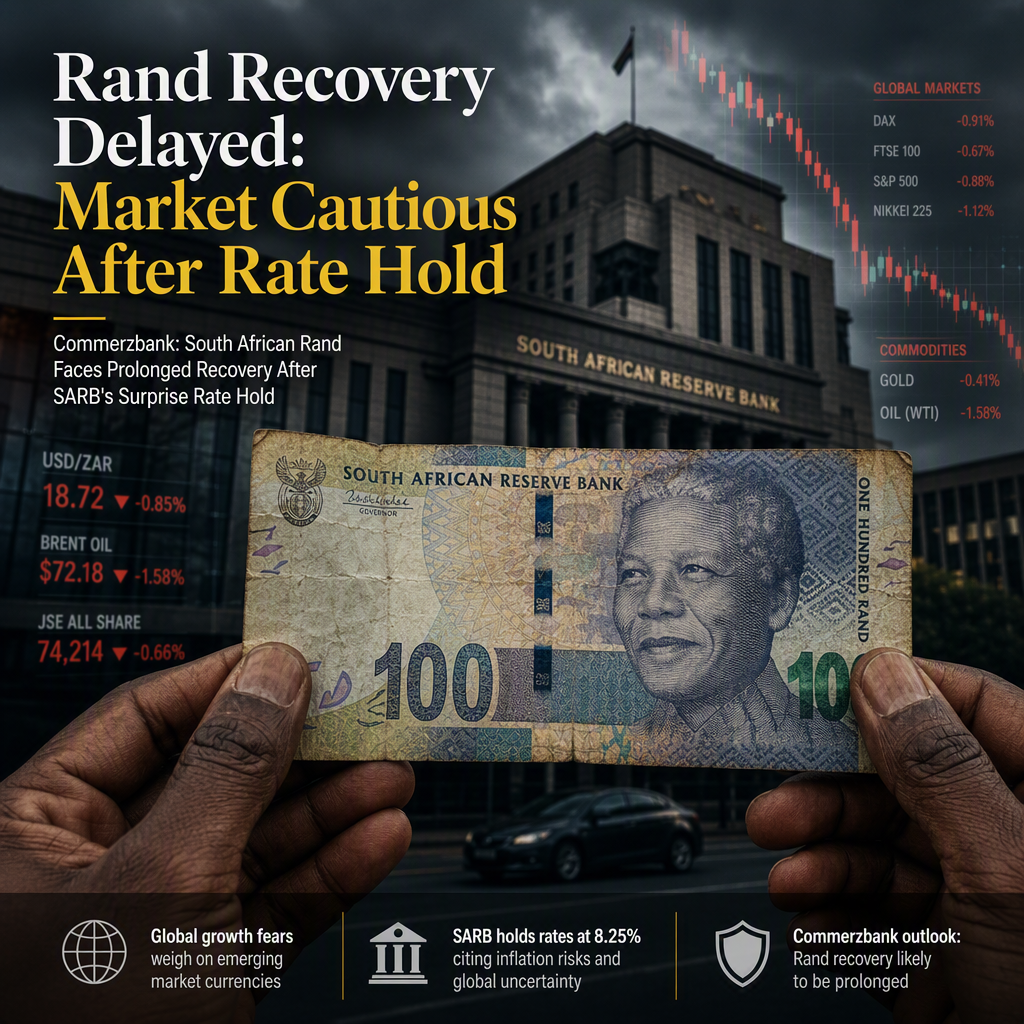
Commerzbank's Volkmar Baur has analyzed the outlook for the South African Rand (ZAR) following the South African Reserve Bank's (SARB) unexpected decision in July to hold interest rates steady, despite rising inflation and deteriorating terms of trade. Baur describes the rate hold as a mistake, suggesting it signals to markets that the SARB is not taking inflation risks seriously enough. As a result, he expects the foreign exchange market to demand a risk premium in the coming weeks, which will likely weaken the rand further [1].
Baur outlines three main scenarios for the rand's recovery. In the first scenario, the SARB is proven correct and inflation does not rise further despite ongoing geopolitical tensions and high oil prices, leading to a potential near-term recovery for the rand. The second scenario involves a resolution to the Iran conflict and a subsequent drop in oil prices, which would also support the rand, though a risk premium would persist due to lingering doubts about the SARB's credibility. The third scenario sees the Iran conflict continuing and oil prices remaining elevated, prompting the SARB to eventually reverse its stance and raise rates. While high energy prices would continue to weigh on the rand, the central bank could gradually rebuild market confidence over time [1].
Baur also notes the possibility, though he considers it highly unlikely, that the SARB might refrain from further rate hikes even if inflationary pressures persist. In this case, the rand would come under significant pressure. Across all but the most optimistic scenarios, Baur emphasizes that any recovery in the rand is likely to be slow, as market trust is difficult to regain once lost [1].
CONCLUSION
Commerzbank sees the South African Rand facing a challenging path to recovery after the SARB's surprise rate hold, with market sentiment likely to remain cautious. The outlook depends heavily on inflation trends, geopolitical developments, and the central bank's future actions, but even in positive scenarios, a swift rebound for the rand is unlikely.