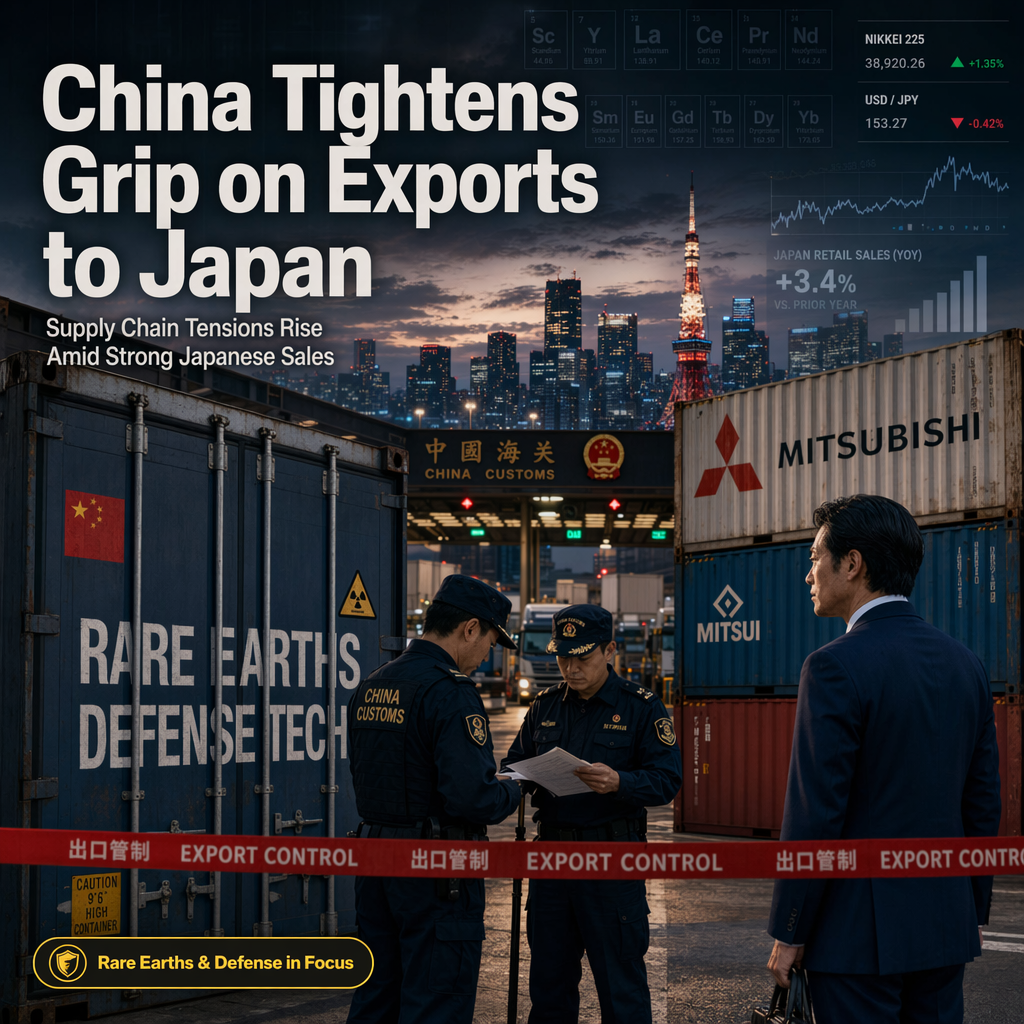
China has expanded its export control list to include more Japanese entities, escalating supply chain risks for sectors such as defense and rare earths, according to BNY’s Geoff Yu [1]. On Monday, the Chinese Ministry of Commerce blacklisted 20 Japanese organizations and placed another 20 under closer monitoring, banning Chinese exports with commercial or military uses to these firms and restricting overseas entities from supplying Japanese companies with dual-use technology originating in China [1]. The targeted entities include defense-related institutes, Mitsubishi units, Mitsui E and S, and Japan Nuclear Fuel. Beijing cited Japan's remilitarization as the reason for these measures, a claim Tokyo has rejected. These actions heighten supply chain risks, particularly for rare earths and defense manufacturing, and are linked to ongoing tensions over Taiwan [1].
Despite these geopolitical tensions, Japanese commercial sales showed robust growth in May, reaching ¥52.549 trillion, up 5.0% year-on-year and 1.4% month-on-month on a seasonally adjusted basis [1]. Wholesale sales increased by 4.9% to ¥39.102 trillion, led by gains in mineral and metal materials, agricultural and marine products, machinery, and chemicals, while pharmaceuticals and building materials declined [1]. Retail sales rose 5.3% to ¥13.447 trillion, with broad-based growth across automobiles, machinery, department stores, supermarkets, convenience stores, drugstores, home centers, and large home appliance retailers [1].
Market reactions were mixed: the Nikkei rose 0.15% to 69,468, while USD/JPY edged up 0.075% to 161.86, and the 10-year JGB yield increased by 1.9 basis points to 2.64% [1]. Despite supportive domestic and geopolitical data, iFlow data indicated persistent JPY outflows and negative scored holdings, suggesting ongoing bearish positioning in the yen [1]. USD and NZD attracted inflows, while CAD, JPY, and NOK saw outflows [1].
CONCLUSION
China's expanded export controls on Japanese firms have intensified supply chain risks, particularly for defense and rare earth sectors, even as Japan reported strong commercial sales growth in May. Despite positive domestic data, market positioning remains bearish on the yen, with continued outflows and negative sentiment. The situation underscores ongoing geopolitical tensions and their complex impact on Japanese markets.