
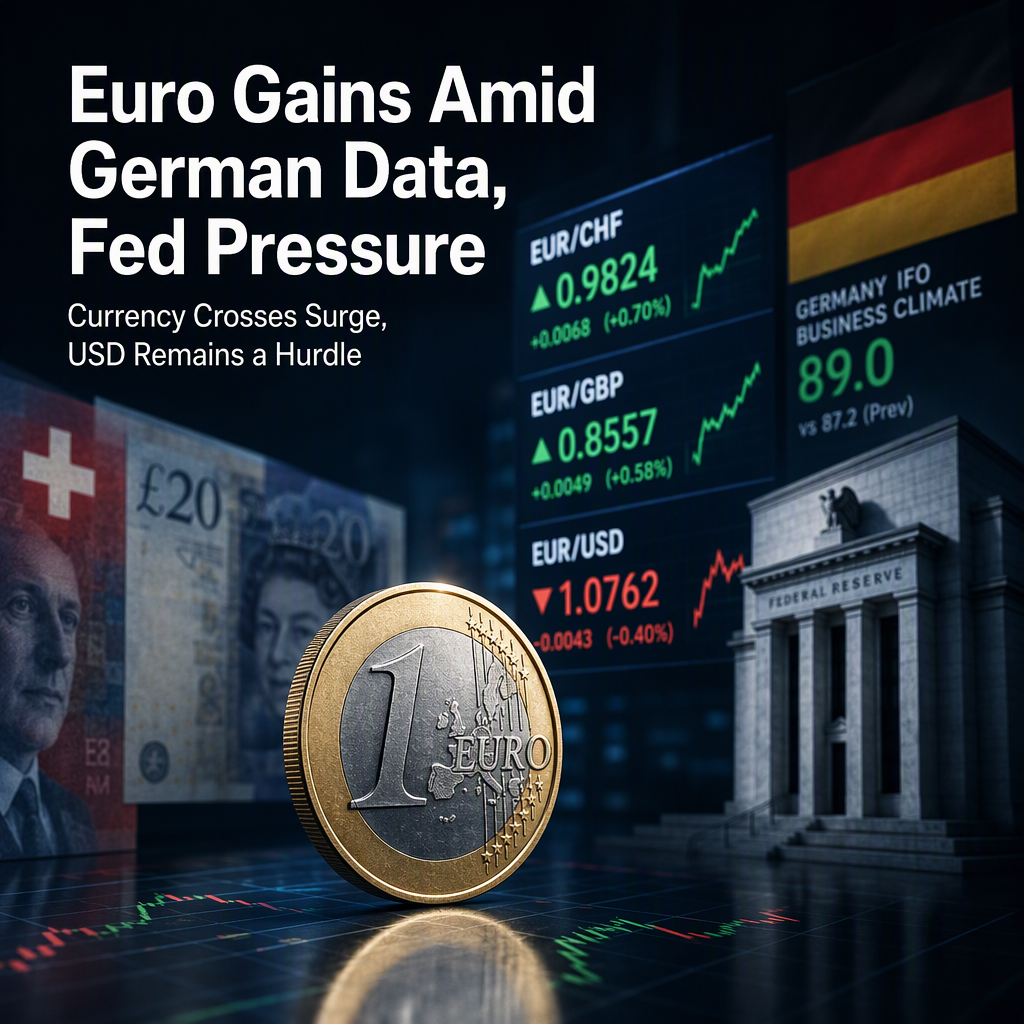
On Thursday, the Euro (EUR) experienced notable movements across major currency pairs, driven by central bank decisions and strong German economic data. The EUR/CHF pair gained 0.24%, trading around 0.9415 after reaching an intraday high of 0.9433, following the Swiss National Bank’s (SNB) decision to keep its key interest rate unchanged at 0% and slightly raise its inflation forecasts to 0.7% for 2026 and 0.8% for both 2027 and 2028. SNB Chair Martin Schlegel attributed the Swiss Franc's depreciation to widening interest rate differentials and reiterated the bank's willingness to intervene in the foreign exchange market if necessary. Despite robust Swiss GDP growth in the second quarter, the SNB expects more moderate growth ahead and remains cautious about global risks, including Middle East tensions and trade uncertainties [1].
The Euro also held gains against the British Pound (GBP), with EUR/GBP trading near 0.8607, just below three-month highs, after a 0.3% weekly appreciation. Strong Eurozone data, particularly the German IFO Business Climate Index, which rose to 89.9 in September from 88.8 in August and beat market consensus, provided support for the Euro. The Current Assessment Index improved to 89.5 from 88.5, and the Expectations Index jumped to 90.4, its highest since February. The IFO Institute noted improvements in manufacturing and services, though the automotive sector faces challenges and construction remains unchanged. Meanwhile, hawkish comments from BoE Deputy Governor Clare Lombardelli about potential rate hikes if energy prices persist had a muted impact on the Pound. Analysts at Brown Brothers Harriman suggested that the BoE may not need to tighten as much as markets expect, given the UK economy's current capacity and fiscal outlook [2].
Against the US Dollar (USD), the Euro faced selling pressure, retreating from an intraday high of 1.1400 to near 1.1380, as the US Dollar Index (DXY) traded higher at 101.17, close to its eight-week high. This move followed hawkish remarks from New York Fed President John Williams, who emphasized the US economy's resilience and persistent inflation risks, suggesting another rate hike by year-end is "reasonable." US Treasury yields responded, with the 10-year bond yield hitting a 19-year high at 5.14%. Despite the positive German IFO data earlier in the day, EUR/USD maintained a bearish near-term bias, trading below the 20-period EMA at 1.1515, with the RSI at 25.5 indicating oversold conditions [3].
Technical analysis across pairs shows EUR/CHF holding above the 100-period SMA but capped by resistance at 0.9433, with momentum indicators suggesting rallies may struggle to sustain. EUR/USD remains below key trend gauges, exposing it to further downside toward the YTD low at 1.1325, unless a daily close above 1.1515 occurs [1][3].
CONCLUSION
The Euro benefited from stronger-than-expected German IFO data, supporting gains against the Swiss Franc and British Pound, while hawkish signals from the Fed pressured EUR/USD lower. Central bank decisions and forward-looking statements suggest continued volatility, with technical barriers limiting further Euro rallies. Overall, market sentiment is cautiously positive for the Euro in cross pairs, but bearish against the US Dollar amid persistent US rate hike expectations.