
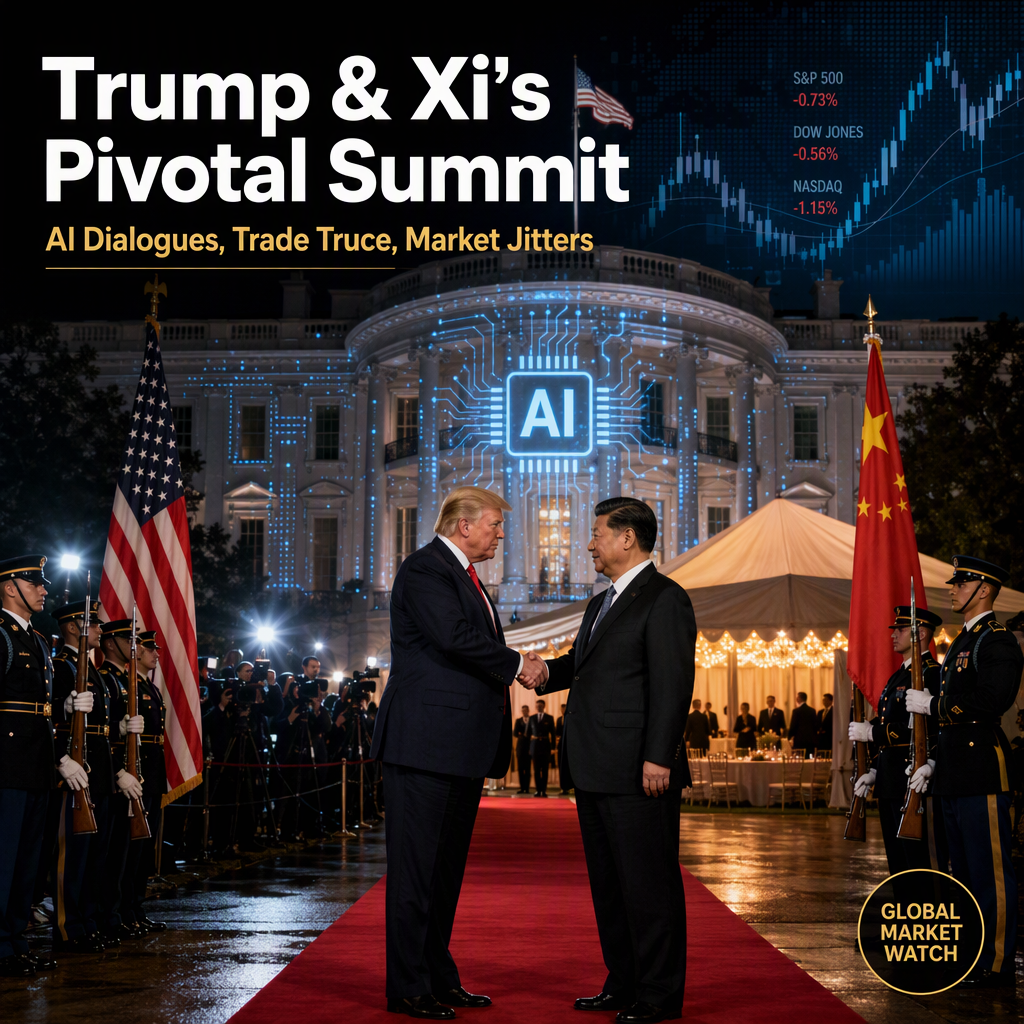
President Donald Trump and Chinese President Xi Jinping are convening for a high-stakes summit in Washington, D.C., marking a pivotal moment in U.S.-China relations as both leaders address critical issues including trade, artificial intelligence (AI), Taiwan, and Iran [1][2][3]. The summit features a series of formal events, including an arrival ceremony, military review, bilateral meetings, and a state dinner attended by U.S. business executives, though Xi's expected entourage of CEOs did not materialize [2]. This is Xi's first visit to Washington since September 2015 [2].
Hours before the summit, China's Commerce Ministry confirmed that senior negotiators from both countries held their first discussions on AI in New York, with Vice Premier He Lifeng and Treasury Secretary Scott Bessent participating [3]. The talks also covered plans to reduce tariffs and extend trade arrangements agreed in Kuala Lumpur last October [3]. Bessent stated that the U.S. and China agreed to extend a trade truce to January, maintaining lower tariffs and limiting China's export controls on rare earths, which are vital for semiconductors, household goods, and defense products [3]. Both sides discussed establishing an AI dialogue and a mechanism to alert each other about AI risks, reflecting concerns over the rapid advancement of autonomous AI systems [3].
Market observers are closely monitoring the summit for signals that could impact global financial markets, given the unresolved issues between the two largest economies [1]. Uncertainty around tariff policies and trade agreements is expected to weigh heavily on Asian and U.S. equity markets, with the S&P 500 facing resistance near 4,350 and the Shanghai Composite supported around 3,000 [1]. The ongoing AI race is seen as a major driver for technology stocks, with traders watching for potential regulatory frameworks or bilateral tech agreements that could spark volatility [1]. Currency movements are also in focus, as the U.S. dollar has shown strength against the Chinese yuan ahead of the summit, reflecting cautious optimism and hedging against possible negative headlines [1].
Analysts recommend a cautious approach due to elevated headline risk, advising day traders to watch for sharp moves following summit statements and longer-term investors to consider defensive sectors until clarity emerges [1]. Technical indicators show mixed signals, with some China-linked stocks appearing overbought and MACD momentum positive but vulnerable to reversal on news flow [1]. Market strategists emphasize that any breakthrough on tariffs or technology cooperation could cause a rally in risk assets, while failure to resolve key disputes may trigger a selloff, especially in sectors exposed to China [1].
According to White House spokeswoman Anna Kelly, President Trump is reciprocating Xi's hospitality from a previous summit in China, aiming to advance national interests and secure favorable deals for the American people [2]. The summit is ongoing, and further updates are expected as talks progress [2].
CONCLUSION
The Trump-Xi summit is a major catalyst for global markets, with immediate implications for trade, technology, and investor sentiment. The extension of the trade truce and initiation of AI talks signal constructive engagement, but uncertainty remains high. Investors should remain vigilant for official statements and market reactions as the summit unfolds.