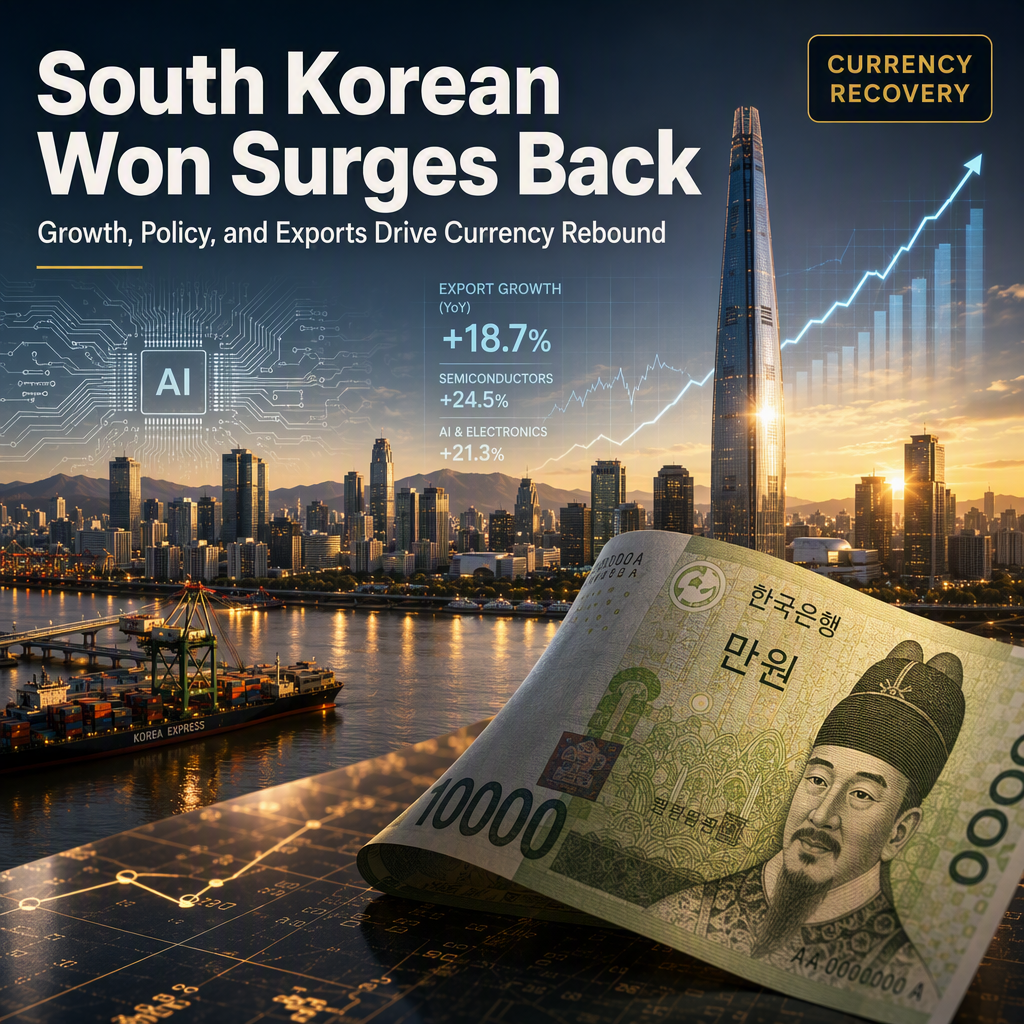
South Korea's currency, the Korean Won (KRW), has experienced a notable recovery after a period of significant weakness earlier in the year. According to Chris Turner at ING, the USD/KRW exchange rate reached as high as 1560 in June, driven by massive portfolio outflows, including $100 billion in foreign selling of Korean equities year-to-date and domestic residents moving funds offshore, despite Korea maintaining a large current account surplus due to a semiconductor export boom [1].
Policy interventions, such as adjustments to National Pension Service hedging strategies and improved access to Bank of Korea (BoK) foreign exchange liquidity, contributed to stabilizing the currency. The AI-led export boom has broadened its impact across the economy, resulting in a robust second quarter GDP growth of 0.6% quarter-on-quarter and prompting the BoK to raise its policy rate by 25 basis points to 2.75% in July [1]. Exporters have shown increased confidence in repatriating foreign earnings, with the current account surplus reaching up to $50 billion on a monthly basis [1].
Despite the recovery, ING notes that foreigners continue to sell Korean equities, and it is not clear that USD/KRW will fall much below 1400 in the near term. The turnaround in the won is seen as a policy lesson for other countries, such as Japan, highlighting the importance of fostering a strong domestic investment environment through economic growth and higher interest rates [1].
CONCLUSION
The South Korean Won's recovery has been underpinned by domestic growth, policy support, and a broad-based export boom, despite ongoing foreign equity outflows. ING suggests that Korea's experience offers valuable insights for other economies seeking to strengthen their currencies through domestic investment and growth-oriented policies.