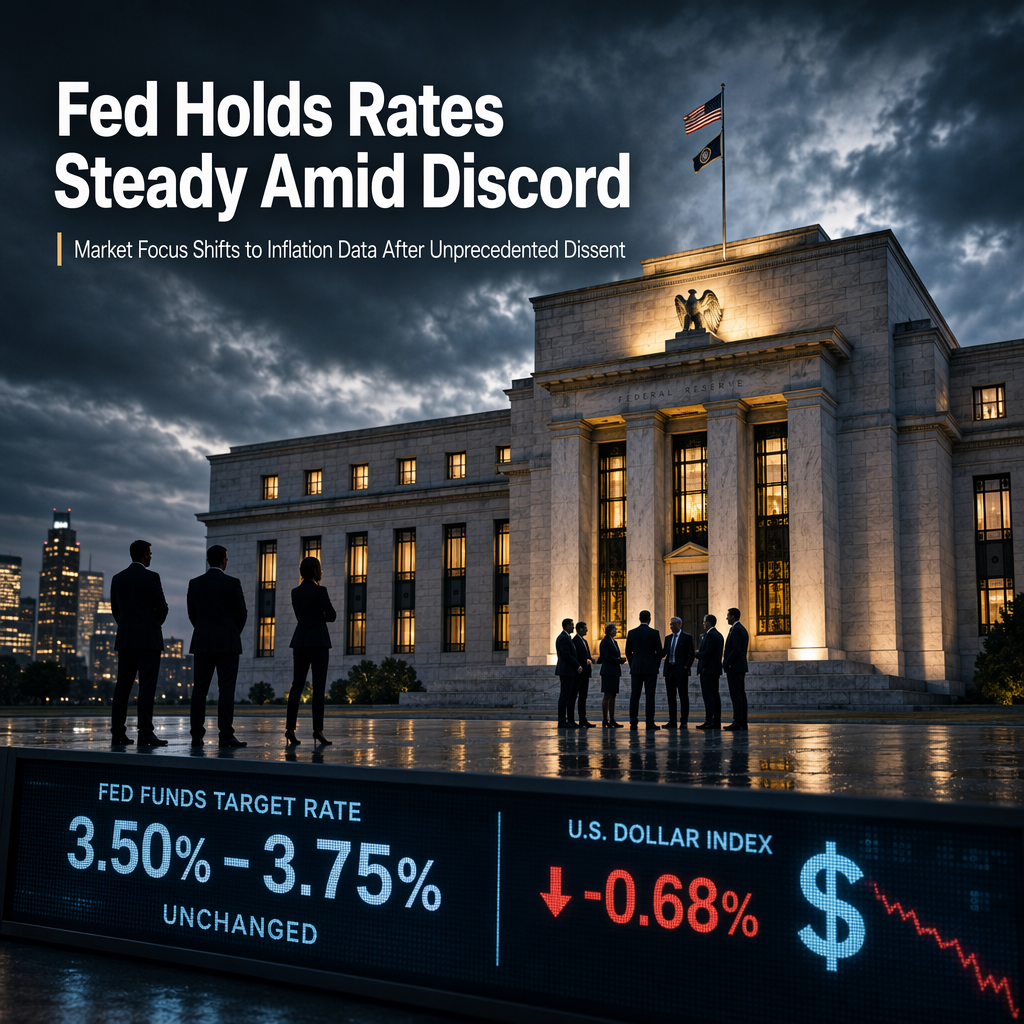
The US Federal Reserve maintained its Fed Funds Target Rate at 3.5%-3.75% during the July 2026 Federal Open Market Committee (FOMC) meeting, marking the fifth consecutive meeting with no change to the policy rate [2][3]. The decision was not unanimous, with three dissenters—Dallas Fed President Logan, Cleveland Fed President Hammack, and Minneapolis Fed President Kashkari—voting in favor of a 25-basis-point hike, a higher number of dissents than some analysts had anticipated [2][3][1].
Following the announcement, the US Dollar index declined by approximately 0.3%, a move that TD Securities described as in line with expectations. The weakness in the Dollar extended moderately after the press conference, attributed to a perceived lack of hawkish guidance from Chair Warsh and concerns about the Fed's credibility [1]. However, TD Securities expects any post-FOMC Dollar selloff to be limited unless US economic data, particularly inflation, surprises materially to the downside [1].
Societe Generale's Jan Groen emphasized that the Fed's cautious stance on inflation and the absence of clear forward guidance mean that upcoming Core Personal Consumption Expenditures (PCE) Price Index and Consumer Price Index (CPI) data will be crucial in shaping future policy decisions. Groen assumes the Fed will remain on hold through 2027, with the possibility of rate hikes from late 2026 if inflation trends shift [2]. UOB analysts Suan Teck Kin and Alvin Liew similarly expect an extended pause in rate changes through 2026, followed by two rate cuts in 2027 as inflation pressures—particularly those driven by oil prices—are expected to fade. However, they also highlight elevated risks of renewed tightening if inflation remains above target [3].
The lack of forward guidance from the Fed places greater emphasis on upcoming economic data, especially inflation indicators, in determining the path of monetary policy. The next FOMC meeting is scheduled for 15/16 September 2026, with a decision expected on 17 September, accompanied by an updated Summary of Economic Projections and Dotplot chart [3].
CONCLUSION
The Federal Reserve's decision to hold rates steady, combined with rising dissent and a lack of forward guidance, has led to moderate Dollar weakness and increased market focus on upcoming inflation data. Analysts expect policy to remain on hold through 2026, with potential for rate cuts in 2027, but caution that renewed tightening is possible if inflation remains persistent. The market's attention now turns to key economic indicators and the September FOMC meeting for further policy direction.