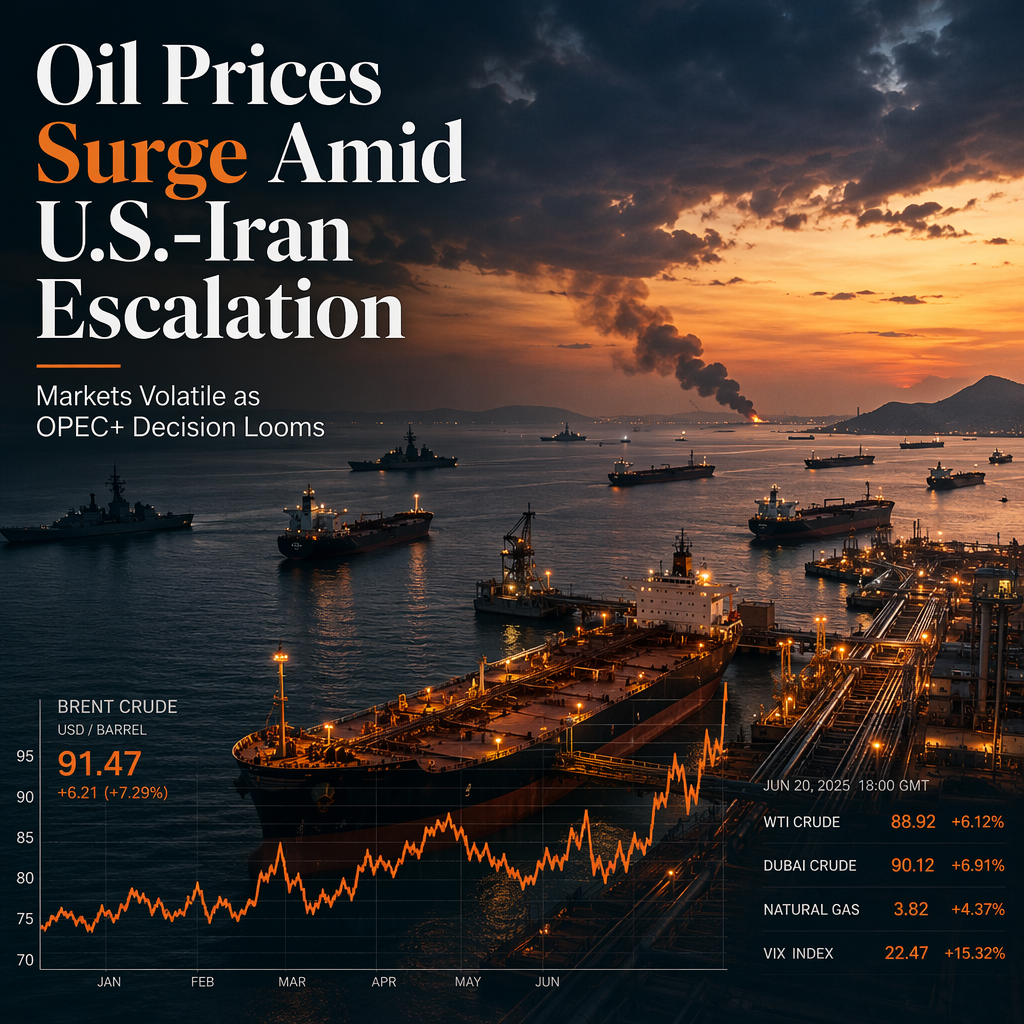
Oil prices rose sharply on Thursday following a 'heavy wave' of U.S. strikes against Iran late Wednesday, which were carried out in retaliation for Iran's missile attacks on American forces in the region. This escalation dashed hopes for de-escalation and heightened tensions in the oil market, with Iran's Islamic Revolutionary Guard Corps threatening further escalation in response [1].
Brent crude futures, the international benchmark, increased by 1.5% to $92.10 a barrel, while U.S. West Texas Intermediate futures advanced 0.9% to $85.23 per barrel [1]. The renewed military action marks the latest development in a conflict that has caused significant volatility in oil markets and disrupted shipping through the Strait of Hormuz since fighting began in late February [1].
The U.S. had paused strikes on Iranian targets for two weeks to allow diplomatic efforts, but President Trump signaled the resumption of military action, stating, 'We'll be hitting them hard. They're going to get a beating,' in a Fox News interview early Wednesday [1]. U.S. Central Command described the operation as a 'powerful response' to Tuesday's attempted Iranian attacks, targeting dozens of Islamic Revolutionary Guard Corps sites across Iran, including military command centers, missile and drone facilities, coastal surveillance and defense sites, and maritime capabilities [1].
Market participants are now focused on the upcoming OPEC+ meeting on Sunday, where the group is expected to announce a supply increase of 188,000 barrels per day for September [1]. ING strategists noted that the main uncertainty through 2027 will revolve around OPEC+ policy, with potential pushback on output quotas [1].
CONCLUSION
The U.S. strikes against Iran have triggered a notable rise in oil prices and renewed market volatility. With further escalation threatened by Iran and an OPEC+ supply decision imminent, traders remain cautious about the outlook for oil supply and prices.