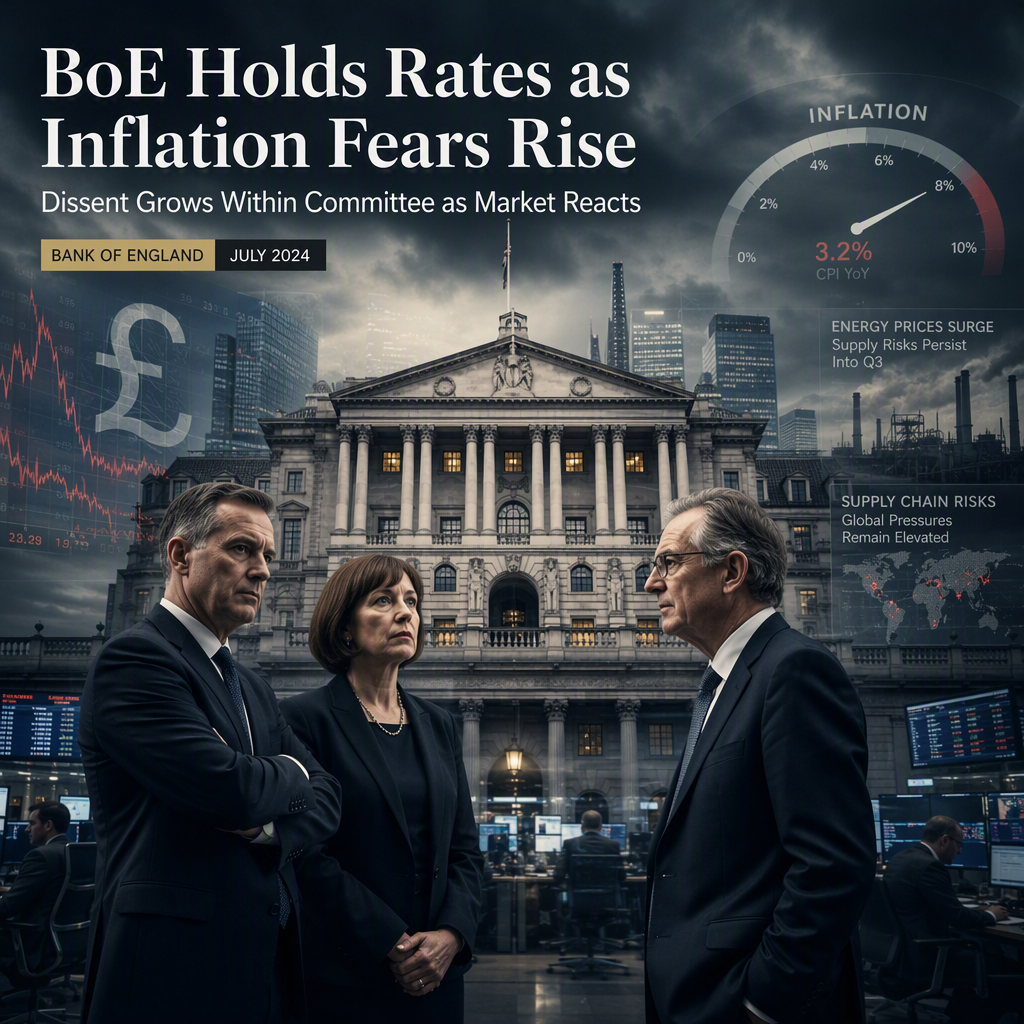
The Bank of England (BoE) maintained its benchmark interest rate at 3.75% following the July monetary policy meeting, with the Monetary Policy Committee (MPC) voting 6-3 in favor of holding rates steady [3][4][6]. This decision was widely anticipated by markets, but the number of dissenting voices increased from two to three, with Megan Greene, Huw Pill, and Catherine Mann advocating for a 25 basis point hike due to persistent inflation risks [3][6]. The BoE cited ongoing energy price pressures and supply risks, including a second energy chokepoint in the Red Sea and AI-related hardware supply constraints, as factors weighing on inflation and market outlook [6]. Greene emphasized that inflation has remained above target for about five years and suggested that a proactive rate hike could reduce the probability of second-round effects [6]. Pill warned of profound uncertainty surrounding energy prices, arguing that raising the Bank Rate now would send a clear signal of the BoE's commitment to addressing upside inflation risks stemming from events in the Gulf [6]. Governor Andrew Bailey stated that UK economic activity remains subdued and the labor market is soft, with weak demand limiting the pass-through of higher costs to prices. He noted that household inflation expectations have fallen but remain elevated, and the BoE stands ready to adjust its stance as evidence evolves [4]. The central bank expects indirect inflation effects to add 0.5 percentage points to inflation in the second half of 2026 [4]. Following the decision, the British Pound (GBP) dropped against its major peers, with GBP/USD edging lower from its intraday high of 1.3405 to near 1.3380, although the initial reaction was slightly positive [3]. However, CNBC reported the pound was up 0.08% against the dollar at $1.3376 after the announcement [6], highlighting a minor discrepancy in immediate market reaction. Felix Feather, economist at Aberdeen, commented that the increase in dissenters signals spreading concerns over inflation risks within the committee, raising the likelihood of rate hikes if inflation does not ease further. Simon Dangoor of Goldman Sachs Asset Management noted that the BoE is content to hold rates for now, but a persistent Middle East shock could keep the September meeting 'live' for further action [6]. The BoE has clarified its readiness to act as necessary to ensure inflation remains on track to meet the 2% target in the medium term [3][4][6].
CONCLUSION
The Bank of England's decision to hold rates at 3.75% was expected, but growing dissent and persistent inflation risks have increased the likelihood of future rate hikes. The market reaction was mixed, with the pound showing minor fluctuations against the dollar. Analysts suggest that while the BoE is comfortable with its current stance, ongoing energy shocks and inflation concerns could prompt action in upcoming meetings.