
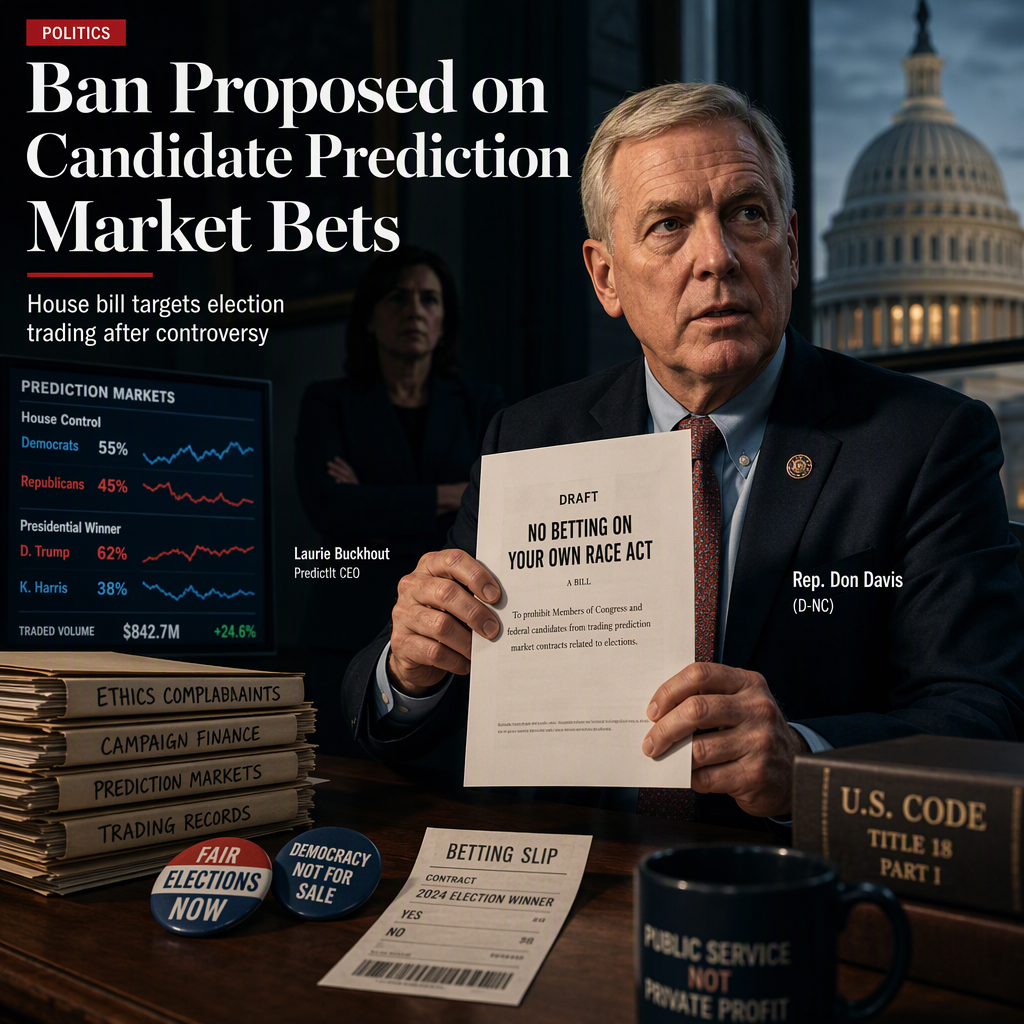
U.S. Rep. Don Davis, D-N.C., introduced the 'No Betting on Your Own Race Act' on October 5, 2026, aiming to prohibit federal candidates from trading prediction market contracts tied to their own elections [1]. The bill proposes a minimum penalty of $10,000 or three times the net financial gain from such trades, whichever is larger [1]. This legislative move comes in the wake of controversy involving Laurie Buckhout, Davis' Republican opponent in North Carolina's 1st Congressional District, who settled with prediction market platform Kalshi in August after being found to have traded contracts related to her own candidacy [1]. Buckhout paid a penalty of just under $2,600 and received a three-year suspension from Kalshi [1].
Buckhout acknowledged her actions, stating, 'I bet on myself. Literally,' and described the incident as a 'dumb mistake,' noting that she worked to rectify the situation upon learning of the issue [1]. Davis criticized Buckhout's actions, calling them 'a disqualifying breach of public trust' in a post on X [1]. The bill seeks to formalize restrictions already enforced by prediction market platforms, which have actively worked to prevent candidates from trading on their own contracts due to concerns about insider trading [1].
With less than a month until the midterm elections, political contracts on prediction markets are under scrutiny as observers assess their ability to forecast election outcomes [1]. However, the House and Senate are not scheduled to meet until after the midterm elections, indicating that Davis' proposal has little immediate chance of becoming law [1].
Davis emphasized the need for consistency, stating, 'We don't want our athletes to bet on their games. A candidate running for federal elected office should be treated exactly the same and should not be allowed to trade on their own election,' and urged Congress to pass the legislation to ensure all federal candidate campaign committees understand the rules [1].
CONCLUSION
Rep. Don Davis' bill responds directly to a recent controversy involving his opponent and aims to strengthen ethical standards for federal candidates regarding prediction market trading. While the proposal highlights concerns about insider trading and public trust, its immediate legislative prospects are limited due to congressional scheduling. The event underscores increased scrutiny on prediction markets ahead of the midterm elections.