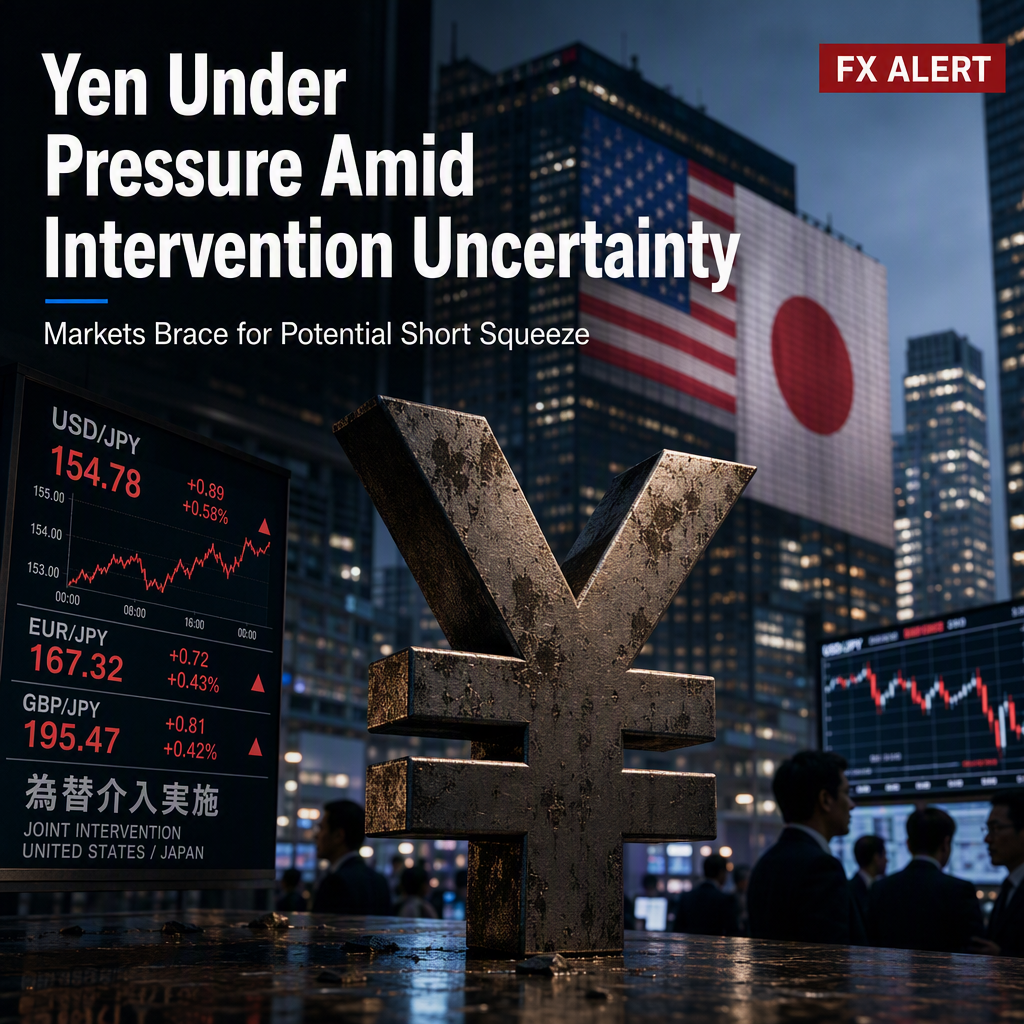
The Japanese Yen (JPY) continued to underperform against major currencies this week, holding onto its losses amid the absence of a follow-up to last week's joint US-Japan intervention in the foreign exchange market. According to Japan's Ministry of Finance, the intervention was aimed at countering 'excessive volatility and disorderly movements in the Japanese yen in recent months' [1]. This week, the JPY was the weakest against the US Dollar, declining by 0.81%, and also posted losses against the Euro (-0.57%) and the British Pound (-0.11%) [1]. The New Zealand Dollar (NZD) was the strongest against the JPY, gaining 0.14% over the week [2].
Market participants are closely watching for signs of further coordinated action. Commerzbank’s Thu Lan Nguyen emphasized that the sustainability of any Yen rebound depends on market confidence in ongoing intervention, stating, 'for the yen to retain its gains, markets must be convinced that coordinated interventions by the BoJ and US authorities will remain on the table going forward.' US Treasury Secretary Scott Bessent has indicated a willingness to act again if necessary, and Japanese Finance Minister Satsuki Katayama reiterated that Japan 'won't hesitate to carry out more forex intervention with the US' [1].
Despite the recent intervention, BNY's David Tam notes that rising US rate volatility typically favors safe-haven currencies like the Yen. He highlights that the JPY has historically appreciated during periods of increased US rate volatility, unlike other funding currencies [3]. However, Tam points out that speculative positioning is heavily net short on the JPY, with CFTC data showing near-historic levels of non-commercial futures shorts. This divergence between speculative and real money positioning could set the stage for a sharp short squeeze if market sentiment shifts, potentially leading to rapid Yen appreciation [3].
While the Yen remains weak in the short term, analysts suggest that the combination of potential further intervention and the risk of a speculative squeeze could alter the currency's trajectory. However, as of now, the market remains cautious, awaiting concrete policy signals and monitoring US rate developments [1][3].
CONCLUSION
The Japanese Yen remains under pressure despite last week's US-Japan intervention, with market participants awaiting further policy action. Analysts warn that heavy speculative short positions could trigger a sharp reversal if sentiment changes, but for now, the Yen's outlook hinges on credible intervention signals and US rate volatility.