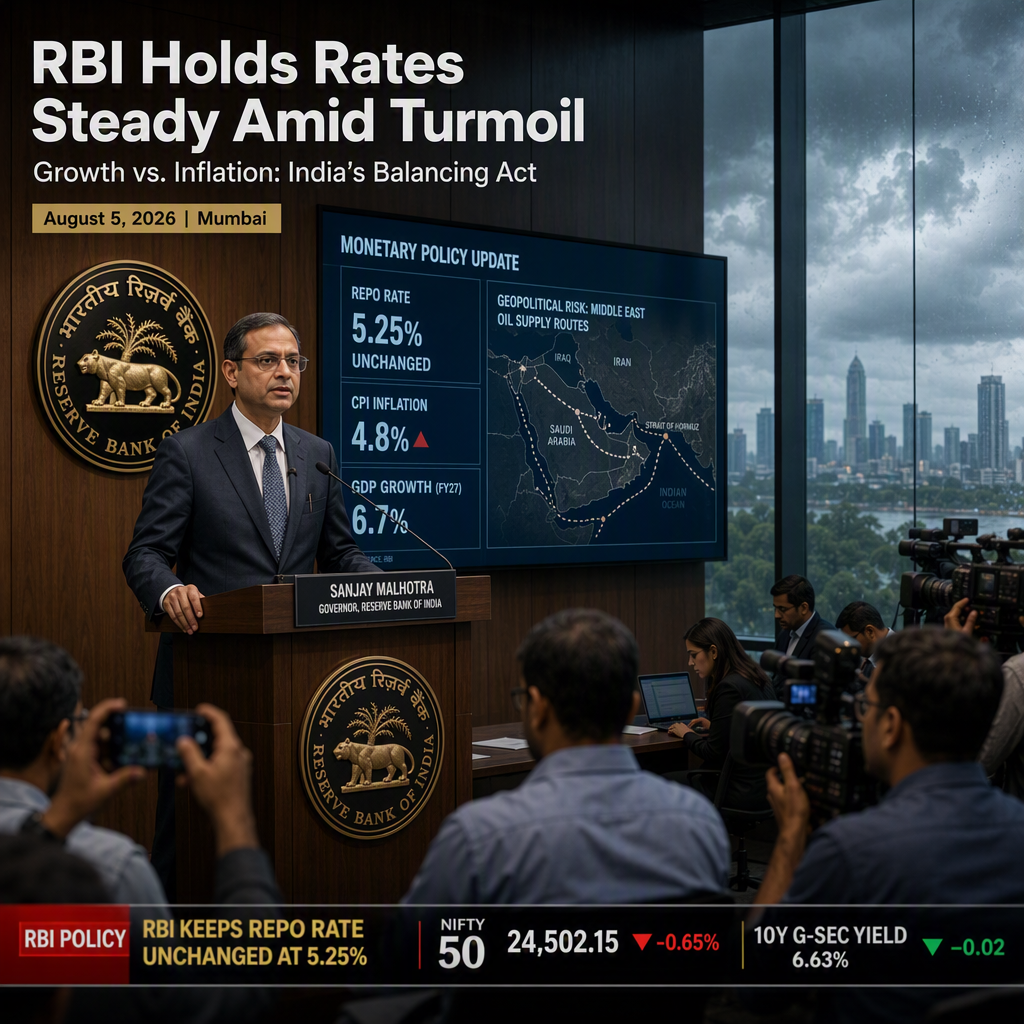
On August 5, 2026, the Reserve Bank of India (RBI) maintained its key policy rate at 5.25%, prioritizing growth momentum despite a recent surge in inflation and heightened volatility in crude oil prices due to the ongoing U.S.-Iran conflict [1][2]. This marks the fifth consecutive meeting where the RBI has kept rates unchanged, even as retail inflation reached an 18-month high of 4.38% in June, surpassing the central bank's medium-term target of 4% for the first time in over a year [2]. The RBI has repeatedly emphasized its focus on core inflation, which excludes energy and food prices, noting that core inflation was at 3.7% at the end of April and is expected to climb up to 4.7% for the financial year ending March 2027 [2]. Governor Sanjay Malhotra stated that core inflation remains 'moderate' and is expected to decline after peaking in the December quarter, but cautioned that the path and composition of inflation require greater clarity before any policy action is taken [2].
The RBI's decision comes amid complex challenges, including volatility in crude oil prices linked to the Middle East conflict, which has complicated the central bank’s task of balancing growth with price stability [1][2]. Since May, the Indian government has partially passed on fuel price increases to the public, adding to cost pressures [2]. HSBC Global Investment Research expects inflation to stay above 5% for eight months starting October and forecasts the RBI will raise rates in October and December by 25 basis points each [2].
Market reactions were muted, with India's benchmark Nifty 50 index trading flat and 10-year bond yields falling about 4 basis points to 6.782% following the announcement [2]. Malhotra noted that while economic growth has been 'resilient,' it is expected to be lower in the current financial year, with the outlook remaining 'hazy' due to uncertainties from the southwest monsoon, El Niño, geopolitics, and global trade policy [2].
Several Asian countries, including Japan, the Philippines, Indonesia, and South Korea, have raised interest rates recently to curb inflation driven by higher energy prices from the Middle East conflict [2]. India, which meets nearly 85% of its fuel needs via imports, is particularly vulnerable to supply disruptions caused by the Iran war, with the Strait of Hormuz being a key supply route prior to the conflict [2].
CONCLUSION
The RBI's decision to hold rates at 5.25% reflects a cautious approach amid rising inflation and geopolitical uncertainties. While core inflation remains moderate, headline inflation and energy price volatility pose ongoing risks. Analysts expect potential rate hikes later in the year if inflation persists, and market reactions have so far been subdued.