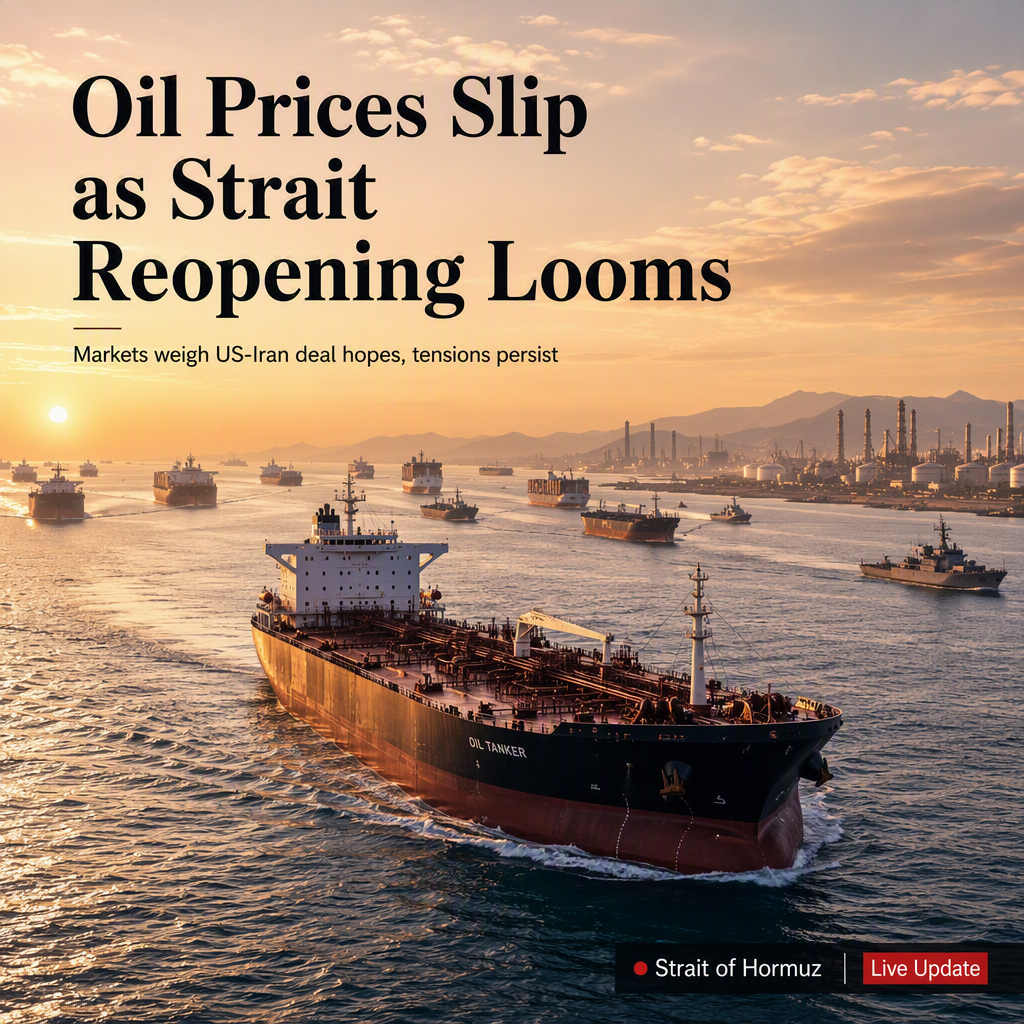
West Texas Intermediate (WTI), the US crude oil benchmark, traded around $74.50 during early European hours on Wednesday, edging lower as traders weighed mixed signals regarding a possible US-Iran ceasefire deal and the reopening of the critical Strait of Hormuz [1]. Brent crude also fell sharply below $80 per barrel as hopes grew for a deal to reopen the Strait, with US Treasury Secretary Scott Bessent stating in a CNBC interview that there could be a deal 'by today or tomorrow to open the strait' [2][3]. Qatar confirmed that a proposed de-escalation resolution was being circulated among the parties, though cautioned that a solid agreement had not yet been reached [2].
Shipping traffic in the Strait of Hormuz and the Bab el-Mandeb remained little changed on Tuesday compared to the previous day, according to Kpler data reported by Reuters [1]. Iran is reportedly considering allowing European nations to remove mines from Hormuz, according to diplomats familiar with the matter [2]. The US Central Command stated that the southern route through the waterway remains free and open for all commercial vessels [3]. About 20% of the world's oil flowed through the Strait before the war, highlighting its strategic importance [3].
Despite ongoing geopolitical tensions, analysts at MUFG/BTMU and Michael Wan at MUFG observed that markets are largely looking through potential conflict risks, focusing instead on the possibility of a resolution [1][2]. Oil prices have remained more benign than supply headlines suggest, supported by weaker Chinese oil imports and increased substitution via coal-to-chemicals and electrification in China [2]. However, Michael Wan also warned that weather shocks, such as a potential Super El-Nino, remain a risk for the market going forward [2].
Technical analysis indicates that WTI remains under bearish pressure, trading below key moving averages such as the 100-day SMA ($87.45) and the 20-day SMA ($80.60), with initial support at $70.70 and resistance at $80.60 [1]. The Relative Strength Index (RSI) is at about 43, suggesting weak but stabilizing momentum [1].
Market optimism over a potential US-Iran deal has contributed to rallies in broader markets, with Asian tech stocks and Wall Street both seeing gains on Wednesday [3]. However, tensions between Iran and the US persist, with reports that Iran claimed President Donald Trump could 'ignite the spark' of World War 3 after Washington warned Tehran it was its 'last chance' to make a deal [3].
CONCLUSION
Oil prices have edged lower as markets focus on the potential for a US-Iran deal to reopen the Strait of Hormuz, despite ongoing geopolitical tensions. Technical and fundamental factors suggest a cautious but resilient market, with traders awaiting further developments. The overall market sentiment remains optimistic but watchful for any shocks or escalation.